

 InfoSearched
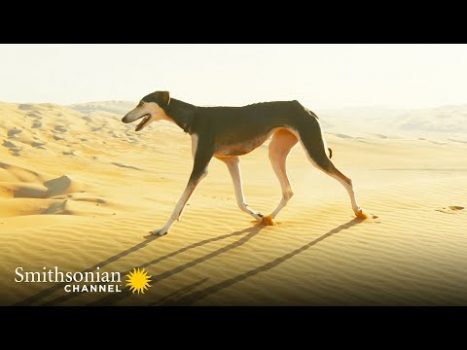
Some dogs chase tennis balls. This one was bred to outrun a gazelle across open desert.
Smithsonian Channel’s Amazing Dogs sends wildlife biologist Patrick Aryee to a desert plain in the United Arab Emirates to meet the Saluki, a breed built almost entirely around one job: running down fast prey in brutal terrain. The segment breaks down the anatomy that makes it possible, from an aerodynamic skull to feet padded for hardpan and sand alike.
- Salukis can sustain speeds between 30 and 42 mph over long stretches, with a Guinness World Record entry crediting the breed with a top speed of 42.8 mph.
- Bedouin tribesmen called the breed “el hor,” meaning “the noble,” and bred them alongside Arabian horses for centuries.
- The dog’s heavily padded feet and gripping claws are adapted specifically to absorb impact on rocky ground and hold traction in loose desert sand.
An Ancient Hunting Partnership
The Saluki is widely considered one of the oldest domesticated dog breeds, and its relationship with desert peoples wasn’t casual. According to the American Kennel Club, nomadic Bedouin tribesmen treated Salukis less like pets and more like hunting equipment of the highest order, raising them alongside Arabian horses and referring to them as “el hor” — “the noble.” Unlike scent hounds that trail prey by nose, Salukis are sighthounds, spotting gazelle or hare across open ground and running them down by eye over long distances rather than short bursts.
That distinction matters in the desert, where prey doesn’t hide in brush the way it might in a forest. A gazelle on a flat plain has nowhere to disappear to — it just runs, and whichever animal has more top-end endurance wins. That’s the gap the Saluki was bred to close.
The Engineering Behind the Speed
Aryee’s segment walks through the physical toolkit piece by piece: an aerodynamic, narrow head that cuts wind resistance, a lean greyhound-like frame built for stride length rather than bulk, and a set of adaptations most house dogs simply don’t need. The feet are the giveaway detail — heavily padded to absorb the pounding of hard desert ground, with claws shaped to dig into shifting sand instead of sliding across it.
Guinness World Records credits the Saluki with a top recorded speed of 42.8 mph — sustained, not just a burst.
Greyhounds still own the record books for flat-out sprint speed over short distances, but the comparison misses the point of what a Saluki actually does. Where a greyhound is built for a track sprint, the Saluki is built for a chase that might cover open desert for minutes rather than seconds, holding a pace between 30 and 42 mph while a gazelle tries to outlast it rather than outrun it. That kind of high-speed endurance, tracing back to a working relationship documented since ancient times, is precisely why the breed has stayed relevant as a hunting partner for so long instead of being replaced by something faster over shorter ground.
Built for the Terrain, Not Just the Chase
What makes the segment worth watching is how much of the Saluki’s speed is really about surviving the ground it runs on. Loose sand, sunbaked rock, sudden drops in terrain — a slender frame and long legs mean nothing if the dog can’t keep its footing, which is why Aryee spends as much time on the paws and claws as he does on the body shape. It’s the same kind of terrain-driven adaptation that shows up across the Arabian desert’s other apex hunters, built less for raw power than for surviving a landscape that punishes anything slow or clumsy.
For viewers who want more of that desert-survival angle, Smithsonian’s own catalog and similar wildlife documentaries have covered how other desert predators — including ones that hunt without relying on sight at all — solve the same basic problem of finding prey in terrain with nowhere to hide. The Saluki’s answer just happens to be speed and stamina rather than stealth.
Aryee’s segment is a short one, but it lands its point: the Saluki isn’t fast by accident. Every part of it, from the skull shape to the claw structure, is a direct answer to one question — how do you catch a gazelle that has nowhere to hide and every reason to run.







The extraordinary final test to become a Shaolin Master | Sacred Wonders
Flying 240 Miles In 22 Minutes
30 Healthy Habit Hacks You Need To Know!
$13 Million NYC PRIVATE ISLAND Tour!?
OFF GRID WILDERNESS LIVING – ALONE // DIY Wood Fired CHINESE WOK STOVE