

 InfoSearched
A masked teacher and a masked gunman describe the same streets — and neither version of childhood looks anything like a normal one.
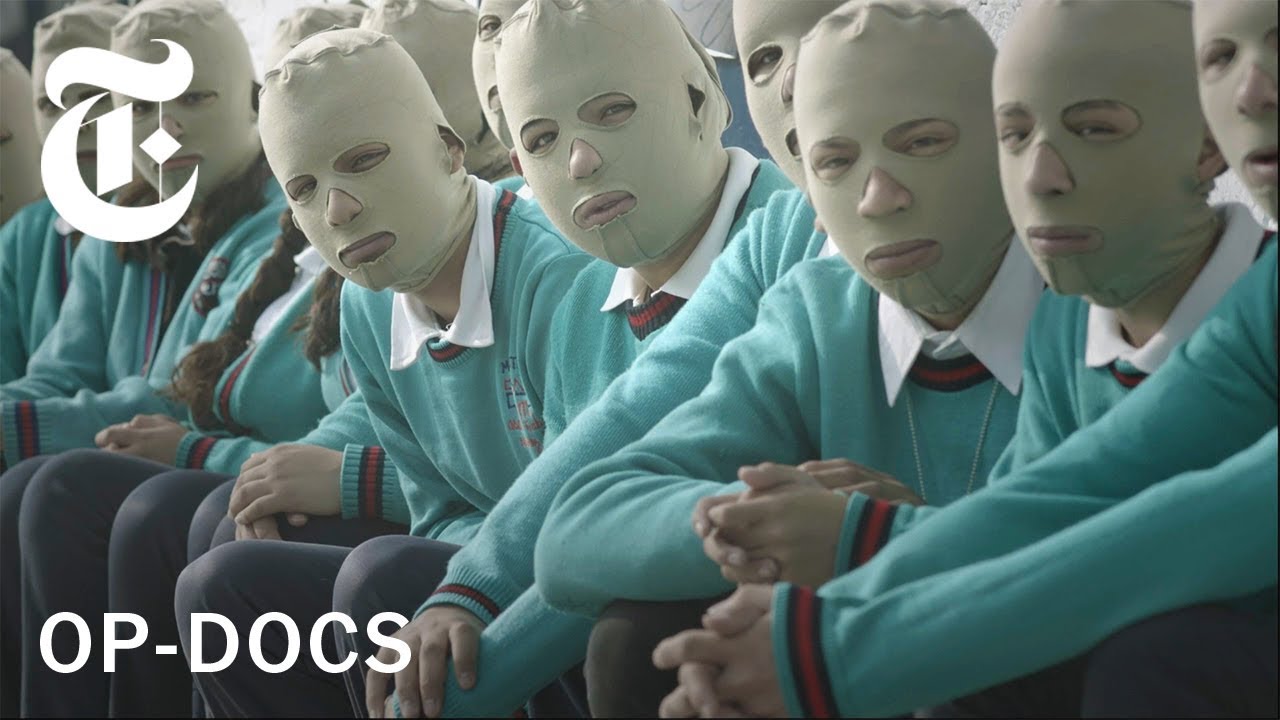
“Children of the Narco Zone,” published on YouTube by The New York Times as “What It’s Like to Grow Up in the Narco Zone,” is the second entry in the Times Op-Docs series “A Moment in Mexico,” a six-part project spotlighting contemporary Mexican filmmakers. Directed by Everardo González, the short strips away identity from its subjects and leaves only voice, testimony, and a uniform, unsettling mask. What’s left is a portrait of childhood built around fear, recruitment, and silence.
- Released in December 2018, the film is the second installment of the Times Op-Docs series “A Moment in Mexico,” a six-part initiative executive-produced by Kathleen Lingo.
- It functions as a companion piece to González’s acclaimed 2017 feature “La Libertad del Diablo” (“Devil’s Freedom”), reusing the same flesh-colored translucent masks to protect interviewees’ identities.
- The film centers on two testimonies: an anonymous elementary school teacher who instructs children of known cartel members, and a young gang member recalling how he was drawn into violence at a young age.
Two Testimonies, One Masked Register
González doesn’t build the film around a narrator or a timeline of events. Instead, he lets two voices carry the entire runtime: a teacher who has to navigate a classroom where some students’ parents are cartel operatives, and a young man who walks through how he was pulled into a gang before he was old enough to fully understand what he was agreeing to. There’s no reenactment, no dramatic score cue — just testimony delivered flatly, almost clinically, through the mask.
The teacher’s account is the quieter of the two, but it’s the one that lands hardest: how do you teach arithmetic and reading comprehension to a child whose home life runs on a completely different set of rules? The gang member’s account works as the inverse — a first-person walk through induction, the moment violence stopped being abstract and became a job description.
The Making of “A Moment in Mexico”
“Children of the Narco Zone” doesn’t stand alone. It’s one piece of a six-film Op-Docs initiative built specifically to hand the camera to Mexican directors covering angles of the country that don’t usually make it into international coverage. Kathleen Lingo, who executive-produced the series, framed the project around giving space to filmmakers already embedded in these stories rather than parachuting in outside crews. González’s entry follows that same throughline — he’s not an outsider explaining Mexico to an audience; he’s a filmmaker who’s spent years documenting the drug war’s aftermath from the inside.
That context matters for how the film gets watched. Readers who’ve followed the broader financial and logistical machinery behind cartel operations — the subject of pieces like How Mexican Drug Cartels Make Billions — will recognize the ground-level cost that González is documenting here: the billions in trafficking revenue eventually translate into recruitment pipelines that run straight through elementary schools.
Borrowing the Visual Grammar of “Devil’s Freedom”
The masks aren’t a gimmick bolted onto this short — they’re inherited directly from González’s 2017 feature “La Libertad del Diablo,” which used the same flesh-colored translucent covering for every interview subject, victims and perpetrators alike. The choice serves two purposes at once: it protects people who could be killed for speaking on camera, and it flattens the visual difference between a cartel hitman and a grieving parent, forcing the audience to listen to the words instead of reading a face.
The teacher and the gunman wear the exact same mask — the film’s only way of saying that in a narco zone, no face is safe to show.
Applied to “Children of the Narco Zone,” that device does something specific: it removes the temptation to categorize the gang member as simply a villain or the teacher as simply a victim. Both are speaking from inside a system neither one built. It’s the same territory covered from a very different angle in reporting like Mexico’s Cartels Are Deadlier Than Ever Despite the Pandemic, which tracks how entrenched cartel violence has become even as enforcement pressure shifts.
The Reveal Behind the Mask
Take away faces, and testimony becomes the only evidence the viewer has. That’s the bet González makes across both films — that the content of what’s said, stripped of the usual visual cues that let an audience file someone as “criminal” or “innocent,” carries more weight on its own. The teacher describing a classroom infiltrated by cartel family ties and the gang member describing his own induction aren’t two separate stories; they’re two ends of the same pipeline running through the same neighborhoods.
“A Moment in Mexico” ran as a six-part series on the Op-Docs channel, with González’s film sitting second in the lineup — a deliberate choice to follow up the series opener with a story about the generation inheriting the drug war rather than fighting it directly. For anyone tracking how that war gets financed and moved, “Cocaine White Gold” and the broader Op-Docs catalog are worth sitting with next.




Violinist STUNS Bangkok Street with “Radioactive” Looping Cover
Rats Save Humans From Landmines
Roofing a Steep 45° Pitch! Barn Board Sheathing
NASA’s Plan to Stop an Asteroid Headed for Earth
Why Escobar’s Hippo Legacy Still Haunts Colombia