

 InfoSearched
A German volcano chaser spent three nights within 4.5 kilometers of an erupting Andean summit — and came back with sound.
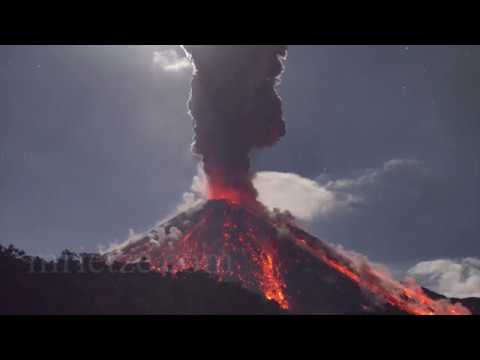
Martin Rietze, a German videographer and photographer known for chasing eruptions on multiple continents, set up an observation camp east of Volcán El Reventador in Ecuador’s eastern Andes between January 5 and January 7, 2020. What he brought back is rare: high-resolution, real-time footage synchronized with natural audio, capturing the volcano’s Vulcanian and Strombolian outbursts in both daylight and darkness under a near-full moon.
- Rietze filmed from roughly 4.5 kilometers east of Reventador’s active summit cone across January 5–7, 2020, capturing daytime and nighttime explosions.
- The footage records visible acoustic shockwaves tearing through condensation and ash, volcanic lightning inside the eruptive columns, and avalanches of incandescent pyroclasts and bombs cascading down the cone’s flanks.
- According to the Smithsonian Institution’s Global Volcanism Program and Ecuador’s Instituto Geofísico (IG-EPN), Reventador has been continuously active since 2008, with near-daily explosions and ash venting reaching 1.2 to 2.5 kilometers above the crater rim during this phase.
Analysis of Authentic Video Footage
The clip is built around real-time sequences rather than sped-up highlight reels, which is what makes it useful to volcanologists as well as viewers. Explosions punch ash and gas skyward while shockwaves ripple visibly through the surrounding moisture and ash cloud — a phenomenon that’s rarely captured this cleanly on camera. At night, incandescent pyroclasts and volcanic bombs roll down multiple flanks of the cone following sudden summit blasts, lit up further by the near-full moon overhead.
Dense, dark gray plumes rise repeatedly through the footage, and several eruptive columns show volcanic lightning — electrical discharges generated by charge separation within the ash itself. Rietze’s synchronized audio track adds the low booms and cracking reports of each blast, something still photography from the same expeditions can’t convey.
Ash venting during the observed activity reached 1.2 to 2.5 kilometers above the crater rim, according to monitoring cited by the Global Volcanism Program and IG-EPN.
A Volcano That Never Really Stopped
Reventador isn’t a one-off news event — it’s been in a continuous eruptive phase since 2008, per records from the Global Volcanism Program and IG-EPN. The January 2020 activity Rietze documented fits squarely into that pattern: near-daily explosive events, frequent thermal anomalies picked up by satellite infrared monitoring, and persistent venting rather than a single dramatic eruption. That steady rhythm is exactly why a three-day, close-range observation window can still produce footage volcanologists consider valuable — the mechanics repeat, but capturing them cleanly with synchronized sound from 4.5 kilometers out doesn’t happen often.
Rietze’s stills and video sequences from the January 5–7 window were subsequently cited in volcanological bulletins to illustrate summit morphology changes and the dynamics of nocturnal incandescent ejecta — the kind of documentation that normally requires either a monitoring station or someone willing to camp within range of an active cone for several nights running.
Strategic Significance of Camp Position
Positioning an observation point 4.5 kilometers east of the active cone gave Rietze a sightline on multiple flanks at once, which is why the footage shows pyroclasts and bombs cascading down more than one side of the cone rather than a single face. That distance also kept the camera far enough back to catch full eruptive columns — plume, lightning, and shockwave together — in a single frame, rather than the tight crops typical of closer, riskier vantage points.
For anyone who’s watched footage of other active cones documented up close, the same appeal shows up in unusual volcanic phenomena caught on camera near active flows — real geological processes playing out in real time, not simulated or sped up. Rietze’s expedition sits in that same tradition of field documentation over studio production, the kind of on-the-ground work also on display in other footage shot within view of an active Central American volcano.
Reventador shows no sign of settling down. With ash venting still running 1.2 to 2.5 kilometers above the rim and explosions arriving on a near-daily basis, the next chance to document a comparable sequence probably isn’t far off — the volcano has been doing this, reliably, since 2008.






How Recycling Machines Make New Clothes From Used Apparel
Step Inside Australia’s Underground Homes
Mountain property with Waterfalls, Cheap land in Kentucky for sale
Building an Off Grid Woodworking Workshop Log Cabin in the Forest
DMT Sent Him Into the Multiverse