

ACKEE Fruit : Trying the Notoriously Delicious Fruit in JAMAICA (& Susumba Fruit Review + Recipe)
 InfoSearched
Jamaica’s national fruit can put you in the hospital if it’s picked at the wrong moment — which is exactly why Weird Explorer’s Dan went looking for it anyway.
Dan, the host of the fruit-tasting channel Weird Explorer, traveled to Jamaica to do what most visitors skip past: eat the ackee itself, not just the ackee-and-saltfish plate on a hotel breakfast buffet. Alongside it, he tracked down susumba, a bitter little green berry that rarely gets mentioned outside a Jamaican kitchen. The episode is less a food-tasting stunt than a walkthrough of how two dangerous-if-mishandled ingredients get turned into an everyday meal.
- Ackee (Blighia sapida), native to West Africa and now Jamaica’s national fruit, contains hypoglycin A at dangerous levels in unripe or forced-open pods, causing severe hypoglycemia known as “Jamaican vomiting sickness.”
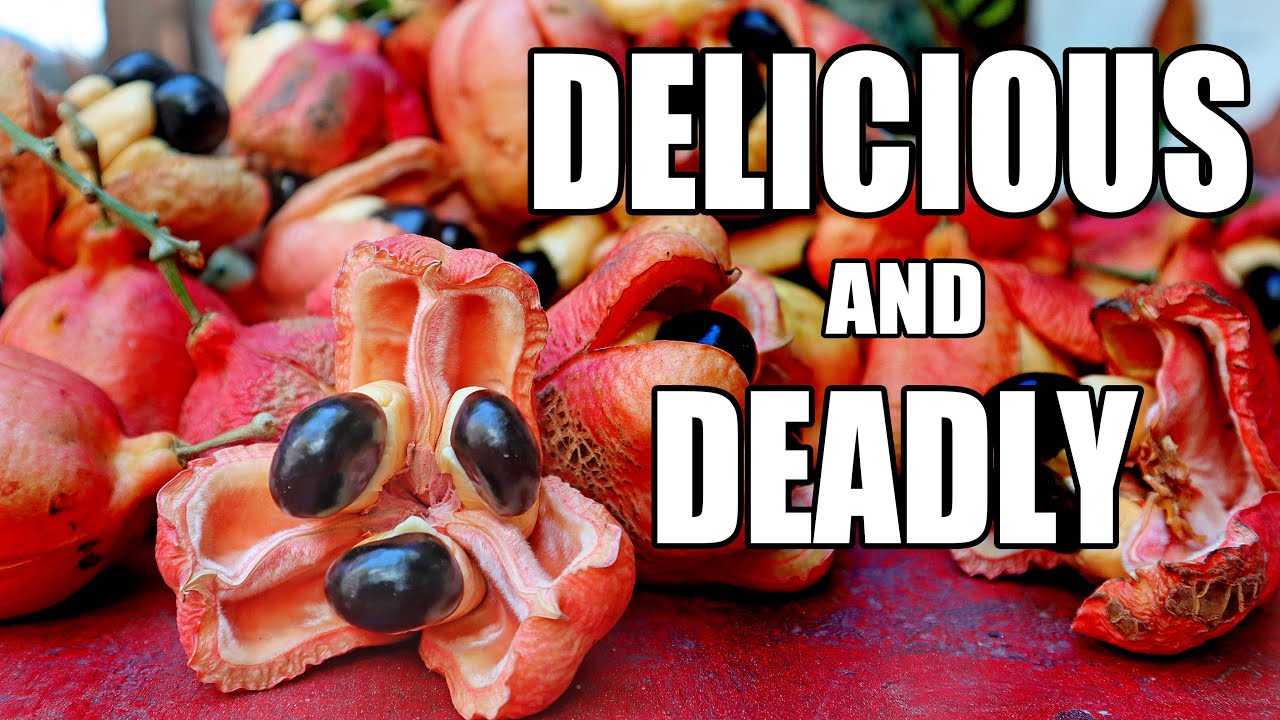
- Safe preparation requires letting the pod split open naturally on the tree, then discarding the black seeds and pink membrane and parboiling only the pale yellow arils.
- Cooked ackee looks like scrambled eggs and has a custard-or-cheese texture that absorbs seasoning rather than delivering strong sweetness on its own, and the episode pairs it with susumba, a bitter nightshade berry known as gully bean or turkey berry.
The Toxin Behind Jamaica’s National Fruit
Ackee isn’t even from Jamaica originally — it arrived from West Africa and became so central to the island’s cooking that it’s now the national fruit, most famously paired with saltfish for breakfast. Dan’s episode skips past that default pairing to explain why the fruit has a reputation that scares off first-timers in the first place. The danger isn’t in eating ripe ackee; it’s in eating ackee that hasn’t been allowed to ripen and open on its own.
Unripe or forced-open pods carry enough hypoglycin A to trigger Jamaican vomiting sickness — the reason the fruit is banned for import in some countries unless canned.
That toxin, hypoglycin A, crashes blood sugar hard enough to cause severe hypoglycemia. It’s concentrated in the black seeds, the pink inner membrane, and any arils pulled from a pod before it has cracked open naturally in the sun. The fix isn’t complicated, but it’s non-negotiable: wait for the tree to do the work, then discard everything except the pale yellow flesh.
Getting It Right: From Pod to Plate
The preparation Dan documents follows the same rule Jamaican cooks have passed down for generations — harvest only pods that have opened on their own, pull out the arils, and throw away the seeds and membrane without exception. From there, the arils get parboiled before they ever hit a skillet, a step that further reduces any residual toxin and softens the flesh for cooking.
It’s a process that rewards patience over convenience, which is part of why ackee isn’t something you’ll find pre-packaged the way you would in a lot of fruit markets. Anyone curious about how far Jamaicans have had to adapt around dangerous or unpredictable local ingredients might also check out this look at Tivoli and Trench Town in Kingston, where day-to-day survival often runs on similarly hard-earned local knowledge.
Scrambled Eggs, Not Sweet Fruit
Once it’s parboiled and sautéed, ackee doesn’t behave like a fruit at all. Visually it’s a dead ringer for scrambled eggs — pale yellow, soft curds — and the texture lands somewhere between custard and cheese rather than anything juicy or sweet. Dan’s tasting backs up what Jamaican cooks have always said about it: ackee isn’t a flavor bomb on its own, it’s a canvas. It takes on whatever seasoning, onion, pepper, or saltfish is cooked alongside it, which is exactly why it works so well as a savory breakfast staple instead of a dessert fruit.
Susumba: The Bitter Counterpart
The second half of the episode turns to susumba, also called gully bean or turkey berry — a small green nightshade berry with an intensely bitter bite that has nothing in common with a sweet garden fruit. Rather than settling for the standard ackee-and-saltfish combination, Dan tries a more regional preparation that cooks the rich, savory ackee together with the sharply bitter susumba, letting the two ingredients balance each other rather than compete. It’s the kind of pairing that rarely makes it onto a tourist-facing menu, and it’s a useful reminder that Jamaican cuisine runs a lot deeper than the dishes that get exported. Viewers who enjoyed watching an outsider work through unfamiliar, occasionally risky, local food traditions might also get a kick out of this look at survival on the smallest island in the Caribbean, which covers similar ground on making the most of what a Caribbean environment actually offers.
By the end of the episode, Dan’s verdict lines up with what generations of Jamaican cooks already knew: ackee and susumba aren’t fruits you eat carelessly, but prepared the right way, they’re exactly the dish locals have been quietly perfecting for centuries.






What I Eat In A Day (how i got my abs) | RENEE AMBERG
How Recycling Machines Make New Clothes From Used Apparel
I was sex trafficked for years. Brothels are hidden in plain sight
3 Years Living In A $1900 Renovated RV – Her DIY Mods & Lessons Learned
Buying a $1.6M foreclosure mansion in Henderson, NV.