

 InfoSearched
A fish that spends most of its life refusing to be in water.
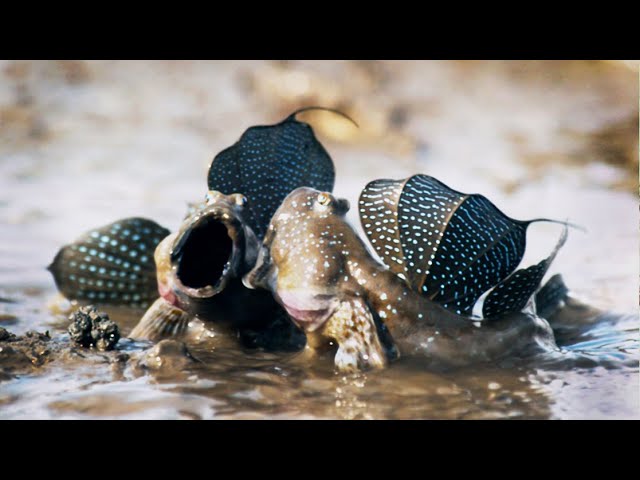
BBC Earth’s Life series turns its cameras on one of the strangest holdouts in the animal kingdom: the mudskipper, a goby that has largely given up on swimming. Across the mudflats and mangrove swamps of the Indo-Pacific, these fish crawl, crutch, and skip over wet silt using pectoral fins built more like stubby legs than flippers. The clip, “Mudskippers: The Fish That Walk on Land,” breaks down exactly how a fish pulls off a life plan built around staying dry.
- Mudskippers spend up to three-quarters of their lives out of water, moving on modified pectoral fins positioned beneath the body.
- They breathe through cutaneous respiration across their skin, mouth and throat membranes, and enlarged gill chambers that trap a private reservoir of water and air.
- Courting males flick their tails to launch themselves vertically off the mud and dig underground burrows, hauling mouthfuls of air down to keep submerged egg chambers oxygenated.
Built for Land, Not Water
Everything about a mudskipper’s frame reads like a fish mid-transition. The pectoral fins sit low and muscular, angled so the animal can prop itself up and crutch forward across exposed mud at low tide, then whip into the skipping motion that gives the fish its name. It’s a body plan that looks improvised but is precisely tuned: on land these fins do the work legs would do on a salamander, while still folding back for the occasional swim when the tide comes in.
Survival outside water comes down to keeping tissue wet. Mudskippers retain moisture through cutaneous respiration — oxygen absorbed directly across capillary-rich skin — backed up by moist membranes lining the mouth and throat. Their gill chambers are oversized for a goby, sealing in a bubble of water and trapped air that functions like a portable aquarium, letting the fish breathe on the move rather than gasping at a puddle’s edge.
Periscope Eyes on a Flattened Head
The video lingers on what might be the mudskipper’s most memorable feature: a pair of bulging, periscope-style eyes mounted high on a flattened skull. They swivel independently, scanning for crabs, worms, and insects while simultaneously watching for anything hunting the mudskipper itself. To stay wet without a dunk in the tide, each eye retracts into a fluid-filled dermal cup beneath the socket — a built-in eyewash the fish can trigger on demand.
That kind of specialized adaptation for surviving away from an animal’s “natural” element shows up across the natural world in different forms, whether it’s a bird engineered for a killing strike or a desert predator built to move where nothing else can. Anyone who found the amphibious tricks in Filming The World’s Deadliest Bird or the sand-dwelling ambush tactics in The Blind Assassin of the Desert will recognize the same pattern here: extreme habitat, extreme anatomy.
Territory, Tail Flicks, and Courtship
Mudflat real estate is contested hard. Male mudskippers stake out patches of mud and defend them aggressively, flashing bright dorsal fins at rivals and, when that’s not enough, driving competitors off outright. To attract a mate, a male will launch himself straight up off the surface using a powerful flick of his tail — a vertical leap with no water underneath him, performed purely to get noticed.
Males dig burrows mouthful by mouthful, then physically carry pockets of air down to oxygen-starved egg chambers just to keep the next generation alive.
Once courtship succeeds, the male gets to work excavating a burrow, removing wet sediment one mouthful at a time. Because the deep chamber where the eggs sit is starved of oxygen, he has to keep making return trips to the surface, hauling pockets of trapped air back down to the clutch — manual life support, repeated for as long as the eggs need it.
A Small Fish With an Outsized Ecological Role
None of this is a novelty act. Mudskippers sit at a genuine crossing point in coastal food webs, picking off small crabs, insects, and worms on the mud while themselves being watched by birds and larger predators from above and below. Their burrows aerate mangrove sediment, and their sheer numbers across Indo-Pacific mudflats make them a working part of an ecosystem that’s under real pressure from coastal development. It’s the same kind of quiet, easily-overlooked ecological function that turns up in stories about rodent booms reshaping farmland, like the scale of disruption covered in Millions of Mice Are Terrorizing Australia — small animals, outsized consequences.
Watch the clip closely and the vertical leap is the giveaway moment: a fish, sitting on exposed mud with no water in sight, flicking its tail hard enough to get airborne just to catch a mate’s attention. That single behavior — evolved from a swimming motion into a courtship display — is the whole mudskipper story compressed into about a second of footage.







DAY 85: Sharks Really Wanted This Fish!
Why Army Recruits Train Inside A Tear Gas Chamber In Boot Camp
How This Woman Started Diving in DIY Submarines
The Man Behind the Most Grueling Footrace on Earth
3 PEOPLE LIVING IN A VAN | Van Life in Scotland