

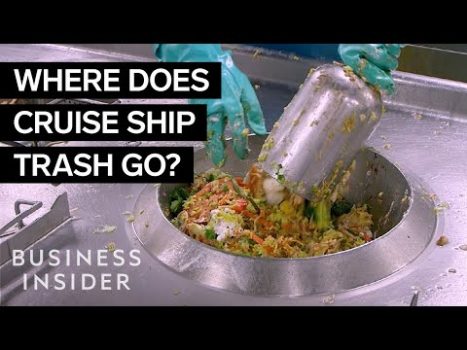
 InfoSearched
Below deck on the world’s largest cruise ship, a 24-hour crew turns millions of pounds of trash into something that never touches the ocean.
Royal Caribbean’s Symphony of the Seas entered service as the largest cruise ship on the water, a 228,081-gross-ton vessel built to carry up to 6,680 guests and 2,200 crew members at once. Feeding, housing, and entertaining that many people generates an enormous volume of garbage every single day, and almost none of it is visible to passengers lounging by the pool or eating at one of the ship’s more than 20 dining venues. Every scrap of it disappears down chutes and service elevators to a crew-only operation on Deck 2 that runs around the clock.
- Symphony of the Seas, at 228,081 gross tons, carries up to 6,680 guests and 2,200 crew, all of whose waste is funneled into a single centralized facility on Deck 2.
- A dedicated team of roughly 20 to 30 crew members staffs the sorting and recycling bays 24 hours a day, processing millions of pounds of refuse each year.
- Glass is sorted by color and crushed into cullet, aluminum cans are baled into dense metal cubes, and food scraps are pulped through stainless-steel vacuum lines before disposal.
Inside Deck 2’s Sorting Bays
Nothing that comes off a plate or out of a stateroom on Symphony of the Seas gets thrown away without passing through human hands first. Every bag delivered down the chutes and service elevators lands in a dedicated, crew-only facility on Deck 2, where a specialized team manually sorts it into streams: glass, aluminum, plastic, cardboard, food scraps, and dry non-recyclable trash. The goal is straightforward — divert as much as possible away from ocean dumping and landfill offloading, and turn the rest into something a port can process cleanly.
That sorting operation never stops. With a rotating crew of 20 to 30 workers running the bays 24 hours a day, the ship processes millions of pounds of waste across food, recyclables, dry trash, and wastewater in a given year — a scale that has more in common with a small municipal transfer station than anything typically associated with a vacation.
Glass, Aluminum, Plastic, and Cardboard
Glass bottles get sorted by color — clear, green, and brown — before being fed into a commercial glass crusher that reduces thousands of bottles into fine cullet, stored in large drums until it can be offloaded. Aluminum beverage cans go through an industrial baler that compresses tens of thousands of them into dense metal cubes. Plastic gets the same sorting treatment, with water bottles specifically run through dedicated densifiers capable of crushing hundreds of gallons of plastic volume in a single week. Cardboard from the ship’s provisioning deliveries is baled into massive rectangular bundles for offloading.
It’s a compaction process similar in spirit to what happens on land, where recycling machines turn used material into raw stock for something new — except here it’s happening in a purpose-built room hundreds of feet below the pool deck, with a working crusher, a baler, and drums of cullet lined up like any industrial recycling depot on shore.
Food Waste and Incineration
Feeding thousands of people across more than 20 dining venues produces a constant stream of food scraps, which are funneled through stainless-steel vacuum lines into pulpers that dewater and grind the solid organics into dry pulp. Cutting the volume down this way makes the material manageable for regulatory-compliant offshore release or shoreside handling, rather than letting it pile up as raw waste.
Whatever can’t be recycled, composted, or pulped gets burned in high-temperature, onboard incinerators — everything else waits in cold storage until a licensed port can take it off the ship’s hands.
Hazardous materials are handled with a different level of care entirely. Batteries, chemicals, fluorescent tubes, medical waste, and electronics are cataloged and segregated in specialized cold storage, held strictly until they can be offloaded at designated ports equipped to accept them.
Wastewater Treatment to Near-Tap Standards
Black water from toilets and gray water from sinks, showers, and galleys are directed into Advanced Wastewater Treatment Systems that use bioreactors and ultrafiltration to purify the effluent to near-tap standards before any discharge. It’s the same category of technology behind land-based municipal treatment plants, scaled down and packed into a ship that also happens to have a zip line and a rock-climbing wall on its top decks.
The combination of manual sorting, industrial compaction, incineration, and advanced treatment is what lets a vessel carrying nearly 9,000 people at capacity keep moving between ports without turning into a floating landfill — a logistics operation most of the 6,680 guests on board never think about once, sandwiched somewhere between the specialty dining reservations and the next stop on the itinerary.




The extraordinary final test to become a Shaolin Master | Sacred Wonders
16 Camping Pranks And Life Hacks
Survival on the smallest island in the Caribbean
World’s CRAZIEST Meal – Alchemist – SOLD OUT in 3 MINUTES
How To Turn Your Lawn Into A Vegetable Garden