

 InfoSearched
A single bloom can weigh as much as an adult human’s leg and smell like roadkill in the sun.
In “World’s BIGGEST Flowers!,” the second entry in Redfern Natural History Productions’ series World’s Most Spectacular Plants, British botanist and explorer Stewart McPherson tracks down the planet’s most oversized flowering structures across the rainforests of Sumatra and Borneo. He splits the story into two categories: the single largest individual bloom on Earth, and the far bigger compound flower clusters that dwarf it in total size. Both, it turns out, rely on the same trick — smelling like something has died.
- Rafflesia arnoldii can span up to 1 meter across and weigh up to 11 kilograms, making it Guinness World Records’ largest single flower — yet it has no leaves, stems, or roots of its own.
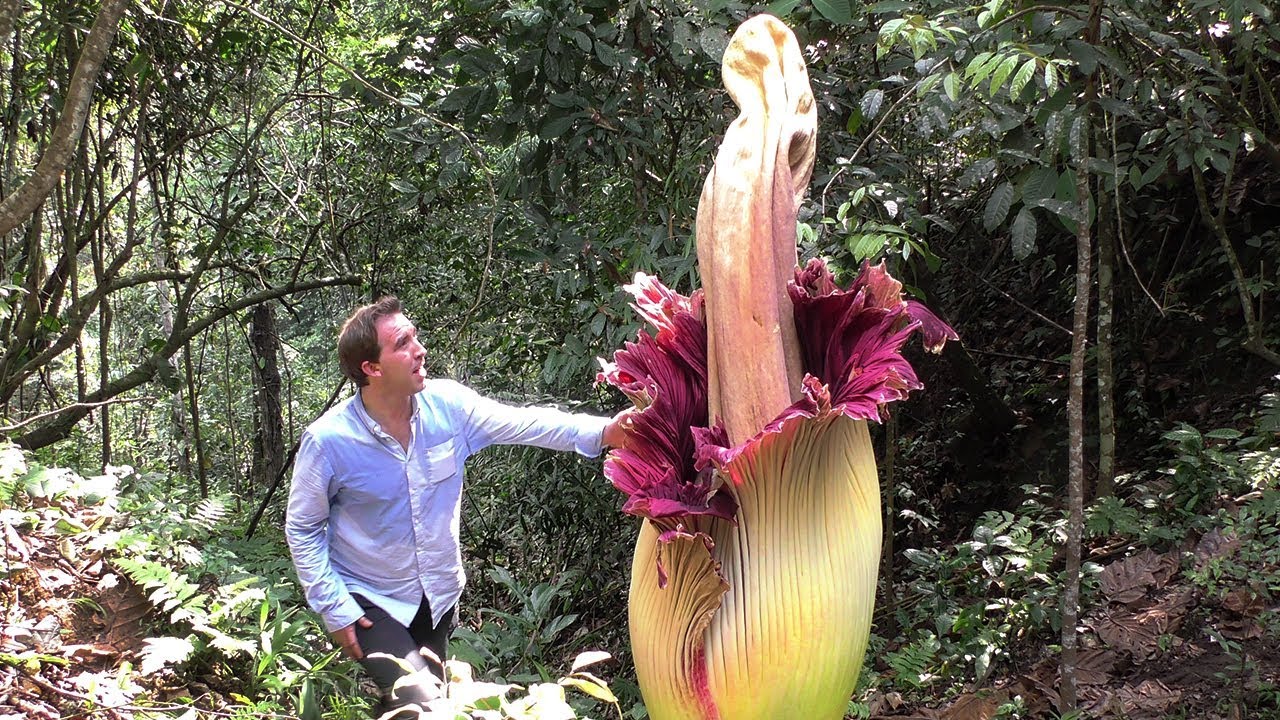
- The Titan Arum (Amorphophallus titanum) produces the largest unbranched inflorescence in the world, topping 3 meters in height and 70 kilograms in weight.
- The Talipot palm (Corypha umbraculifera) grows a branched flower cluster bearing millions of individual blooms on towering scapes — then dies once it’s finished flowering.
Rafflesia arnoldii’s Parasitic Life Cycle
McPherson’s search for Rafflesia arnoldii takes him into the tropical rainforests of Sumatra and Borneo, where the plant lives as an obligate parasite on Tetrastigma vines. It has no leaves, no stems, and no true roots — the entire organism survives hidden inside its host’s tissue until it’s ready to flower, at which point a dark brown, cabbage-like bud pushes up through the vine’s bark.
When that bud finally opens, the fleshy reddish-brown petals unfurl to a diameter of up to 1 meter and a weight of up to 11 kilograms. The bloom doesn’t attract pollinators with nectar or color the way most flowers do. It relies on sulfur compounds — dimethyl disulfide among them — that replicate the smell of decaying meat, fooling carrion flies and beetles into treating the flower as a corpse worth investigating.
A flower with no leaves, no stem, and no roots of its own — that still manages to weigh 11 kilograms and smell like something died.
The Titan Arum’s Rotting-Flesh Disguise
Where Rafflesia wins on raw size for a single bloom, McPherson shows how the Titan Arum surpasses it in overall scale by building a compound structure instead of one flower. Native to Indonesia’s rainforests, Amorphophallus titanum produces the largest unbranched inflorescence on the planet — a towering spike that can exceed 3 meters in height and weigh more than 70 kilograms.
Like Rafflesia, the Titan Arum leans on deception rather than beauty. Its inflorescence gives off the same stench of rotting flesh, drawing in carrion insects that unwittingly carry pollen from plant to plant. The scale of the structure, paired with the odor, is what earned it the popular nickname “corpse flower” long before McPherson’s documentary went looking for it in the field.
The Talipot Palm’s Once-and-Done Bloom
The episode’s final stop is the Talipot palm, Corypha umbraculifera, which takes a completely different approach to going big. Rather than one giant flower or one giant spike, the Talipot produces a massive branched terminal cluster carrying millions of tiny individual flowers spread across towering scapes.
McPherson frames this as the ultimate reproductive gamble in the plant kingdom: the Talipot pours everything it has into that single flowering event, and once the bloom is spent, the palm dies. There’s no second season and no repeat performance — just one enormous release of flowers built up over the plant’s entire life before it’s gone.
McPherson’s field-driven approach to giant flora echoes the same on-the-ground style found in Filming The World’s Deadliest Bird, and viewers drawn to unusual plant biology will find a similar deep dive in Cultivating Gourmet and Medicinal Mushrooms. Both follow the same instinct that runs through this episode — nature’s biggest, strangest specimens are usually chasing survival, not spectacle.








A Guide To Bridesmaids Dresses And Wedding Planning
Quarantine at the Edge of the World
Snowmobile Camper with Off Grid Heater- Surviving the Night in -18C / 0F Temperature!
Living on a Self-Sufficient Sailboat for 10 Years
Beautiful Tiny Turf House in Iceland – Full Tour & Interview