

 InfoSearched
A 73-year-old carpenter in rural China just built a bridge that would make Lu Ban proud — without touching a single nail.
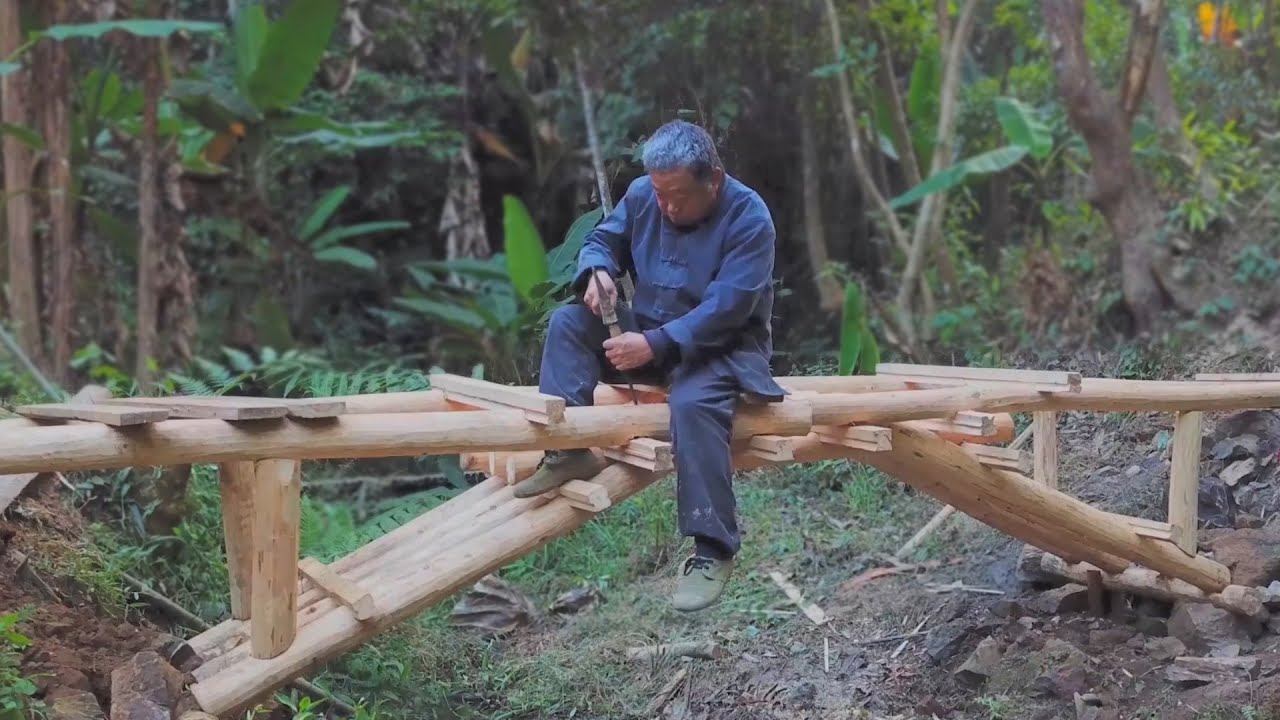
Wang Dewen, the craftsman millions online know simply as “Grandpa Amu” (阿木爷爷), spends his days doing something almost nobody else still does: building with wood the way Chinese carpenters did thousands of years before power tools existed. In his latest video, he takes on one of the toughest tests of that old knowledge — a full interlocking wooden arch bridge, assembled piece by piece with no nails, no screws, and no glue anywhere in the structure.
- Grandpa Amu builds the entire arch bridge using traditional mortise and tenon (sunmao) joinery — every beam is cut to interlock with the next, with no fasteners or adhesive used at any point.
- The bridge’s strength comes purely from precise cuts and geometric load distribution between the interlocking wooden beams, not from any added hardware.
- The video is filmed in his rural village by his son, who runs the camera, while his daughter-in-law helps manage the channel — a family operation behind every project.
The Build That Needs No Hardware
What separates this bridge from a typical carpentry project is the complete absence of anything holding it together except the wood itself. Grandpa Amu shapes each beam so its tenon — the protruding end — fits into a matching mortise, a notch cut into the connecting piece. Get the angles and dimensions right, and the joint locks under its own weight and the forces pressing through it; get them wrong, and the whole thing has nothing else to fall back on.
That precision is what makes the arch form possible at all. As beams are laid across the span, they wedge against neighboring pieces, spreading the load sideways and downward through the interlocking geometry rather than pulling straight down on a single fastener point. It’s the same principle that let ancient sunmao structures survive earthquakes that toppled buildings held together with rigid nails — flexible joints that shift slightly instead of snapping.
No nails, no screws, no glue — just cut wood locking into cut wood, and it holds.
A Farmer Who Became the Internet’s Favorite Craftsman
Wang doesn’t call himself a master or an artisan — he identifies as a farmer who happens to know an old trade. That plain self-description is part of why the videos have resonated so widely: there’s no performance to it, just a man in work clothes in a village courtyard, cutting joints he learned decades ago and never stopped using. Viewers have taken to calling him a modern-day Lu Ban, invoking the legendary carpenter and structural engineer credited as the father of Chinese woodworking and building craft in ancient texts.
The comparison isn’t casual flattery. Lu Ban is the reference point Chinese carpentry has measured itself against for centuries, and putting Wang in that company reflects how rare it is to see someone still building this way, on camera, from scratch. For viewers who’ve watched countless renovation and construction videos, from a load-bearing wall removal to a full DIY structure going up from a kit, Wang’s approach lands differently — there’s no drywall, no drill, nothing modern in frame at all.
Keeping a Family Trade on Camera
The production is deliberately unpolished. Wang’s son operates the camera and manages the footage, and his daughter-in-law helps run the channel, turning what could easily have stayed a private village skill into content watched worldwide. There’s no narration explaining the physics as he works — the joints, the mallet taps, and the slow assembly of the arch do the talking.
That format has become something of its own genre online, sitting alongside other hands-on builds and off-grid projects that show process over polish — the kind of viewers who watch someone build a woodworking workshop from scratch in the forest tend to be the same audience pulled in by Wang quietly notching a beam until it locks into place.
By the time the last beam drops into its mortise and the arch stands on its own, there’s no hammering to test it, no glue curing overnight — Wang just walks across it. That’s the whole demonstration.








Inside a $9.75M NYC Townhouse with a Prohibition Era Tunnel
The Tragedy of John Jones | Sealed Forever in a Cave
The Mexican Restaurant Hidden in a Barn on a Rural New York Farm
Mudskippers: The Fish That Walk on Land
How My Luxury Lifestyle Started! – Candid Conversations With Anna Bey #1 School of Affluence