

 InfoSearched
A glassblower in rural Massachusetts has spent five decades scattering tiny planets across the globe for strangers to find.
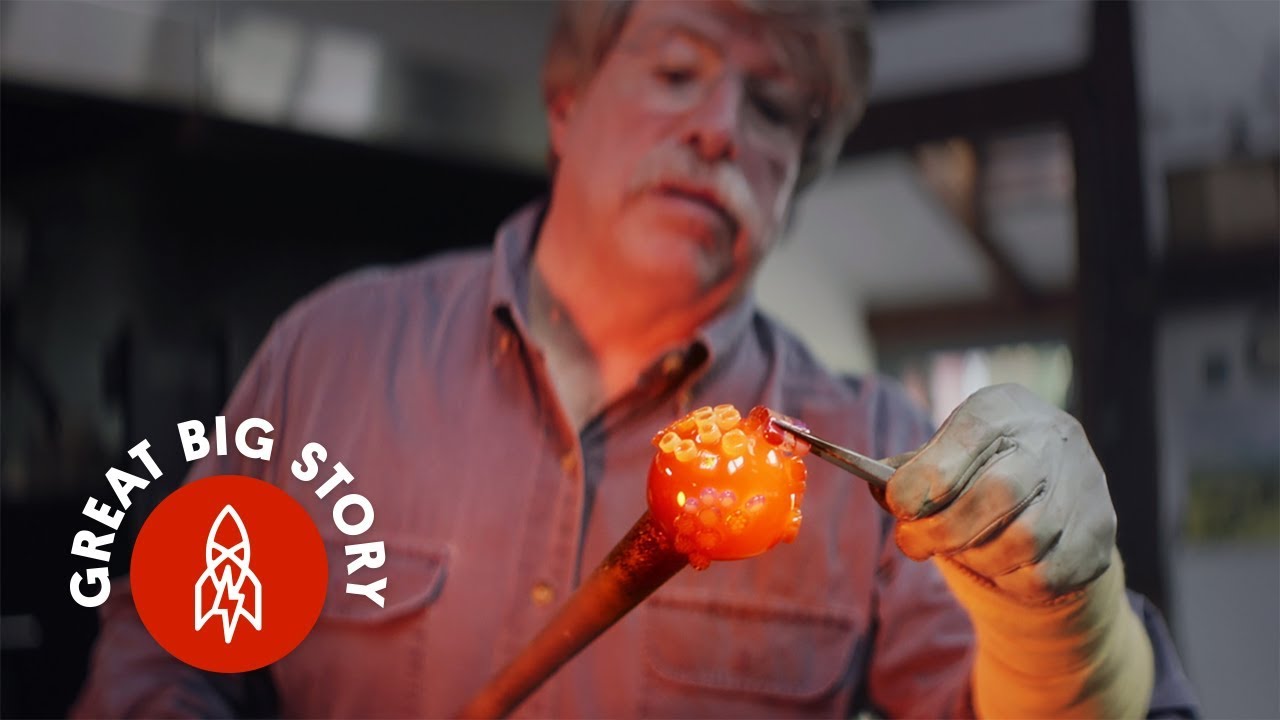
Josh Simpson works out of a studio in Shelburne Falls, Massachusetts, where he melts sand and minerals into solid glass spheres he calls “planets.” He’s been at it since the early 1970s, and the idea for the celestial designs took shape a few years later, after he heard Apollo astronauts describe seeing Earth from space as a small blue marble suspended in the dark. That image became the seed of a body of work that now numbers in the thousands.
- Simpson began experimenting with glass in the early 1970s and developed his signature planetary spheres by the mid-1970s, directly inspired by Apollo astronauts’ “blue marble” descriptions of Earth.
- His pieces range from marble-sized orbs to massive, multi-layered “Megaplanets” built with internal continents, swirling atmospheres, and layered landscapes suspended inside the glass.
- Through his ongoing “Infinity Project,” Simpson hides his glass planets in locations worldwide — mountaintops, ocean floors, city corners — and also hands them to travelers and scientists to plant on his behalf.
From Shelburne Falls to the Rest of the World
Simpson’s workshop sits in a small former mill town in western Massachusetts, the kind of place better known for its covered bridges than for supplying hidden art to four continents. It’s there, working at the furnace, that he builds each planet layer by layer — gathering molten glass, embedding color and texture to suggest coastlines or storm systems, then encasing the whole thing in another clear shell so the “landscape” appears to float inside solid glass.
No two are identical. The smaller pieces can be held in a palm; the Megaplanets are dense, heavy objects that take considerable skill and repeated trips to the furnace to finish without cracking. Decades of repetition have let Simpson push the internal detail further with each generation of the work, adding more intricate cloud bands, fault lines, and color gradients inside the glass itself.
The Infinity Project
What separates Simpson from most studio glass artists is what he does with the finished pieces. Rather than selling every planet through a gallery, he’s spent years depositing them in places where someone might stumble across one by accident — tucked into a crevice on a mountain trail, left on a beach, set down in an urban alley. He’s also given planets to travelers, scientists, and friends heading to far-flung locations, asking them to leave the pieces behind on his behalf.
Simpson has hidden thousands of glass planets around the world — on mountaintops, on ocean floors, and in city streets — for strangers, and maybe future archeologists, to find.
The intent isn’t a scavenger hunt with posted clues; it’s closer to leaving a message in a bottle. Simpson has said he likes the idea of someone in the distant future turning up a planet with no explanation and wondering who made it and why — treating the pieces less like collectibles and more like small artifacts planted for people who haven’t been born yet.
A Craft Built on Repetition
Glassblowing rewards the kind of patience Simpson has put into this project for decades. Each planet demands precise heat control, timing, and a steady hand, the same fundamentals prized across other hands-on crafts — the sort of painstaking, start-to-finish process detailed in projects like this pine-needle basket build, where the finished object is inseparable from the hours spent shaping it. It’s the difference between mass production and something made one deliberate piece at a time.
That same patience runs through the backstories of makers who built entire reputations from a single obsessive idea, the kind of origin story explored in the account of Louis Vuitton’s unlikely beginnings. Simpson’s version of that obsession just happens to involve leaving his work behind for someone else to keep.
Nobody tracks exactly how many of Simpson’s planets are still out there waiting to be found — that’s the point. Somewhere between a mountaintop cache and whatever a diver might one day pull up off a reef, the next one is already sitting in the dark, waiting on the right person to walk by.






The WEIRDEST Bike Park?
Mexico’s Cartels Are Deadlier Than Ever Despite the Pandemic
This Arabian Dog is Fast Enough to Catch a Gazelle
Miami’s Most Legendary Playboy
Cuba’s Scariest Food!!