

 InfoSearched
A legendary natural builder turned a hillside of trees into a real-life fairytale.
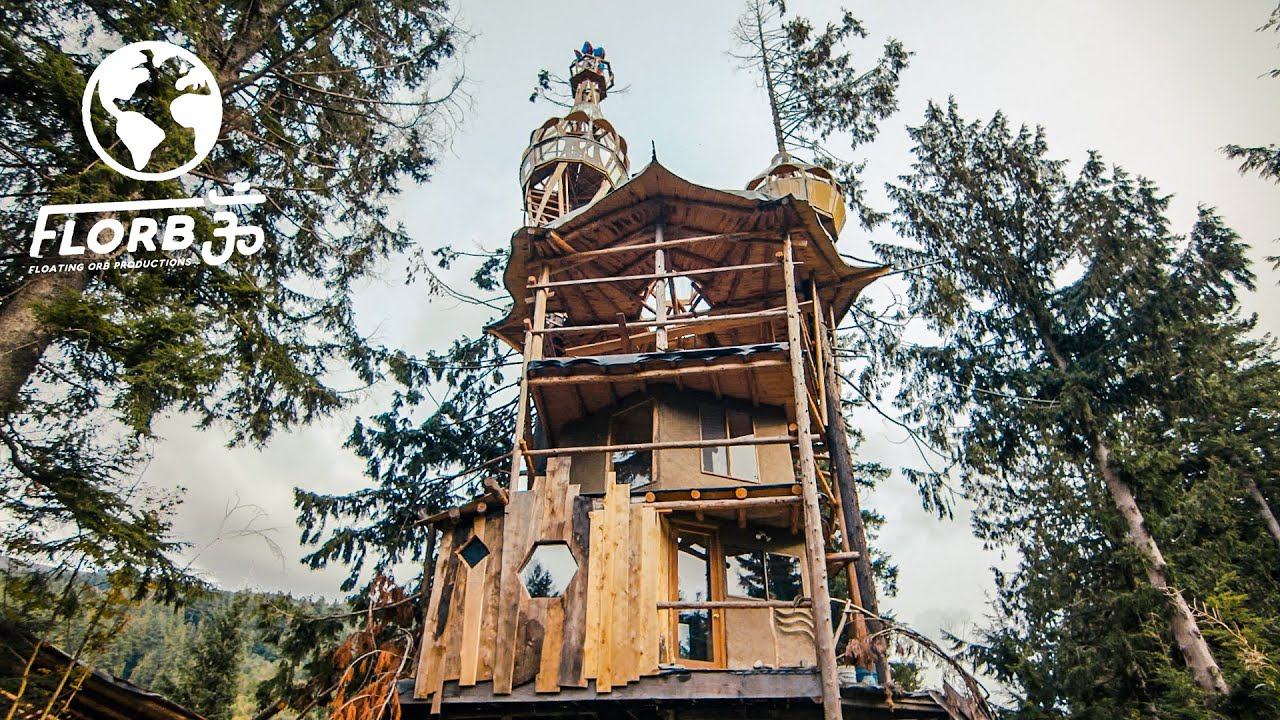
Long before “treehouse” became a real estate buzzword, SunRay Kelley was already building them out of whatever the forest handed him. The counterculture builder and sculptor has spent decades constructing homes that look like they grew rather than were built, and the multi-story cabin featured in “This Fairytale Treehouse will make you Relive your Childhood Dreams” is one of his signature works — a structure that leans on raw timber, hand-sculpted cob, and salvaged wood instead of a single square-cut stud.
- The treehouse was built by SunRay Kelley, a counterculture natural builder and sculptor known for treating the surrounding woods as “God’s Hardware Store.”
- The structure is a multi-level cabin featuring live-edge wood decks, an observation level, and hand-sculpted earthen cob walls.
- Kelley’s construction relies on cob — a mix of clay, sand, and straw — plus curved timbers and whole branches rather than standard dimensional lumber framing.
The Builder Behind the Structure
SunRay Kelley isn’t a contractor in any conventional sense. He’s a self-taught natural builder whose reputation rests on decades of freehand construction that treats a tree’s natural bend, fork, or knot as a design feature rather than a flaw. Outlets like Dwell and The Year of Mud have documented his work as some of the most distinctive natural architecture in the Pacific Northwest, built without blueprints in the traditional sense and shaped instead by whatever material the land offered that season.
That approach shows up everywhere in the featured cabin. Whole branches pierce straight through sections of the roof plane rather than being cut around, and the deck framing follows the natural curve of the timber it was milled from. It’s the opposite of a kit-built cabin — every piece looks like it was chosen for the tree it once was, not ordered from a lumber yard. Readers who enjoyed the freehand construction in Magical Adult-Sized Tree House That Looks Like a Hobbit Hole will recognize the same instinct at work here, just scaled up across multiple stories.
Cob Walls and “God’s Hardware Store”
Kelley has described the forest itself as his supply chain — a “Super Natural Store” where curved branches, salvaged timber, and clay soil replace a hardware store run. The technique holding it all together is cob: a blend of clay, sand, and straw that’s built up by hand into load-bearing walls, then sculpted while still workable into curves, alcoves, and window openings that a framed wall could never achieve.
The forest is God’s Hardware Store — everything you need is already there.
That philosophy is why Kelley’s cabins never look identical to one another. Each cob wall is shaped on-site to the specific branches and timbers on hand, which means the treehouse’s rounded corners, thick sills, and organic window frames exist because a particular piece of wood or a particular batch of clay dictated the shape, not the other way around.
Inside the Fairytale Cabin
The tour moves through a structure that reads more like a sculpture you can walk through than a house you’d find in a subdivision. Natural skylights are cut directly into the cob and timber roof to pull daylight down through the canopy, while the observation level sits high enough to put visitors at eye level with the surrounding branches rather than looking up at them.
Live-edge decking wraps sections of the exterior, keeping the bark-edge silhouette of the original log intact instead of squaring it off. It’s the same natural-materials logic that shows up in builds like The Pinecone Treehouse: A Spectacular Tiny Home In The Trees, though Kelley’s version leans harder into cob sculpting than most treehouse builders attempt.
A Structure Meant to Be a Sculpture
Kelley has been explicit that he doesn’t think of these cabins as buildings in the ordinary sense — he calls them living sculptures, designed to sit inside the forest canopy rather than clear a space out of it. That’s the throughline of the video: a builder who treats every curved branch and every batch of cob as material for something closer to art than architecture.
What makes Kelley’s cabins hold up decades later isn’t a floor plan — it’s that no two branches he’s worked with have ever been the same, so no two rooms in his builds ever are either. That’s the detail worth sitting with after the tour ends: this fairytale treehouse isn’t a reproducible design, it’s one specific set of trees, shaped by one builder’s hands, and it will never exist twice.







Small Vintage Trailer Renovated ON A BUDGET: Step by Step!
Is War Good for The Economy?
The remote visa-free island at the top of the world
Hiking 70 Miles Alone on the Sawtooth Loop Trail in Idaho
Musician’s Incredible Modern Tiny House & Mobile Music Studio