

 InfoSearched
Roughly a mile beneath the Gulf of Mexico, there are lakes that shouldn’t exist — and they can kill anything that swims into them.
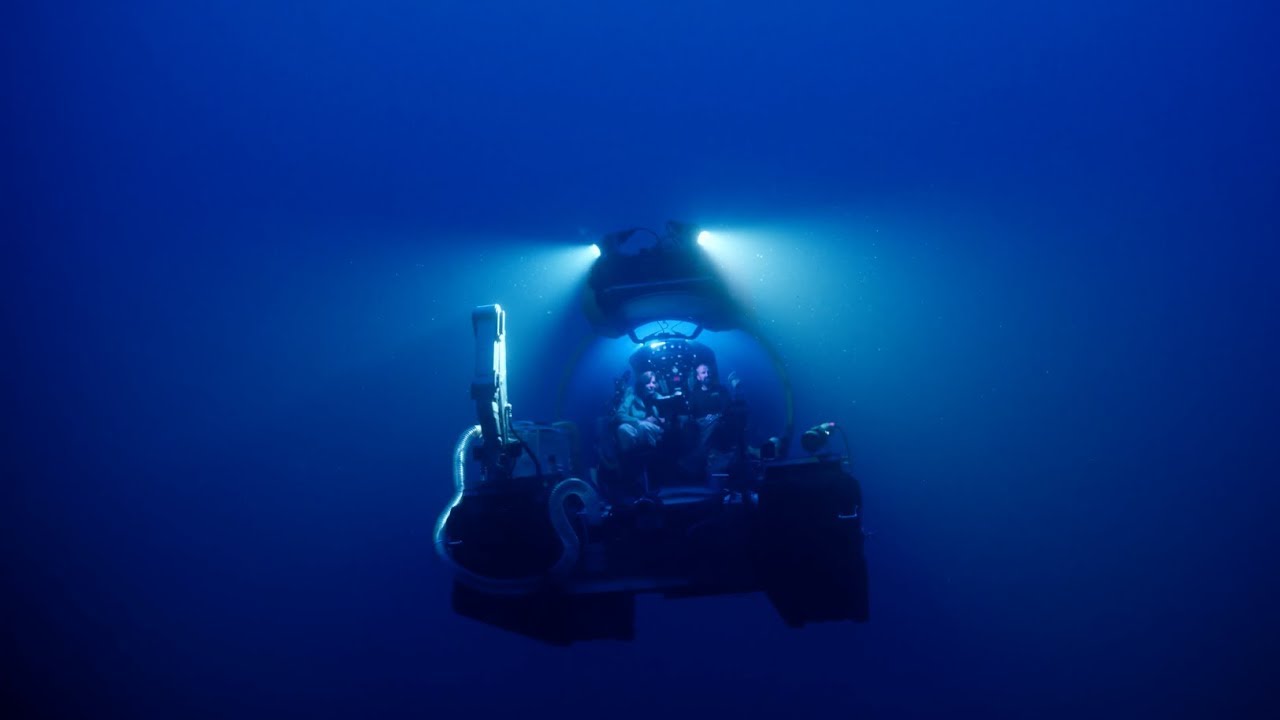
OceanX’s “Exploring the Alien World of Brine Pools” takes viewers down to the ocean floor to film one of the strangest habitats on the planet: dense, hypersaline lakes sitting in depressions on the seabed, complete with their own surface, waves, and shoreline hundreds of fathoms below daylight. The footage shows exactly why marine biologists and astrobiologists alike treat these pools as one of Earth’s closest analogs to alien oceans.
- Brine pools form through salt tectonics and the dissolution of buried evaporite deposits, producing water so much saltier than the surrounding sea that it settles into distinct, denser underwater “lakes” with visible boundaries.
- The pools are lethal to unadapted marine life — devoid of dissolved oxygen and loaded with toxic concentrations of salt, methane, or hydrogen sulfide, they trigger toxic shock and asphyxiation in animals that cross the halocline.
- Despite the deadly interior, the pool edges support chemosynthetic communities, including beds of bathymodiolin mussels that host symbiotic methanotrophic and thiotrophic bacteria to survive without sunlight.
A Lake at the Bottom of the Ocean
The physics behind a brine pool is what makes the footage so disorienting. As salt tectonics push evaporite deposits upward and groundwater dissolves them, the resulting brine becomes so dense it refuses to mix with the ocean water above it. Instead, it pools in seafloor depressions, forming a body of water within a body of water — one with a measurable surface, its own wave action, and a shoreline that ROV cameras can trace along the depression’s rim.
It behaves like a lake, sitting inside the ocean, with a shoreline no human had ever seen until submersibles went looking for it.
The Halocline That Kills
The line where normal seawater meets brine — the halocline — is effectively a kill zone. The pools carry no dissolved oxygen and instead saturate the water with salt, methane, or hydrogen sulfide at concentrations that overwhelm any fish, crab, or invertebrate not built for them. Animals that wander across the boundary face toxic shock or asphyxiation, and the footage captures the eerie result: carcasses preserved at the pool’s edge, trapped between two entirely different chemical worlds separated by inches.
Life That Thrives on the Edge
What makes the brine pools more than a graveyard is what grows around them. Along the perimeter, colonies of bathymodiolin mussels cluster in dense beds, each one carrying symbiotic bacteria inside its tissue — methanotrophic microbes that consume methane and thiotrophic microbes that metabolize sulfide compounds seeping from the pool. With no sunlight reaching these depths, this chemosynthesis, rather than photosynthesis, powers the entire local food web, turning the deadliest patch of seafloor into one of its richest.
Tools Built for the Abyss
None of this is visible without specialized hardware. OceanX’s research vessels deploy deep-sea submersibles and ROVs fitted with sampling gear designed specifically to probe the brine without disturbing the delicate mussel beds or destabilizing the halocline itself. That same deep-ocean engineering mindset shows up across other extreme-environment expeditions, from the divers charting flooded sinkholes on South Australian farms to crews documenting how the sea reshapes the lives of the people who work it.
Astrobiologists Monitor Key Space Developments
The scientific payoff extends well past the Gulf of Mexico. Brine pools host extremophile microorganisms adapted to zero oxygen and crushing osmotic pressure — conditions that mirror what researchers expect to find in the hypersaline subsurface oceans believed to exist on Europa and Enceladus. For astrobiologists, every sample pulled from a Gulf brine pool doubles as a rough sketch of what a probe might one day find cracking through ice on a moon of Jupiter or Saturn.
OceanX built its reputation on exactly this kind of footage — places too deep, too toxic, or too remote for anyone to have filmed before. The brine pools are one more entry on that list, and the mussel beds ringing their shorelines are still turning up new microbial strains every time a submersible goes back down.







Building a Medieval House | 10 Day Bushcraft Shelter Build
WOMAN Builds Breathtaking SUSTAINABLE DOME HOMES
How Waste Is Dealt With On The World’s Largest Cruise Ship
Living From The Ocean… Solo Beach Camping On An Uninhabited Island – Day 2
Inside Dakota Johnson’s Serene Hollywood Home