

 InfoSearched
Bruce Lee’s legend was built on speed, but the strength underneath it is what let him hit like a heavyweight in a 135-pound frame.
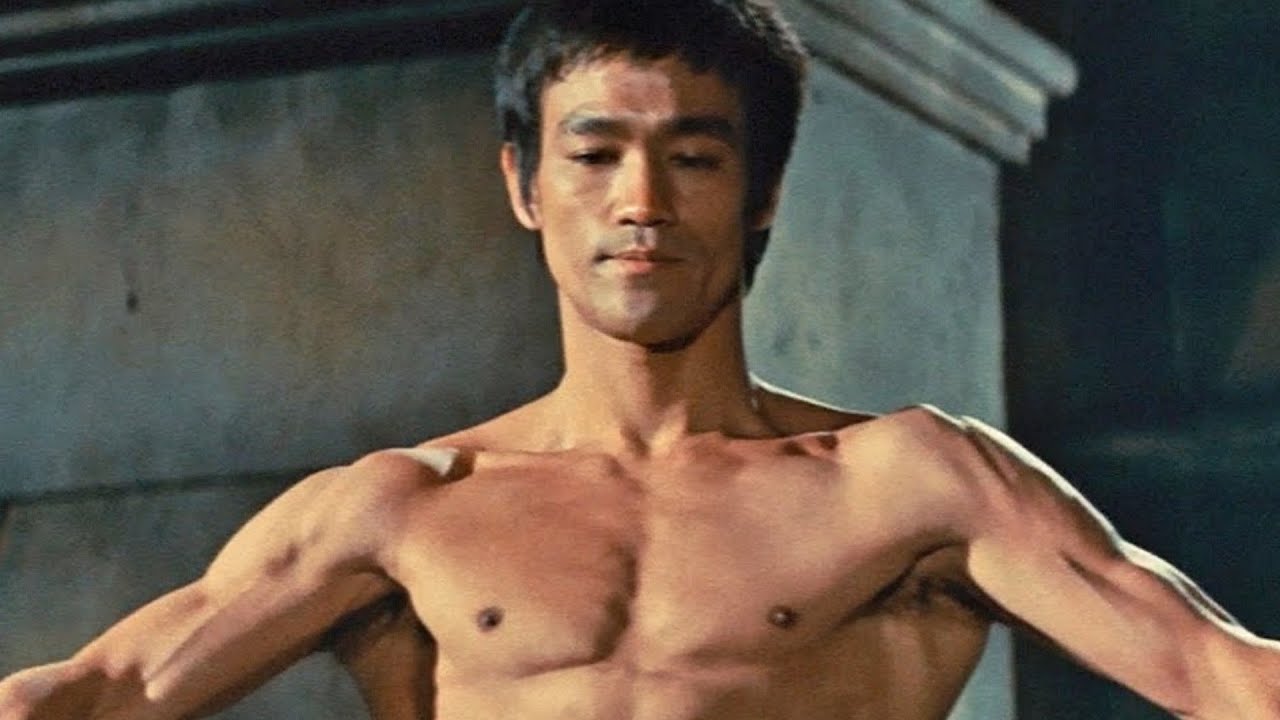
Every fight scene ever cut together of Lee shows the same thing: blows too fast to track, footwork that seems to skip a frame. But strip away the speed and ask a simpler question — how strong was the man actually? Standing around 5-foot-7 and walking weight of roughly 130 to 145 pounds with 5 to 6 percent body fat, Lee looked more like a gymnast than a fighter. He was anything but ordinary once you look at what that frame could produce.
- Lee maintained an estimated 5–6% body fat at a walking weight of 130–145 pounds, prioritizing dense, functional muscle over bodybuilder mass.
- He performed two-finger push-ups on a single hand, held a 125-pound barbell horizontal in front of him, and reportedly held a 75-pound weight outstretched in one hand while doing 50 one-armed chin-ups with the other.
- His famous one-inch punch — generated through hip torsion and kinetic alignment rather than mass — has been studied by biomechanics researchers for how a strike thrown from almost no distance could knock grown men backward.
The Physique Behind the Myth
Chuck Norris, who trained and sparred with Lee, described his build simply as “muscle upon muscle.” That wasn’t hyperbole — Lee’s lats reportedly flared so wide they stretched visibly past his sides, a byproduct of a training obsession that had almost nothing to do with vanity. He wasn’t chasing size. According to training philosophies built around functional output over bulk, Lee’s approach mirrors a broader idea in athletic conditioning: strength that actually transfers to movement beats strength that just looks good in a mirror.
Bodybuilders took notice while he was alive to see it work. Arnold Schwarzenegger and Lou Ferrigno both credited Lee’s conditioning with influencing how bodybuilding itself came to value leanness and definition, not just raw mass. For a man who never entered a bodybuilding competition, that’s a strange kind of legacy — shaping a sport from the outside by simply looking different from everyone in it.
Feats of Pound-for-Pound Strength
The two-finger push-up, done on a single hand, is the kind of party trick most gym-goers can’t fathom attempting. Lee did it as a baseline. He was also known to hold a 125-pound barbell horizontal at arm’s length — a feat that punishes the deltoids and core far more than a straightforward lift — and reportedly held a 75-pound weight outstretched in one hand while cranking out 50 one-armed chin-ups with the other.
“Muscle upon muscle.” — Chuck Norris, describing Bruce Lee’s physique
Then there’s the one-inch punch, the single most-studied physical feat of Lee’s career. Thrown from barely any backswing, it relied on hip rotation, total-body kinetic linking, and a burst of muscle contraction speed that let him drive an opponent backward off a strike that traveled almost no distance at all. Scientists have picked apart the mechanics of that punch for decades, because conventional power generation says it shouldn’t work the way Lee made it work.
Training Built for Speed, Not Size
According to BruceLee.com, Lee treated his own body like an ongoing experiment, building his own equipment when nothing on the market fit what he wanted to train. He logged everything — every crunch, every punch, every mile — with the same discipline a scientist logs data. His regimen mixed progressive resistance training, isometric holds, core work including the “dragon flag,” and heavy forearm and wrist conditioning specifically aimed at maximizing grip strength and punching power without slowing him down.
He was blunt about the standard he held himself to: “Above all, never cheat on any exercise. Use the amount of weight that you can handle without undue strain.” He treated meditation and jogging as recovery for the mind as much as the body, once describing his runs as an hour alone with his own thoughts.
His diet followed the same function-first logic. He cut alcohol, caffeine, tobacco, dairy, and refined flour, but never turned eating into a rigid ritual. “Eat what your body requires, and don’t get carried away with foods that don’t benefit you,” he said — a simple rule from a man who otherwise obsessed over every rep.
Proof Under Real Pressure
Lee rarely fought for real, which is part of why his legend calcified into something almost mythical. But the closest thing to a documented real fight — his 1964 encounter with Wong Jack Man, later dubbed the “Battle of Oakland” — reportedly lasted only about three minutes before Lee came out on top. That single data point, thin as it is, lines up with everything his training logs and sparring partners described: speed backed by strength that could actually finish something fast.
It’s also the encounter Lee later cited as pushing him to refine his approach into what became Jeet Kune Do — less choreography, more efficiency. The philosophy that came out of that reevaluation is the same one that shows up in his strength training: cut anything that doesn’t produce output. Two-finger push-ups, one-inch punches, and 50 one-armed chin-ups under load aren’t circus tricks in that light. They’re the byproduct of a guy who refused to separate physical capability from combat readiness for even a single training session.



12 Most Mysterious Abandoned Places That Hide A Secret
Inside Hong Kong’s cage homes
INCREDIBLE OFF-THE-GRID HOUSEBOAT (Coron, Philippines)
How to Grow Raspberries, Blueberries, and Blackberries in Containers
Turning My ENTIRE Ceiling Into a Light Fixture