

 InfoSearched
Okinawa Marines take a jolt of 50,000 volts to earn the right to carry one on patrol.
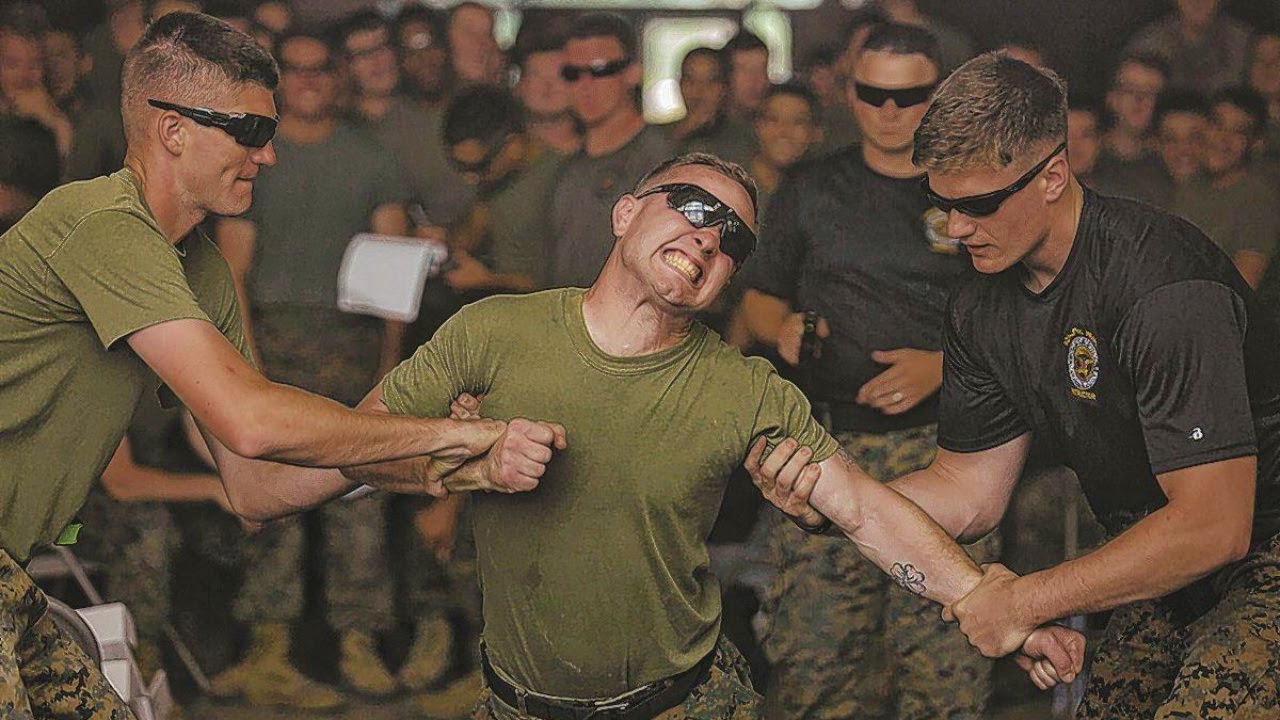
At Camp Foster on Okinawa, Japan, Marines with the Provost Marshal’s Office annually strap into a training few law enforcement jobs require: getting shot with their own weapon. On October 22, 2019, military police and corrections Marines from Headquarters and Support Battalion, Marine Corps Installations Pacific, ran through Human Electro-muscular Incapacitation training — the Corps’ formal name for Taser certification — and several volunteered to take a live hit from the X26E or X26P just to know what it does to a body.
- Marines in the 58XX military police and corrections field must recertify on conducted electrical weapons every year, since Taser instruction isn’t taught at the Fort Leonard Wood schoolhouse and instead falls to non-lethal weapons instructors at each duty station.
- Staff Sgt. Robert A. Votta ran the October 22 session, covering the nomenclature, history, and deployment of the X26E and X26P platforms before Marines sat a written exam and moved to live handling drills.
- Taking an actual shock is optional for certification, but volunteers who did were braced by fellow Marines and lowered onto padded mats as the barbed dart prongs delivered a jolt that knocked out neuromuscular control.
The Certification Marines Can’t Skip
Carrying a Taser on duty at Camp Foster isn’t a given just because a Marine wears the military police field’s 58XX designator. According to the training record from the event, initial schoolhouse instruction at Fort Leonard Wood, Missouri, doesn’t include Taser handling at all — that piece gets bolted on later by non-lethal weapons instructors once Marines report to their operational command. It’s a deliberate gap: the tool is treated as something to master locally, under supervision, and to requalify on every single year rather than something checked off once in a career.
Staff Sgt. Votta’s classroom block walked trainees through the mechanics that make the X26E and X26P work — how the cartridge fires two barbed prongs that stay tethered to the weapon, and how the current that follows triggers involuntary muscle contractions strong enough to drop a resisting suspect instantly. After the lecture and a written test, Marines moved into practical reps: drawing from the holster, loading and unloading cartridges, aiming, and firing at stationary targets before anyone touched a live volunteer scenario.
Marines Volunteer For Electric Shock
Nobody has to take the shock to pass. That’s the detail that makes the volunteers’ choice notable — they stepped forward anyway, got a grip from fellow Marines on either side, and rode the incapacitation surge down onto a padded mat. Votta’s reasoning for encouraging it wasn’t about toughness for its own sake.
Understanding the physiological disruption helps MPs recognize why a suspect cannot immediately comply with verbal instructions during or right after deployment.
That’s the practical payoff: an MP who’s felt the loss of motor control firsthand reads a suspect’s post-shock confusion correctly instead of mistaking it for continued defiance. It’s the same “lead from the front” logic that runs through a lot of Marine training pipelines — the instructors and the volunteers experience the exact stress they’re asking junior Marines to manage on patrol, whether that’s special forces conditioning or a scout sniper’s field craft under pressure.
A Tool In The Force Continuum
Cpl. Cheyenne Kay Hiatt, a patrol supervisor with PMO, framed the qualification in plain operational terms: finishing the course hands patrol officers a non-lethal option that sits between verbal commands and lethal force. That’s the actual point of the annual recert — not proving Marines can take a hit, but making sure the ones carrying a conducted electrical weapon at Camp Foster understand exactly what it does before they ever have to point it at someone in the field. Cpl. Kayla V. Staten, a combat correspondent with Marine Corps Installations Pacific, documented the October 22 session for the Corps’ public record.
The X26E and X26P aren’t new to law enforcement anywhere, but the annual requirement at Camp Foster means this isn’t a box checked once and forgotten — every MP on that patrol roster went through the same holster draws, the same written test, and for the volunteers, the same jolt, on the same October afternoon, and they’ll be back doing it again next fall.







Inside a $9.75M NYC Townhouse with a Prohibition Era Tunnel
The Mars Homes That NASA Awarded $500k
HOW MUCH $$$ DOES WRAP COST? | The REAL STORY Shops Might Not Tell You!
How To Build A Deck // DIY Home Improvement
10 Summer Style Essentials All Men Need