

 InfoSearched
Mexico didn’t invent the cocaine trade — it inherited it, and then perfected it.
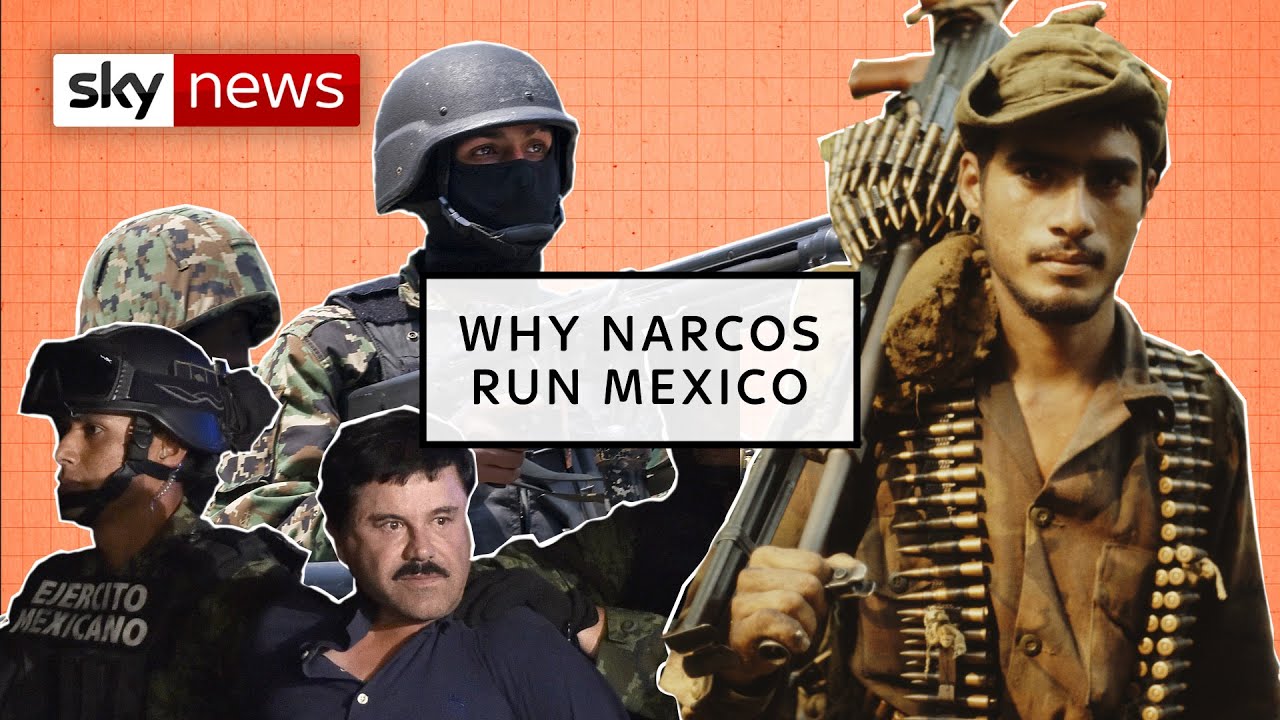
The Sky News explainer “How did Narcos take control of Mexico?” traces how a country once known mainly for marijuana and heroin became the command center for the largest, most violent narcotics pipeline on earth. The shift didn’t happen overnight — it took a U.S. crackdown, a redrawn smuggling map, and four decades of consolidation to get there. Along the way, cartels built armies, bought off entire security agencies, and outlasted the Colombian syndicates that once controlled the trade.
- U.S. crackdowns on Caribbean and South Florida smuggling routes in the 1980s forced Colombian cocaine traffickers to route shipments overland through Mexico, handled first by the Guadalajara Cartel.
- The Guadalajara Cartel’s fragmentation gave rise to the Sinaloa Cartel — led by Joaquín “El Chapo” Guzmán — alongside rivals including the Tijuana, Juárez, Gulf, and Jalisco New Generation (CJNG) cartels.
- Felipe Calderón’s militarized drug war, launched in December 2006, splintered the established cartels and triggered a violent escalation that produced tens of thousands of homicides and widespread disappearances across Mexico.
The Pipeline Shifted Northward
For most of the 20th century, Mexican trafficking organizations were secondary players — regional operators moving homegrown marijuana and heroin, while Colombian cartels ran cocaine through the Caribbean and into South Florida. That changed once U.S. law enforcement shut down those sea corridors in the 1980s. Colombian traffickers needed a new way north, and they found it overland, through Mexico, working with early syndicates like the Guadalajara Cartel to move product across the border.
That arrangement rewired the entire hemisphere’s drug trade. Mexican groups stopped being couriers taking a cut and started controlling the pipeline itself — the routes, the corridors, the border crossings. Once they held that leverage, there was no going back to being subcontractors.
The Demand That Never Stopped
None of this scales without a buyer, and the United States remains the world’s largest consumer of illicit narcotics. That demand is the economic engine behind everything the cartels built — the smuggling infrastructure, the corruption networks, the paramilitary wings. Over roughly four decades, Mexican organizations extended their grip over every link in the chain, from cultivation and production to transport and street-level distribution, eventually eclipsing the Colombian cartels that had once been in charge.
That same demand dynamic runs through the broader trafficking economy covered in How Mexican Drug Cartels Make Billions, and it’s the throughline connecting Mexico’s cartels to the maritime smuggling operations detailed in Watch the Coast Guard Capture Another Narco Sub With $69 Million in Cocaine.
Corruption, Alliances and Armed Muscle
Cartels didn’t just outgun the state — they infiltrated it. Systemic corruption and historical alliances with political and security structures, including Mexico’s now-defunct Federal Security Directorate (DFS), gave traffickers cover at the highest levels. To protect smuggling territory from rivals, cartels stood up their own paramilitary forces, turning trafficking disputes into open warfare over plazas — the local term for the corridors and crossings worth fighting over.
Mexico’s cartels didn’t just move drugs north — they built the corruption networks and private armies needed to guard the route, and then went to war over it.
Out of the Guadalajara Cartel’s collapse came the modern landscape: the Sinaloa Cartel under Joaquín “El Chapo” Guzmán, and competitors including the Tijuana, Juárez, Gulf, and Jalisco New Generation (CJNG) cartels — each fighting to control its own share of the routes into the U.S.
Calderón’s War and the Fallout
The turning point came in December 2006, when then-President Felipe Calderón launched a militarized offensive against the cartels. Rather than pacifying the trade, the crackdown fractured the established organizations into smaller, more violent factions, each fighting to fill the vacuum. The result was an escalation that produced tens of thousands of homicides, widespread disappearances, and deep political destabilization across Mexico — a toll that continues to shape the country’s security situation today.
El Chapo’s eventual capture and extradition didn’t end the Sinaloa Cartel’s reach, and CJNG’s rapid rise since has only added another heavily armed faction to a map already crowded with rivals fighting over the same border corridors that Colombian traffickers first handed off in the 1980s.








Compilation of Best Hydro Dipping Videos
CLEAREST WATER EVER | Catch And Cook
Kayak Urban Stealth Camping On The River
Exploring The Most Beautiful Place on Earth
Why people are choosing to quit social media