

 InfoSearched
Alex Honnold trades granite for glass, steel, and rooftops in a five-minute film that reveals his playful side.
Released in June 2014, Stride Health’s “Urban Ascents” pulls the world’s most famous free-solo climber off the rock face and drops him into San Francisco. The 5:41 short follows Honnold from the tide pools of Stinson Beach into the heart of the city, where he treats steel sculptures, historic columns, and office buildings like just another route. It’s a promotional film for a healthcare startup, but it doubles as one of the more revealing looks at how Honnold actually thinks about risk.
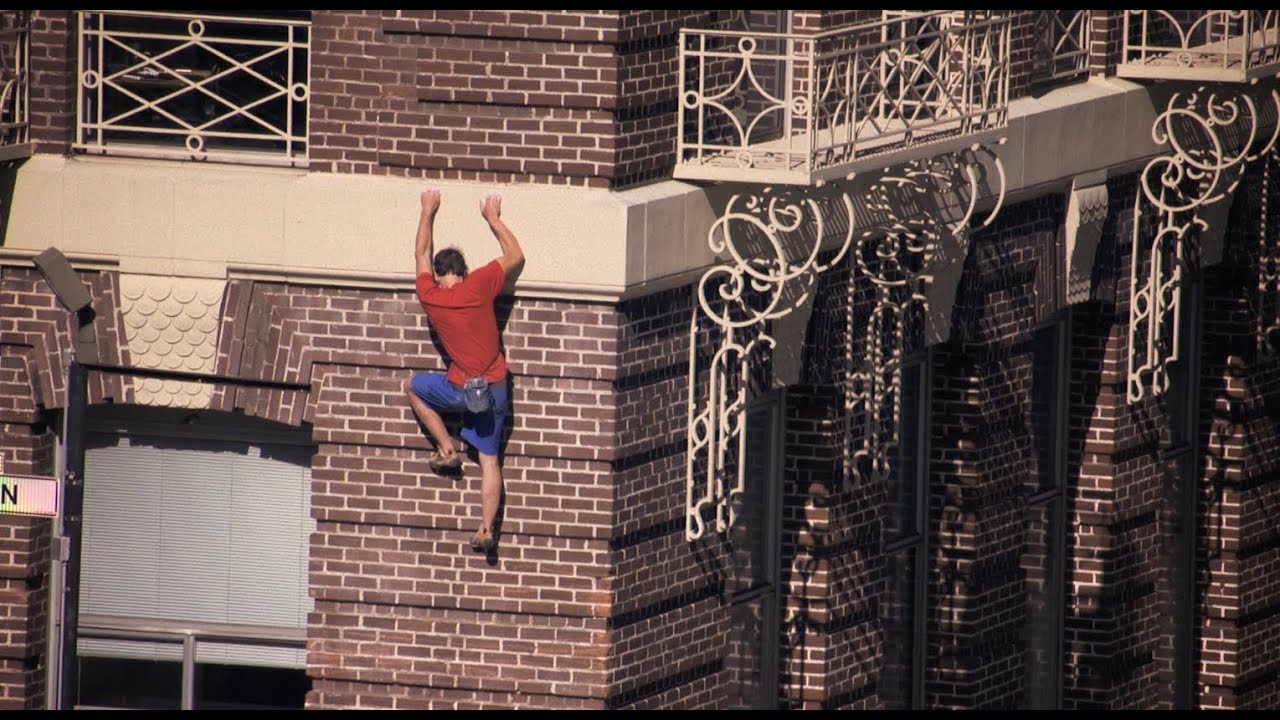
- Honnold’s route runs from bouldering at Stinson Beach in Marin County to Mark di Suvero’s steel sculptures at Crissy Field, the columns of the Palace of Fine Arts, and finally the exterior of the Goodby, Silverstein & Partners building in the Financial District, beneath the Transamerica Pyramid.
- The film was coordinated by Stride Health CEO Noah Lang to promote health coverage for self-employed workers, framing Honnold’s risk management as a metaphor for the company’s pitch.
- Honnold contrasts his comfort on natural rock with the novelty of “buildering,” calling the man-made ascents more of an adventure precisely because he lacks the repetition he has on stone.
From Stinson Beach to the Skyline
The film opens where Honnold is most at home: scrambling along the coastal boulders of Stinson Beach, moving with the same economy of motion that’s defined his climbing since he started free soloing without ropes. That familiarity is the point of contrast the rest of the short is built on. Once the crew moves into San Francisco proper, the terrain changes from something Honnold has spent two decades reading to something he’s essentially improvising on the spot.
Di Suvero’s massive steel sculptures at Crissy Field give Honnold his first urban test — angular, industrial shapes with none of the texture or predictability of granite. From there he works his way to the Palace of Fine Arts, chimneying up the neoclassical columns of the Beaux-Arts landmark, using the same technique climbers apply to rock chimneys, just against fluted plaster instead of stone.
The Financial District Finish
The ascents build to their most dramatic setting: the Financial District, directly beneath the Transamerica Pyramid, where Honnold climbs the exterior of the Goodby, Silverstein & Partners building. It’s the most exposed, most obviously “urban” sequence in the film — glass, steel, and right angles standing in for the cracks and edges he’d normally be reading on a cliff face.
Throughout, Honnold narrates his own risk calculus in a way that separates this film from typical climbing footage. His comparison between rock and buildings gets at something climbers rarely explain out loud: familiarity isn’t just about safety, it’s about how much of the climbing becomes routine versus how much stays genuinely uncertain.
“I spend so much more time on rock where it’s so natural to me, whereas with buildings it’s much more of an adventure… I don’t have that much experience climbing up buildings, so it’s more exciting.”
Risk, Conditioning, and the Stride Health Pitch
Stride Health built “Urban Ascents” around a straightforward idea: self-employed people manage their own risk every day, the same way Honnold does on a wall. The film, backed by a 30-second teaser campaign, uses his more than 18 years of physical conditioning and mental preparation as the visual proof that calculated risk isn’t the same as recklessness — a case the company was making directly to freelancers and contractors shopping for health coverage on their own. It’s an unusual pairing of subject and sponsor, but it works because Honnold’s own words do the explaining rather than a voiceover selling the product.
Anyone drawn to the mechanics of what Honnold’s doing on that GS&P facade will find the same principles — reading terrain, managing exposure, trusting technique over gear — on display in the wilder compilation reel over at CLIMBING GONE WRONG fails, which shows what it looks like when that risk math goes the other way. The conditioning side of Honnold’s approach also lines up with the kind of unconventional training methods covered in Laird Hamilton’s Revolutionary Pool Workout, another athlete whose entire discipline runs on preparing the body for controlled danger.
A Different Kind of Honnold Footage
What sets “Urban Ascents” apart from the documentaries that made Honnold a household name is the tone. This isn’t a life-or-death free solo with a film crew holding its breath — it’s Honnold having fun on architecture, openly admitting the buildings excite him precisely because he hasn’t mapped them the way he’s mapped El Capitan or Half Dome over 18-plus years of climbing. That lighter register is rare in his filmography, and it’s a big part of why the short still gets passed around years after Stride Health first put it out.


Pablo Escobar’s hippos keep multiplying and Colombia doesn’t know how to stop it
Impossible Climb In Dirt Bike Graveyard
Jim Norton and Joe Rogan Debate Bob Lazar’s Story
8 Fall FASHION TRENDS To Actually Wear in 2019!
Eric Maundu’s home-aquaponics can grow veggies & fish anywhere