

 InfoSearched
Every wine cork has spent nine years waiting on a tree in Portugal before it ever met a bottle.
Great Big Story’s short documentary “This Is Where Your Wine Corks Come From” follows the harvesters who strip bark from cork oak trees across the Iberian Peninsula, a trade that hasn’t changed much since it started centuries ago. The work is done entirely by hand, with axes instead of machines, on trees that can live for two centuries. It’s a slow, patient industry hiding behind something as small and disposable as the stopper you toss aside after opening a bottle of red.
- Portugal and the broader Iberian Peninsula supply roughly half of the world’s commercial cork.
- Harvesters work in teams of two with curved axes, making precise cuts to peel bark without damaging the tree’s cambium and phloem layers underneath.
- A cork oak can’t be harvested until it’s about 25 years old, needs another 30 to 40 years before its bark is fine enough for premium wine stoppers, and once mature is only harvested once every nine years.
The Two-Person Job of Peeling a Tree Alive
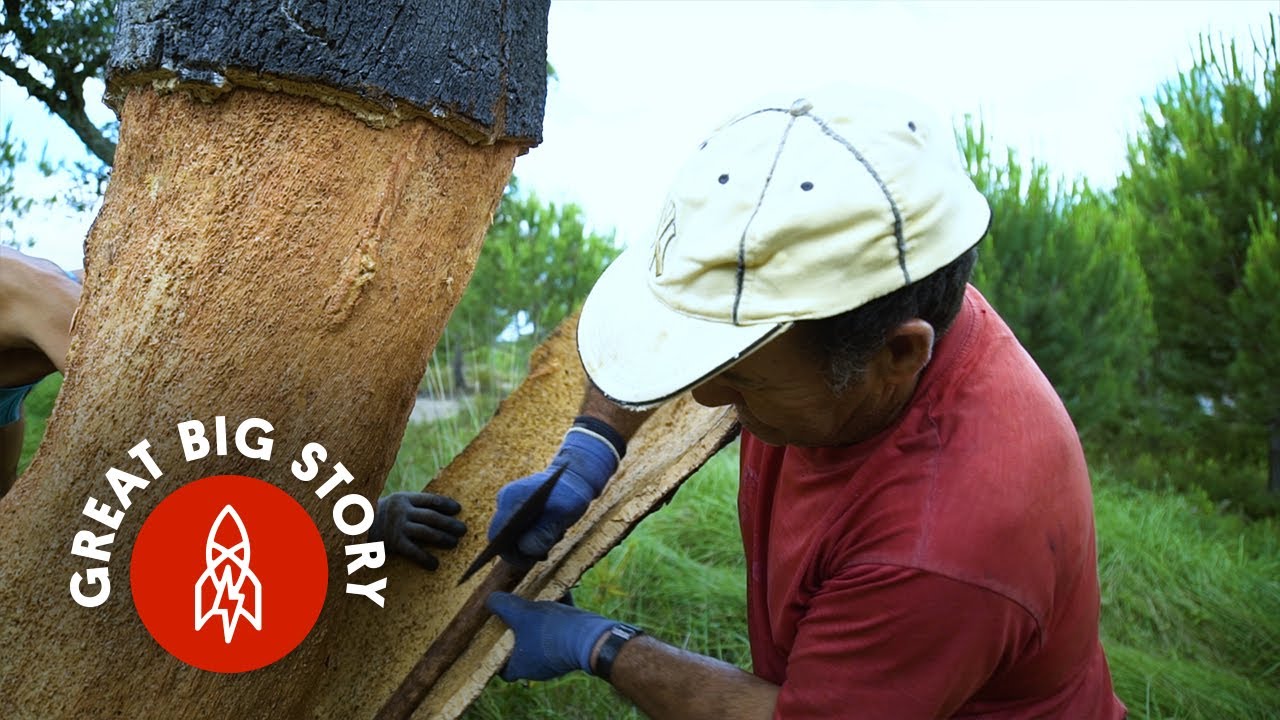
The harvesters in the video work in pairs, a system passed down through families for generations. Using a specialized curved axe, one makes vertical and horizontal cuts along the trunk while the axe head doubles as a wedge, prying loose massive planks of bark in single pieces. The margin for error is thin — cut too deep and the tree’s cambium and phloem layers are damaged, cutting off the sap flow that lets the bark regrow at all. Done correctly, the tree stands there stripped bare and keeps living like nothing happened.
Quercus suber, the cork oak, can survive 150 to 200 years, and a single tree might get harvested a dozen or more times across its lifespan. That’s a wildly different relationship to a resource than clear-cutting a forest for lumber — the tree stays rooted, the same crew or their descendants come back nine years later, and the bark simply grows again.
Justification for the Nine Year Timeline
Timing is everything in this trade. A cork oak isn’t touched until it hits roughly 25 years old, and even then the first stripping — called virgin cork — comes out coarse and irregular, good for flooring or insulation but not for sealing a bottle of Douro red. It takes 30 to 40 years of repeated harvests before the bark grows in fine and even enough to be punched into a proper wine stopper.
Once a tree reaches that quality, harvesters still can’t touch it more than once every nine years — that’s how long it takes the bark to regrow to the correct thickness. To keep track, workers paint a single white digit directly onto the bare trunk after each harvest, representing the last number of that year. An “8” means 2018, and it’s a signal to every harvester who passes that tree for the next nine years: leave it alone.
A single white numeral painted on a stripped trunk is the only paperwork this harvest needs — the last digit of the year, and a promise not to come back for nine more.
From Bark to Bottle
Once stripped, the cork planks are left to dry and cure before making the trip to regional processing plants and larger factories near Porto, companies like Amorim among them. The highest-grade planks get hand- or machine-punched into the natural solid stoppers that end up in wine bottles. Everything else — the thinner bark, the offcuts that can’t be punched cleanly — gets ground into granules and pressed into technical composite corks, flooring, insulation, and other consumer goods. Almost nothing from the harvest goes to waste; it just gets sorted by grade.
It’s a similar story to other slow-grown specialty crops that only make sense once you see the labor behind them — the same way cashew nuts carry a hidden processing cost most shoppers never think about, or how an ancient fermented beverage can quietly outlast entire industries built around it.
Next time a cork pops loose from a bottle, that little cylinder has already been through a 30-to-40-year apprenticeship before it ever touched glass — and somewhere in Portugal, there’s a tree with a fresh white number painted on its trunk, waiting out another nine years before anyone comes near it again.









I Built My House By Myself – 3 Year Timelapse – Off Grid – Debt Free
One Homestead Day – Day In The Life On Our Small Farm
Ginger Spice Tells the Story Behind Her Union Jack Dress
Why Do Hyenas Laugh?
Building New York’s $200M Apartment