

 InfoSearched
A family in Rotterdam spent three years testing whether a house wrapped in glass could feed itself.
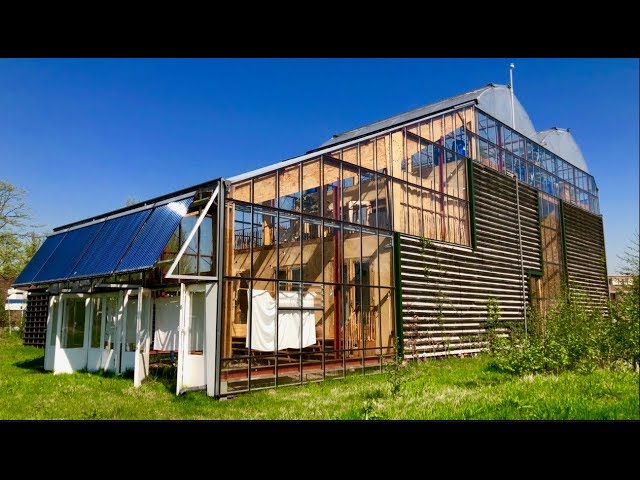
When Helly Scholten heard that a research team needed volunteers to live inside an experimental greenhouse home on the docklands of Rotterdam, she didn’t hesitate. The botanical stylist, her partner Mark de Leeuw, and her two teenage daughters moved into the structure — known as the CHIBB House, part of the Concept House Village project — and started planting the four greenhouse zones wrapped around and on top of their living quarters almost immediately.
- Students at Rotterdam University of Applied Sciences, led by architect and research professor Arjan Karssenberg, designed and built the greenhouse home from recycled and recyclable materials on stilts so it could be dismantled or relocated once the trial ended.
- Scholten’s family lived in the home for a three-year residency, growing food across four greenhouse zones and collecting rainwater in rooftop tanks to irrigate the crops.
- Interior walls were coated in unfired loam stucco that stores daytime heat and releases it at night — plaster designed to wash away with a garden hose when the structure comes down.
Living Inside the Experiment
The CHIBB House was never meant to be permanent. Karssenberg’s students built it on stilts using materials chosen specifically because they could be taken apart again, turning the whole structure into a reversible experiment rather than a fixed building. Scholten’s family agreed to live inside it for three years so researchers could see whether an ordinary household could actually grow a meaningful share of its own food under glass in a Dutch climate.
That meant tending four separate greenhouse zones — some surrounding the living space, some sitting on top of it — and trying to keep them productive year-round. An exterior wall covered in vegetation did double duty, softening indoor temperature swings while giving local bees a habitat right against the building. For a family living in a dense harbor district, it was urban self-sufficiency tested in real time, not on paper.
Heat, Water and Loam
Keeping the place livable without cranking a furnace or an air conditioner came down to two low-tech systems. Rainwater collected in rooftop storage tanks handled irrigation for the gardens, cutting the household’s dependence on mains water for anything green. Inside, the walls were finished in loam stucco that behaves like thermal mass: it soaks up radiant heat from the greenhouse glass during the day and gives it back once temperatures drop in the evening.
The unfired loam plaster was built to dissolve with nothing more than a hose — designed from day one to disappear as easily as the house itself.
That disposability was the point. Because the CHIBB House was always going to be evaluated and eventually torn down or relocated, every material — from the loam on the walls to the recycled framing on stilts — had to come apart cleanly rather than end up as demolition waste.
Scholten Reflects On Three Years
Scholten came away from the residency genuinely fond of the light-filled, plant-covered life the greenhouse gave her family, but she’s blunt about what she’d change in a second version. Greenhouses stacked above ground level, she found, run dangerously hot because they lose the earth beneath them as a natural heat sink — a problem the ground-floor zones never had. She’d also add a natural protective sealant over the interior loam stucco next time, since parts of the untreated walls broke down under the ordinary wear of daily living, well before the planned teardown.
Those are the kinds of lessons that only show up after living somewhere for years rather than touring it for an afternoon, and they’re exactly why Karssenberg’s team built the CHIBB House as a lived-in experiment rather than a showpiece. Anyone drawing up the next version of a self-sufficient glass house — whether it’s a self-built off-grid home or a family trying to turn their own yard into a working vegetable garden — now has Scholten’s ground-floor rule and her note on sealing the loam to work from.
The CHIBB House was always built to come down eventually, hose and all. What Scholten’s family proved first is that four greenhouses stitched around a stilt house in a Rotterdam dockyard can actually keep a family in vegetables for three straight years — heat problems on the upper level and all.








Drinking Vodka In A Soviet Apartment…What Could Go Wrong?!
Maui’s HALO Wingsuit
Money-Laundering FBI Expert Rates 8 Money-Laundering Scams In Movies and TV | How Real Is It?
World-class sinkholes attract divers to South Australian farms
Alaskan 12×16 Shed Tiny House – Living In Style On A Budget