

 InfoSearched
Living Big In A Tiny House takes its own advice, trading a rental lease for a canvas roof and a wood stove.
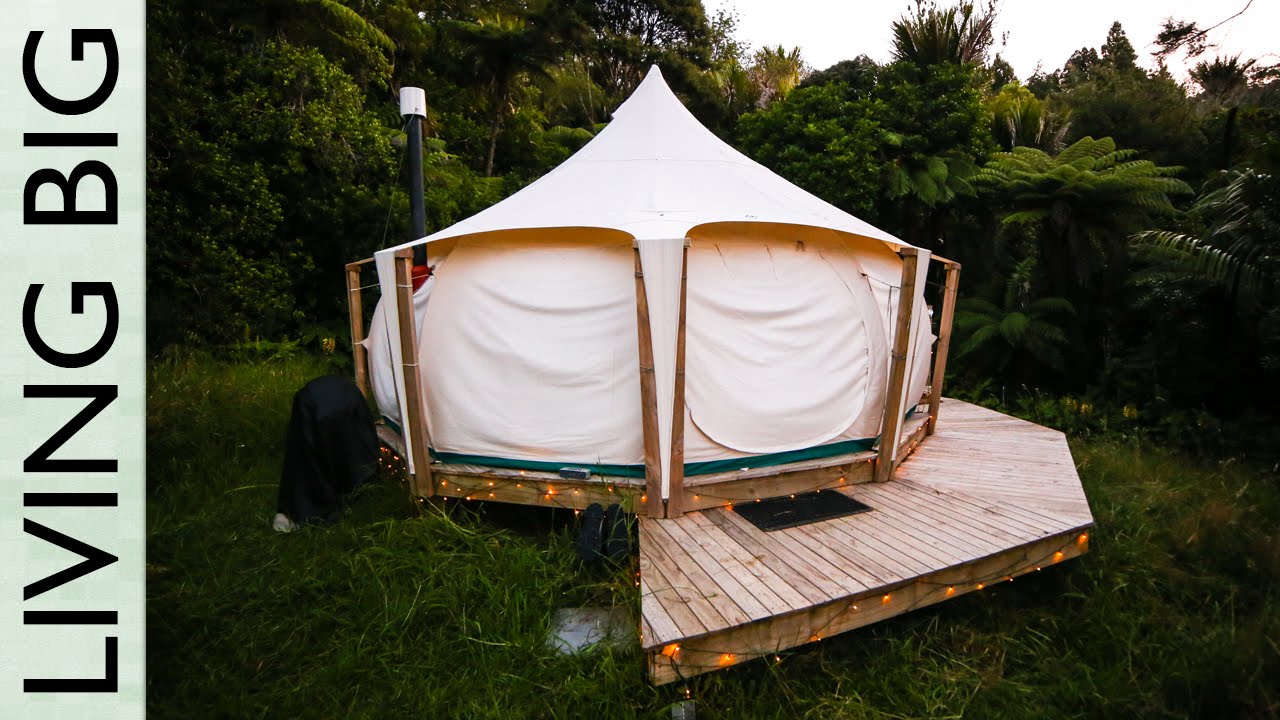
In September 2015, host and creator Bryce Langston packed up his belongings in New Zealand and moved into a Lotus Belle Outback tent pitched on a custom-built deck. It wasn’t a stunt for the cameras — the 16-foot canvas structure became his actual full-time residence while he built his own tiny house on wheels nearby. The move cut his living costs, freed up cash for the build, and put him within easy reach of the construction site.
- Langston moved into a 5-meter (16-foot) diameter Lotus Belle Outback tent in September 2015 specifically to escape the “rent trap” and fund his tiny house build.
- The setup ran fully off-grid on a 150-watt solar system, hot and cold running water, a 25-liter Waeco Coolfreeze fridge, and an Anevay Traveller Stove for heat and cooking.
- A detached tiki-hut-style bathroom — built from a neighbor’s bamboo and a recycled patio umbrella — sat across a rope bridge from the deck.
Langston Selects Canvas Over Lease
Langston built his reputation on Living Big In A Tiny House, the web series that tours downsized homes across New Zealand and beyond. When it came time to build his own tiny house, he faced the same problem as the people he’d been filming for years: rent was eating the budget he needed for materials and labor. Rather than keep paying a landlord while he saved, he decided to live in the cheapest, most flexible shelter that could still function as a real home — a Lotus Belle tent.
The location mattered as much as the cost savings. Pitching the tent close to his build site meant Langston could work on the tiny house daily without a commute eating into his schedule. It’s the same logic that shows up across the DIY housing world documented in projects like We Built Our Dream Home, FROM A KIT! — get cheap, get close, get building.
The Platform and the Canvas
The tent itself sat on a custom decagon-shaped wooden platform with a cantilevered deck, giving the round structure a stable, level base despite its unconventional footprint. Lotus Belle’s Outback model is built from 350gsm heavy-duty canvas, the same weight-class fabric used in expedition-grade shelters, with a kayak-grade groundsheet forming the floor. That combination gave Langston a structure durable enough for genuine four-season living rather than a weekend camping setup.
A 4-kilowatt wood burner and a thermoelectric fan turned a canvas tent into a heated home through a New Zealand winter.
Power, Water and Heat Off the Grid
Inside, Langston ran a 150-watt solar power system to keep the place electrified without a grid connection, supplying hot and cold running water and powering a 25-liter Waeco Coolfreeze refrigerator for food storage. Heating and cooking both came from an Anevay “Traveller Stove,” a compact 4-kilowatt wood burner paired with a thermoelectric fan that circulated warm air through the tent rather than letting heat pool near the flue. For anyone weighing similar setups, the same wood-heat logic shows up in builds featured in TIMELAPSE 5min. Metal House | Costs, Pros-Cons, The Container House Killer?, where off-grid heating and cost trade-offs get the same close look.
A Bathroom Reached by Rope Bridge
The most memorable detail of the build sat outside the main tent entirely. Langston constructed a detached, tiki-hut-style bathroom accessible only by a rope bridge extending off the deck. Its walls were bamboo cut from a neighbor’s property, and the roof was fashioned from a recycled patio umbrella. Inside, the little structure held a sink, a hot-water shower, and a composting toilet — a genuinely functional bathroom built almost entirely from salvaged and borrowed materials.
The whole arrangement — canvas tent, solar array, wood stove, rope-bridge bathroom — turned “escaping the rent trap” from a slogan into a working blueprint. Langston kept living in the Lotus Belle while the tiny house took shape a short walk away, proving the tent wasn’t a temporary compromise but a legitimate home for as long as the build required.






The Mysterious Animal Gangs Of Nigeria | Hyena Men
I Attempted the Air Force Special Warfare PAST Test (without practice)
This Is The NEW Koenigsegg Gemera – And I’ve ORDERED One! 1700hp & 4 Seats
Living In A Treehouse in Hawaii
15 RAREST and FREAKY Snakes