

 InfoSearched
A slug’s slime defense meets an enemy that simply digs through it.
Driver ants don’t chase anything. They don’t need to. In this clip from the BBC’s Natural World series, a marching column of African driver ants stumbles onto a slug moving across the forest floor, and what follows is a masterclass in insect teamwork over brute speed. Narrator Andrew Sachs sums up the slug’s problem in one line: it can’t outrun what’s coming for it.
- The footage comes from “Ant Attack,” a 2006 episode of the BBC’s Natural World documentary series, narrated by Andrew Sachs.
- The prey is a large terrestrial slug attacked by driver ants of the genus Dorylus, a group known for aggressive, coordinated foraging swarms.
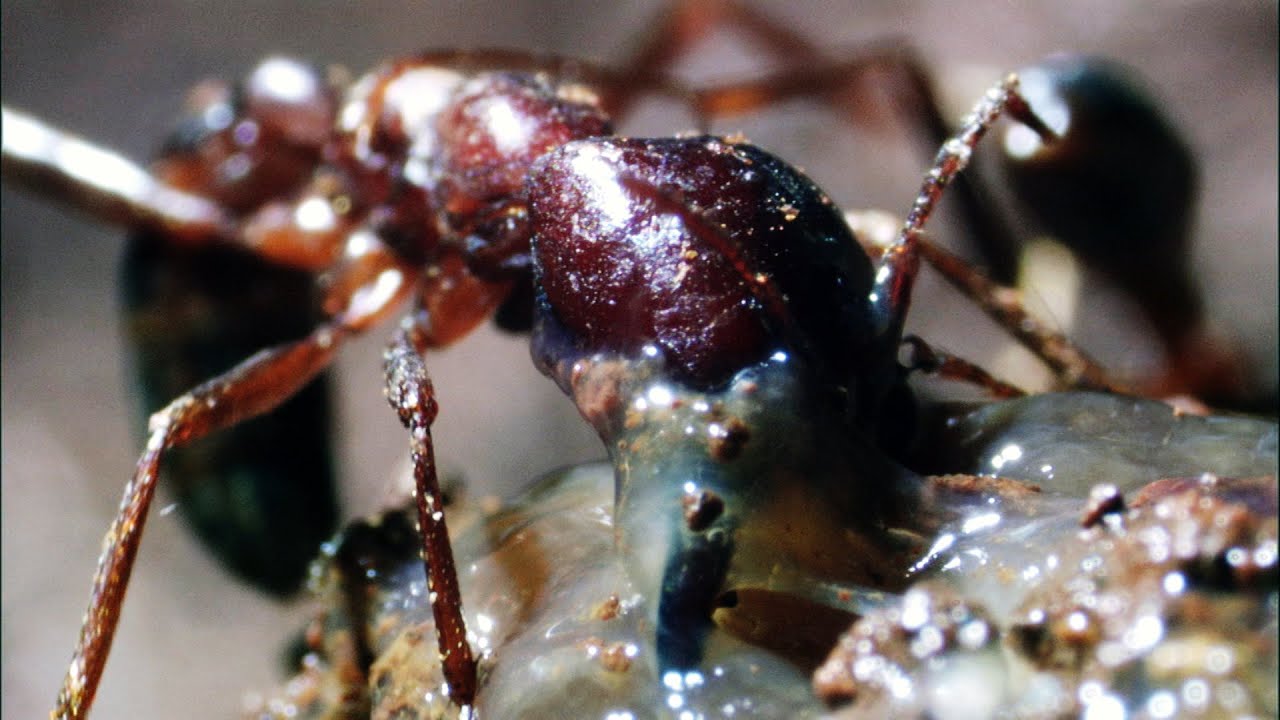
- The slug’s defense — a thick, slippery mucus coating — is neutralized when the ants pack soil and debris onto it, and the swarm then tears the slug apart with its mandibles.
Slugs Defenseless Against Driver Ant Swarms
Every other predator a slug encounters has to solve the same problem: get a grip on something engineered to be un-grippable. Slime coats the slug’s body specifically to make jaws, claws and beaks slide right off, and against a lone attacker that trick usually works. Sachs puts the slug’s real vulnerability plainly in the narration: “Slugs are fair game for driver ants. They don’t run away.” There’s no burrow to dive into, no shell to retreat behind, no speed to put distance between itself and the column crossing its path.
That immobility is the whole opening. Driver ants don’t need to outmaneuver prey; they need time, and a slug offers unlimited time. The colony’s foraging swarms can number in the hundreds of thousands, moving as a single search-and-destroy front across the forest floor, and anything too slow to clear out of the way becomes a target by default.
Turning the Slime Into a Liability
What makes the sequence remarkable is the ants’ countermeasure. Rather than trying to bite through a live layer of mucus, the swarm buries the slug in soil and forest debris, effectively caking over the slime barrier and robbing it of the slickness that would normally let the slug wriggle free of a grip. Once the defense is packed down and useless, the ants go to work with their mandibles, cutting into the flesh while the slug is still very much alive and pinned beneath the writhing mass covering it.
“Slugs are fair game for driver ants. They don’t run away.”
It’s a brutal but efficient division of labor: some ants hold and smother, others cut and feed, and the whole operation runs on chemical signaling rather than any single ant calling the shots. The same principle that lets driver ants overwhelm prey many times their individual size — sheer coordinated numbers — is what shows up across the animal kingdom whenever a group predator takes down something an individual couldn’t touch, the kind of mismatch covered in The Most Extreme Wild Animals Battles!.
Stripping the Carcass for the Colony
Once the mandibles get through, the slug doesn’t last long. The swarm strips the carcass down while it’s still buried under dirt and insects, and the meal ultimately goes back to feed the wider colony rather than the ants doing the biting. It’s the same collective-feeding logic that drives other insect swarms profiled in nature documentaries — a hunt where the individual insect barely matters and the colony’s hunger is the only thing being served, not unlike the coordinated group attacks detailed in Top 5 Ferocious Hornet Moments.
Sachs’ narration in “Ant Attack” frames driver ants as one of the forest floor’s more efficient clean-up crews, and this sequence is the clip that made that case to viewers when the episode aired on BBC’s Natural World back in 2006 — a slug that never had a chance the moment the column crossed its path.








How To Install Epoxy Floors In A 2000 sq ft Home | Step By step Explained
Can Cuttlefish camouflage in a living room?
How does luxury car lease hacking work?
Life On Enceladus | NASA’s Unexplained Files
Building a Cabin from Pallet Wood: Cheap Off Grid Homestead