

 InfoSearched
A carpenter spent four years building his own house — and then floated it on Kootenay Lake.
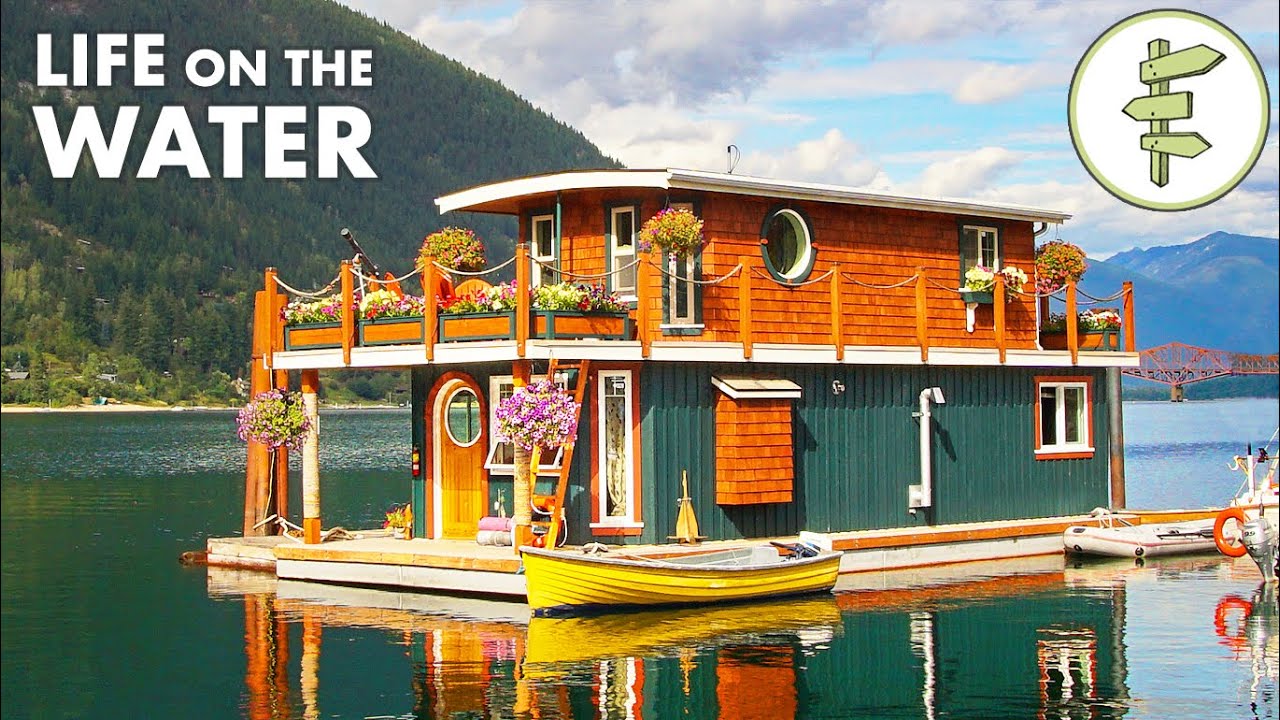
Jay Blackmore didn’t buy a houseboat. He built one, board by board, over four years of nights and weekends, and moved it into a marina slip in British Columbia rather than a subdivision. The result, featured by the YouTube channel Exploring Alternatives in May 2020, is a 700-square-foot, two-story floating home that runs entirely off-grid on Kootenay Lake.
- Blackmore designed and built the 700-square-foot, two-story floating home himself over four years, contracting out only the electrical and propane installations.
- The house runs off-grid on solar power, heats with a pellet stove backed up by a propane heater, and uses a closed-loop graywater evaporation system that sends zero waste into the lake.
- Moored at a marina within walking distance of town, the home requires every supply — heating pellets, groceries, propane tanks, garbage — to be hauled by hand across the docks, even in icy winter conditions.
Four Years, One Builder, No Shortcuts
Blackmore is a sailor and carpenter by trade, and it shows in the build. He handled essentially every stage of construction himself — framing, siding, interior finishing, plumbing for the lake-fed water system — and only brought in outside contractors for the electrical wiring and propane hookups. The work happened in whatever hours he could find between his job, raising his kids, and sailing his own boat, stretched across four years before the home was livable.
The project replaced a rural property Blackmore owned previously, which he’d come to see as too expensive, too much upkeep, and too far removed from town. The floating home solved all three problems at once: no lawn, no driveway to shovel, and a location he can walk from to reach shops and services.
Off-Grid on Kootenay Lake
The home is moored at a local marina on Kootenay Lake, close enough to his own docked sailboat that he can step from one to the other. Power comes entirely from a solar array, with no connection to the municipal grid. Heat for the region’s freezing winters comes primarily from a pellet stove, with a propane heater as backup and decorative gas lamps adding secondary warmth and light.
Freshwater is pumped straight out of the lake and run through a filtration system for drinking and household use. Sanitation runs through a composting toilet rather than a conventional septic hookup, and Blackmore engineered a closed-loop graywater evaporation system specifically so that sink and shower water never gets discharged into the lake — a detail he treats as central to the whole design, given how easily a floating home could otherwise pollute the water it sits on.
Inside the 700 Square Feet
The main floor is built around an open-concept kitchen, dining, and living area, with a bedroom and bathroom also on that level. Maritime details carry through the design — an arched interior doorway and a porthole window nod directly to Blackmore’s sailing background rather than standard residential styling. Two more bedrooms sit on the second floor, and exterior flower planters line the outside of the structure.
The top of the house is a wraparound deck delivering 360-degree views across the lake — the closest thing the home has to a yard, and arguably better than one.
Actual Living Costs for Residents
Blackmore is upfront that the lifestyle isn’t effortless. There’s no driveway to back a truck up to, so everything — bags of heating pellets, groceries, full propane tanks, bagged garbage — has to be carried by hand across the marina dock, including in the middle of winter when that dock is frozen over and the wind is up.
Every pellet bag, propane tank, and bag of garbage gets carried across the dock by hand — even when it’s iced over.
Privacy is the other tradeoff. Boaters and paddlers pass close by throughout the day, and there’s little separating the home’s living space from public water traffic. Blackmore’s framing for all of it comes down to mindset: he sees the hauling and the exposure as a fair price for ditching lawn mowing, snow shoveling, and a long drive into town.
A Different Kind of Off-Grid Build
Compared with land-based off-grid projects — the kind of solar cabin or workshop builds documented in Building an Off Grid Woodworking Workshop Log Cabin in the Forest — Blackmore’s project adds the extra engineering problem of keeping waste out of the water entirely, not just off the grid. It’s a challenge shared by other floating off-grid builds, like the setup shown in INCREDIBLE OFF-THE-GRID HOUSEBOAT (Coron, Philippines), where solar power and careful water management matter just as much as square footage.
Four years of solo carpentry got Blackmore a home with no mortgage-driven land, no lawn, and a 360-degree deck view he built with his own hands — and at some point this winter, he’ll be hauling another bag of pellets across an icy dock to keep the stove going.



INCREDIBLE OFF-THE-GRID HOUSEBOAT (Coron, Philippines)
Turning My ENTIRE Ceiling Into a Light Fixture
Building an Off Grid Woodworking Workshop Log Cabin in the Forest
How to Grow Potatoes in Buckets: Planting Techniques!
5 Basic Survival Skills Everyone Should Know