

 InfoSearched
A helicopter with no engine, just legs, arms, and a bet that the laws of aerodynamics could be out-pedaled.
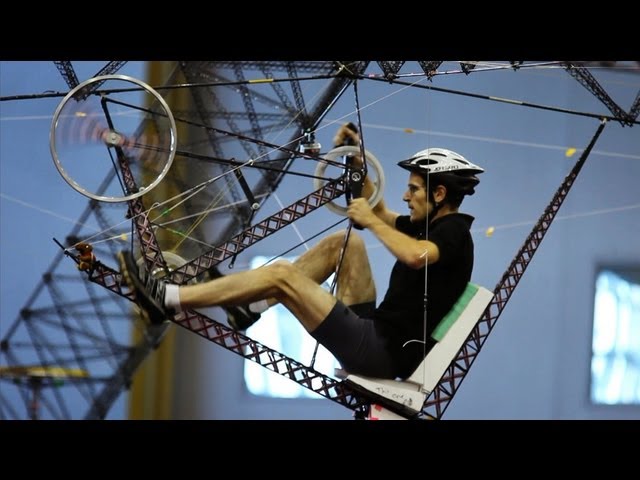
For three decades, the $250,000 Sikorsky Prize sat unclaimed, a standing dare to anyone who thought a human body could lift a helicopter off the ground under its own power. NPR’s Skunk Bear followed the University of Maryland’s Clark School of Engineering as its students built Gamera, a spindly, four-rotor contraption designed to do exactly that. The video traces the trade-offs — weight versus strength, pilot power versus airframe drag — that define one of the strangest engineering competitions in aviation history.
- The Igor I. Sikorsky Human Powered Helicopter Competition, established by the American Helicopter Society in 1980, required a craft to hover 60 seconds, hit 3 meters (9.8 feet) of altitude, and stay inside a 10-meter square.
- Gamera’s X-shaped frame spans roughly 100 feet and carries four 42-foot rotors, yet the empty structure — built from carbon fiber, balsa, foam, and mylar — weighed under 100 pounds.
- Piloted by biology graduate student Judy Wexler, Gamera I set a women’s endurance record with an 11.4-second hover in May 2011; later versions pushed that to a 65.1-second flight and an 8-foot altitude mark by August 2012, before AeroVelo’s Atlas finally claimed the full prize in June 2013.
The Sikorsky Prize’s Impossible Math
The American Helicopter Society put up the Sikorsky Prize in 1980 figuring nobody would win it soon — and nobody did, for 33 years. The rules sound modest on paper: hover for 60 seconds, climb to 3 meters, don’t drift outside a 10-meter box. In practice, they demanded a machine that could stay aloft on the output of a pilot pedaling at roughly 0.5 to 0.7 horsepower, a fraction of what a small motor produces without even trying. Rotors big enough to generate lift at that power level have to be enormous and nearly weightless, which is its own contradiction — bigger structures usually mean more weight, not less.
Building Gamera Under Faculty Advisors Pines, Chopra, and Nagaraj
At the Alfred Gessow Rotorcraft Center, faculty advisors Darryll Pines, Inderjit Chopra, and V.T. Nagaraj oversaw a team of more than 50 undergraduate and graduate students who designed Gamera around a massive X-shaped truss frame stretching about 100 feet across. Four slow-turning, 42-foot-diameter rotors sat at the corners of the frame, with the cockpit suspended dead center so the pilot could drive all four at once. The team leaned on carbon fiber, balsa wood, foam, and mylar to keep the empty airframe under 100 pounds — light enough that a person’s legs and arms, working together, had a real shot at lifting it.
That hand-and-foot pedaling setup separated Gamera from earlier human-powered aircraft, which relied on legs alone. By recruiting the arms and back into the power stroke, the Maryland team squeezed more usable wattage out of a single pilot without adding a second body’s worth of weight to the frame — the same instinct that shows up in other lightweight personal-flight projects like the Jetson One, where every extra pound has to justify itself against the power source.
Judy Wexler’s Record Flights
Gamera I flew for the first time in May 2011 with biology graduate student Judy Wexler pedaling, and the craft immediately put a women’s world endurance record on the board, including an 11.4-second hover. It wasn’t the Sikorsky Prize — not close, on altitude or duration — but it proved the concept could get real air under real rotors with a real person supplying the only power source.
An empty frame under 100 pounds, four 42-foot rotors, and one pilot’s legs and arms — that was the entire powerplant.
Gamera II, IIXR, and the Chase for the Full Prize
The team didn’t stop at Gamera I. Gamera II and the refined Gamera IIXR shed weight from the original design, and the records kept climbing: a national duration mark of 49.9 seconds in June 2012, then a 65.1-second flight paired with an 8-foot altitude record in August 2012. Maryland had the endurance piece nearly solved and was closing in on the altitude requirement, but stacking all three Sikorsky conditions — 60 seconds, 3 meters, inside the 10-meter box — into a single flight proved to be the harder problem.
That final combination went to AeroVelo’s Atlas, built by a University of Toronto team, which fulfilled every Sikorsky criterion in June 2013 and finally claimed the prize that had sat open since 1980.
Gamera never got its own Sikorsky flight, but it left Maryland with the pieces AeroVelo needed to see how close the margins actually were — a 65-second hover, an 8-foot ceiling, and a frame lighter than a mid-size dog. Atlas beat the clock by a few years and a few feet; Gamera is the reason anyone knew how close those numbers really were.






Former Jewel Thief Reviews GTA V Jewel Heist
My FIRST Solo Flight in a Cessna 172! | ATC Audio
19 Savvy Hacks to Make You Extra Resourceful!
Catch and Cook BATRAY! Delicious Recipe!!
Single Mother Builds Scandinavian Inspired Tiny House To Escape