

 InfoSearched
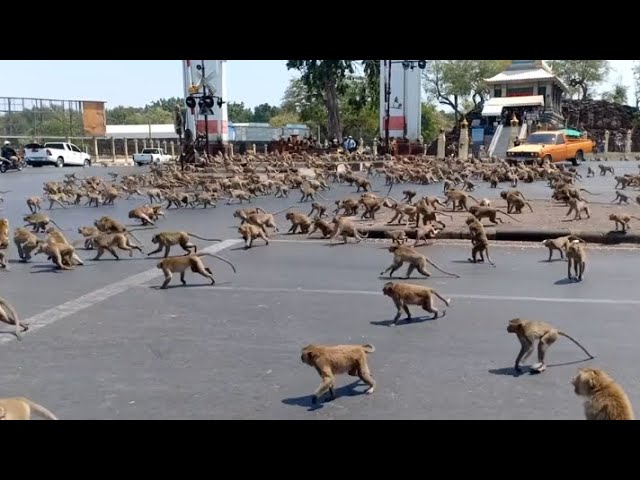
Hundreds of hungry macaques turned a Thai street into a battleground over a single banana.
Viral footage out of Lopburi, the ancient central Thai city famous for its resident monkey population, shows a street brawl that looks less like a wildlife curiosity and more like a riot. Hundreds of crab-eating macaques swarmed a road and public square, halting traffic for roughly 10 minutes as they tore into each other over one piece of food. The clip was filmed outside a shop by local resident Sasaluk Rattanachai around 11:00 a.m., and it quickly spread as a visceral snapshot of what happens when tourism disappears overnight.
- Hundreds of macaques clashed in the street for about 10 minutes over what was widely reported as a single banana or tub of yogurt.
- The fight was a turf war between Lopburi’s two rival monkey factions: temple macaques from the Phra Prang Sam Yod complex and city macaques based around Phra Kan Shrine and the local markets.
- The collapse of international tourism from the COVID-19 outbreak cut off the fruit and snack handouts the monkeys normally depend on, driving them into rival territory and unusually aggressive fights.
A Turf War Decades in the Making
Lopburi’s monkey population has long been split into two camps that mostly keep to their own patches. The temple macaques cluster around the Khmer-era Phra Prang Sam Yod ruins, while the city macaques hold the streets and markets surrounding the Phra Kan Shrine downtown. Biew Um-in, a local motorcycle taxi driver, said the trouble started when temple macaques crossed into urban market territory hunting for food, provoking a clash that dwarfed the usual pecking-order scuffles.
Skirmishes between small groups of five to 10 monkeys are apparently routine in Lopburi. What made this one different was scale — hundreds of animals converging at once, fighting hard enough to stop street traffic dead for 10 minutes over scraps that would normally barely register.
Tourism Dries Up, Tempers Boil Over
The underlying cause traces straight back to the sudden halt in visitors triggered by the global coronavirus outbreak. Lopburi’s macaques have effectively been subsidized for years by tourists and tour groups tossing fruit and snacks, a steady food supply that kept the peace between rival troops. With markets quiet and tour buses gone, that supply chain collapsed almost overnight, and the monkeys went looking for it themselves.
They looked more like wild dogs than monkeys. They went crazy for a single piece of food. I’ve never seen them this aggressive.
That’s how Rattanachai described what she filmed — a description that lines up with what wildlife-adjacent footage tends to show when an animal population’s food source disappears without warning. It’s the same dynamic that turns otherwise skittish creatures desperate, whether it’s mice overrunning Australian farmland or macaques storming a Thai market square.
A City Built Around Its Monkeys
Lopburi has marketed its macaque population as a tourist draw for years, complete with an annual monkey buffet festival meant to keep the animals fed and photogenic for visitors. That arrangement only works as long as the money and the fruit keep flowing in from outside. Take away the tourists, and the city is left managing an animal population that had grown dependent on handouts rather than foraging — a dependency that turned into a liability the moment flights stopped landing and shop shutters stayed down.
For a deeper look at how quickly animal behavior shifts when the usual food sources vanish, it’s worth comparing this to other extreme wild animal confrontations driven by scarcity rather than instinct alone.
Ten minutes of traffic-stopping chaos over a banana, and the fight was over as fast as it started — the monkeys scattered once the food was gone, back to their respective turf until the next scrap. Lopburi’s shopkeepers, for now, are the ones left sweeping up the mess and bracing for round two.





The Craziest Dictator You’ve Never Heard of | Jean-Bédel Bokassa
100 Years of Controversial Fashion | Glamour
What If A Nuclear Bomb Was Detonated In The Marianas Trench? (Science not Fantasy)
What an Affordable Luxury Mansion in Los Angeles looks like!
Inside The US Government’s Top-Secret Bioweapons Lab