

 InfoSearched
Eighteen inches of clearance, 400-plus mph, and zero room for error — that’s a Tuesday for the Blue Angels.
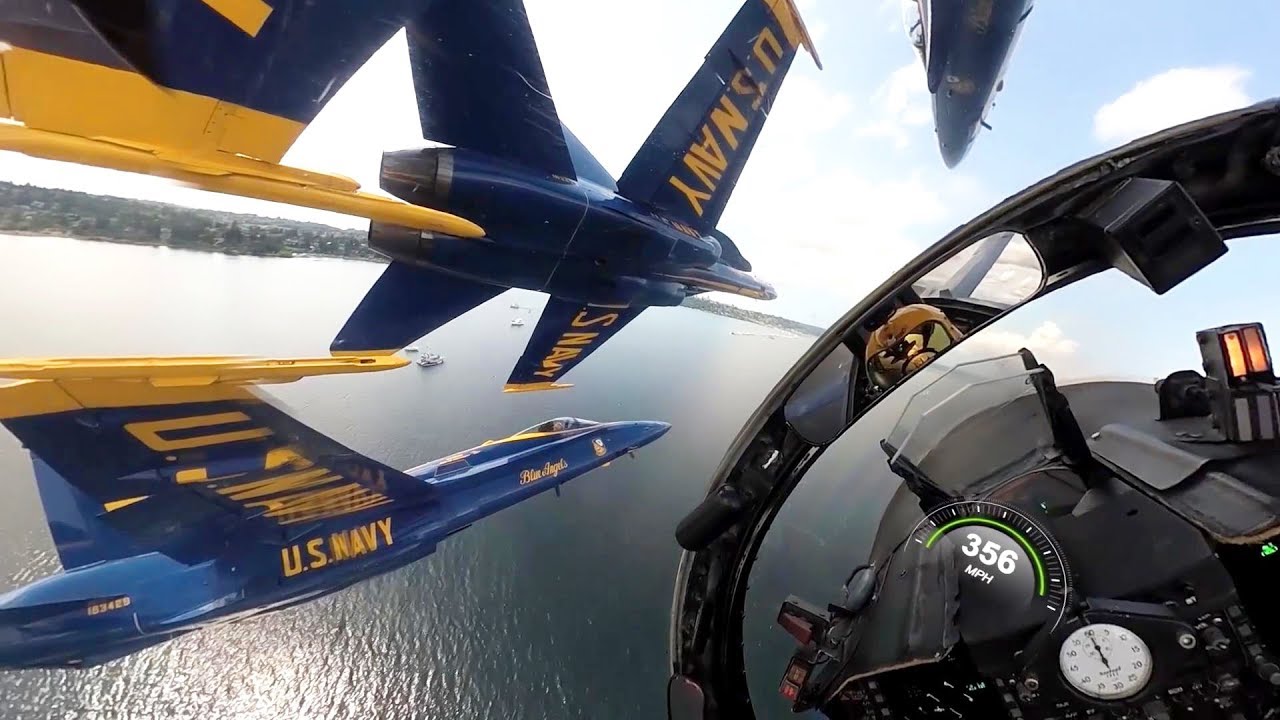
A cockpit-camera compilation from the YouTube channel Military Archive, titled “Amazing Cockpit View! US Navy Blue Angels Team Highlights,” has racked up more than 13 million views by putting viewers directly in the seat of a Navy F/A-18 Hornet mid-maneuver. The footage strips away the airshow announcer and the crowd noise and leaves just the pilot, the stick, and the wingman’s canopy a few feet away. It’s a rare, unfiltered look at what the “Blues” actually see and feel while executing the formations that made them famous.
- The multi-angle footage documents the squadron’s signature four-jet Diamond Formation and six-jet Delta Formation, along with opposing solo passes, from inside the cockpit itself.
- Pilots pull up to 7.5 Gs without inflatable anti-G suits — standard gear elsewhere in Navy aviation — because suit inflation risks bumping the Blue Angels’ specialized spring-tensioned flight control stick.
- Formation flying is shown with wingtip-to-canopy clearances as tight as 18 to 36 inches at speeds exceeding 400 mph.
Inside the Cockpit at 400 MPH
What the camera captures isn’t just speed — it’s the constant, minute correction. Blue Angels pilots fly by referencing a fixed point on the flight leader’s aircraft, holding that line of sight while their hands make continuous, tiny inputs on the stick to keep the formation locked. There’s no autopilot smoothing any of it out. At 18 to 36 inches of separation between aircraft, a delayed correction of even a few inches is the difference between a clean pass and a mishap.
The absence of an inflatable G-suit is one of the more counterintuitive details the footage brings home. Every other Navy strike-fighter pilot wears one to keep blood from pooling away from the brain under G-load. Blue Angels pilots forgo it specifically because the suit’s bladder inflating against the leg could nudge the sensitive, spring-loaded stick just enough to throw off a formation flying inches from another jet — so they manage 7.5 Gs largely through breathing technique and muscle tensing alone.
Eighteen to 36 inches between wingtips and canopies, over 400 mph, with a control stick so sensitive that pilots skip the G-suit rather than risk bumping it.
The Formations on Display
The clip’s most recognizable sequence is the Diamond Formation — four Hornets flying nose-to-tail and wingtip-to-wingtip in a tight diamond — followed by the full six-jet Delta Formation that adds the two remaining aircraft. Interspersed are the high-speed opposing solo passes, where two jets close on each other from opposite directions at closing speeds well over 700 mph combined before crossing paths in front of the crowd. From the cockpit, the onboard cameras show just how little margin the pilots are working with on every pass, and how much of the maneuver depends on split-second trust in the pilot flying formation alongside them.
The Squadron’s Roots and Setup
The Blue Angels were formed in 1946 on the order of Chief of Naval Operations Admiral Chester Nimitz, making the team one of the oldest formal aerobatic demonstration squadrons in the world. The squadron is based out of Naval Air Station Pensacola, Florida, with winter training conducted at Naval Air Facility El Centro, California. As of May 2020, the team was still flying its legacy F/A-18A/B/C/D Hornets, ahead of a planned transition to the larger F/A-18E/F Super Hornets later that year. Fans who want a similar over-the-shoulder perspective from a different demo team can check out the F-16 cockpit footage from the Myrtle Beach Airshow, which offers a comparable single-seat vantage point.
The cockpit view also underscores how much preparation goes into a show that lasts roughly 45 minutes in the air. Every roll, loop, and inverted pass is briefed and rehearsed on the ground long before the jets ever leave the tarmac, and the margin for improvisation once airborne is close to zero. For readers curious about the broader world of high-performance military flight, the 240-miles-in-22-minutes flight feature offers another angle on just how fast modern military aircraft cover ground.
None of this changes when the Blue Angels swap airframes — the Super Hornet transition later in 2020 brought a bigger jet with more thrust, but the same 18-to-36-inch tolerances and the same no-G-suit rule carried over, because the stick sensitivity that makes the formations possible hasn’t changed since 1946.








HOW TO IMPLEMENT A HEALTHY LIFESTYLE | Setting Habits & Wellness Goals
BIG FAMILY RV TOUR : HOW WE LIVE IN OUR RV FULLTIME W/9 KIDS!!!
THE MOST INSANE TENTS THAT ARE ON ANOTHER LEVEL
Harvesting Honey From A FLOW HIVE & Thoughts & Impressions of the Flow Hive
What an Affordable Luxury Mansion in Los Angeles looks like!