

 InfoSearched
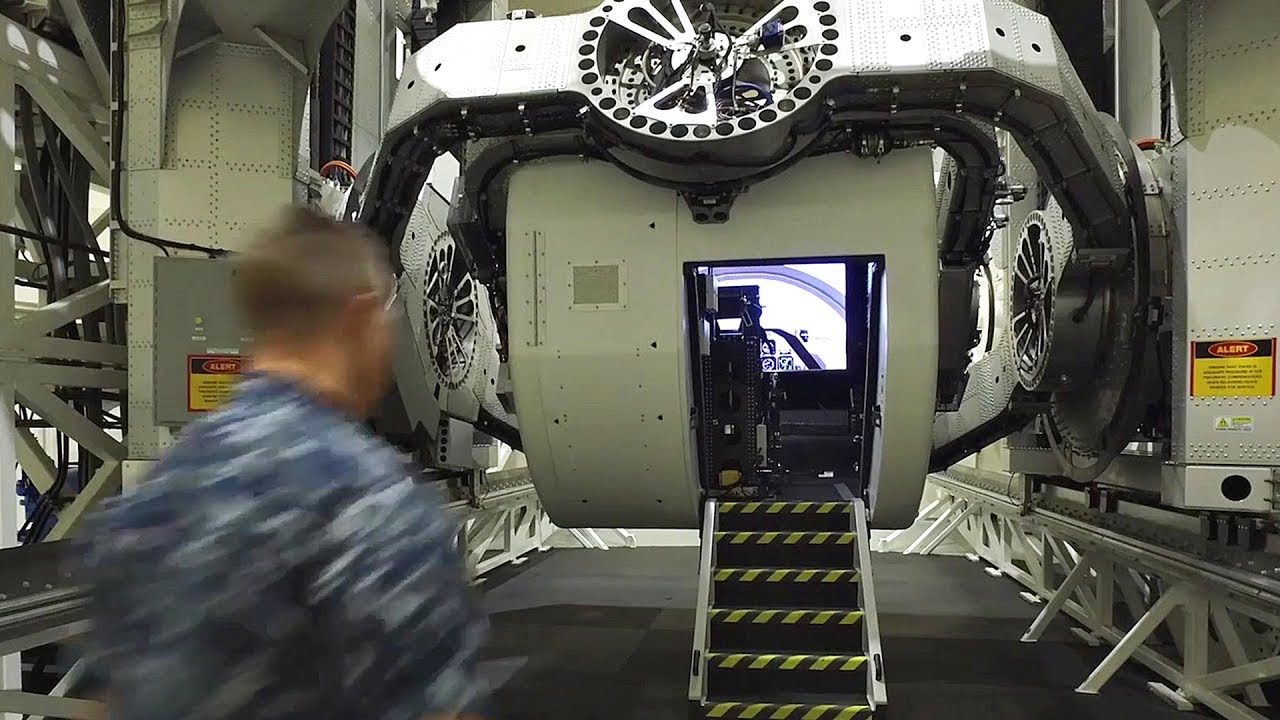
A $19 million machine built to make pilots dizzy on purpose just went online at Wright-Patterson.
On June 17, 2016, Naval Medical Research Unit Dayton officially christened the GL-6000 Disorientation Research Device — known to nearly everyone involved simply as “The Kraken” — inside the newly opened Captain Ashton Graybiel Acceleration Research Facility at Wright-Patterson Air Force Base in Ohio. Built by Pennsylvania-based Environmental Tectonics Corporation, the machine exists for one grim, practical reason: pilots die when they lose track of which way is up, and NAMRU-D wants to understand exactly how and why before it happens in the cockpit.
- The Kraken weighs 245,000 pounds, runs on a 4,500-horsepower drive system, and moves through six degrees of freedom simultaneously.
- Its mechanical arm gives 16.5 feet of horizontal track displacement while subjecting the enclosed human capsule to sustained motion forces up to 3G.
- According to NAMRU-D Commanding Officer Capt. Rees Lee, an Air Force report ties roughly $2 billion in lost aircraft to spatial disorientation mishaps.
Inside the Machine
The Kraken isn’t a flight simulator in the training sense — it’s a research instrument built to recreate the physical sensations that scramble a pilot’s inner ear and inner sense of orientation. Sealed inside a capsule at the end of that 16.5-foot arm, a test subject can be pitched, rolled, yawed, and swung through combined motions that no fixed-base simulator could ever reproduce. The 4,500-horsepower system driving all six axes at once is what lets researchers layer sustained G-forces on top of disorienting rotational motion, essentially recreating the exact sensory confusion that has put real aircraft into the ground.
Capt. Rees Lee, NAMRU-D’s commanding officer, framed the machine’s ambitions against the legacy of the man the facility is named for. “The Kraken will allow researchers to create the most realistic motion simulations never before imagined — except by perhaps one person — the pioneering physician, Navy Capt. Ashton Graybiel, who dared to imagine the physiologic impacts of motion and acceleration on the human body,” Lee said.
“The Disorientation Research Device, together with the human centrifuge and hyperbaric chamber at the 711th Human Performance Wing will set Wright-Patterson Air Force Base as the center of acceleration research in the nation.”
Named for a Navy Pioneer
The facility housing the Kraken carries the name of Capt. Ashton Graybiel, a naval medical researcher whose decades of work on motion sickness, acceleration, and disorientation laid the scientific groundwork for everything the new device is built to study. During the dedication ceremony, the machine was formally christened by neuroscientist Ann Graybiel — Ashton Graybiel’s daughter — tying the $19 million research device directly back to the man whose early findings made it possible in the first place.
The Cost of Spatial Disorientation
The dollar figures behind this program aren’t abstract. Lee’s citation of roughly $2 billion in lost aircraft from motion-related mishaps is the reason NAMRU-D exists in this form at all — spatial disorientation isn’t a training footnote, it’s a recurring cause of fatal crashes across military aviation. Pair that with the physical toll on pilots and aircrew, and the case for a machine capable of safely reproducing those exact disorientation states, under controlled and observed conditions, becomes straightforward.
That’s also why the Kraken doesn’t sit alone. It’s installed alongside the 711th Human Performance Wing’s human centrifuge and hyperbaric chamber, giving Wright-Patterson a full suite of acceleration and aeromedical research tools in one place — from testing G-force tolerance to reproducing hypoxia to now recreating full six-axis disorientation. Anyone who’s followed the Air Force’s other aeromedical work, like the physical screening standards used for special warfare candidates, will recognize the same underlying obsession: measuring exactly what the human body can take before it fails.
Core Research Objectives Defined
The end goal isn’t a bigger, scarier ride — it’s data that keeps aircrews alive. By putting volunteers through repeatable, sustained disorientation states inside the capsule, NAMRU-D researchers can study how the vestibular system reacts, how quickly disorientation sets in, and what warning signs precede it, all in ways that can’t be ethically or safely tested in an actual cockpit. That data feeds directly into training protocols and cockpit design decisions meant to cut into that $2 billion mishap figure Lee cited. It’s the same underlying logic behind other high-stress human-performance testing across the military — the kind seen in cockpit footage from demo pilots pulling hard G’s, like the over-the-shoulder F-16 demo runs at Myrtle Beach — except here the goal is understanding failure before it happens, not showcasing mastery of it.
The Kraken has been running at Wright-Patterson since that 2016 dedication, quietly generating the kind of disorientation data that doesn’t make headlines but ends up in the training manuals every Navy and Air Force aviator eventually reads.









The Mars Homes That NASA Awarded $500k
Off-The-Grid Desert Living in a Tiny Earthen Home & Permaculture Community
Amazing Bushcraft Tent made from Plastic Wrap!
Chinese online star Li Ziqi provides an escape from urban life
Why Matthew Gray Gubler Lives in a “Haunted Tree House”