

 InfoSearched
A dying craft in Fukuoka is kept alive by a single family, one 0.08-gram charge at a time.
When science YouTuber NightHawkInLight — known off-camera as Ben Krasnow — wanted to understand why a hand-rolled Japanese sparkler burns nothing like the wire sparklers sold at American fireworks stands, he didn’t buy a box and experiment in his garage. He flew to Miyama, in Fukuoka Prefecture, and apprenticed under Ryota Tsutsui, the third-generation master craftsman behind Tsutsui Tokimasa Fireworks Co. The resulting 15-minute video, posted January 28, 2020, is as much a rescue mission as it is a tutorial.
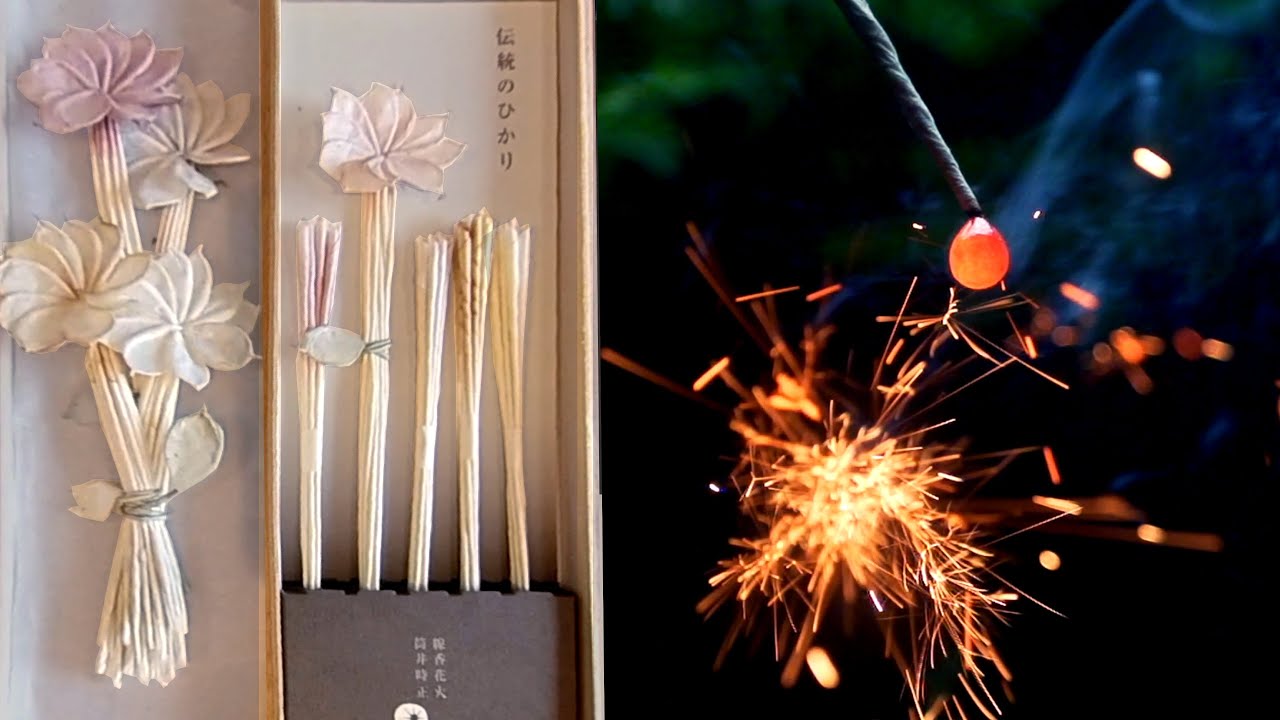
- Tsutsui Tokimasa is one of only three workshops left in Japan that still hand-make senko hanabi, the traditional “incense stick” sparkler, after cheap imports pushed the craft to the edge of extinction.
- Each nagate-botan sparkler holds just 0.08 grams of black powder — not standard pyrotechnic powder, but a formula built on pine soot (lampblack) drawn from pine roots aged for decades, mixed with potassium nitrate and sulfur.
- Lit and held tip-down, the charge produces a molten droplet of potassium sulfide that erupts into silent, branching sparks reaching up to 20 centimeters — a burn sequence with distinct, named phases going back to the Edo period.
Inside Tsutsui Tokimasa
Ryota Tsutsui runs the workshop alongside Kyoko Tsutsui, continuing a family trade that has survived three generations while dozens of competitors folded under pressure from mass-produced imports. Krasnow’s video makes clear that “surviving” is the operative word — there are only three workshops of this kind left standing in the entire country, and Tsutsui Tokimasa is one of them. That scarcity is why NightHawkInLight framed the trip less as a novelty segment and more as documentation of a craft that could plausibly disappear within a generation if nobody records it.
The stakes of that scarcity show up in the materials themselves. Where a modern sparkler is machine-dipped wire, a senko hanabi is handmade washi paper rolled around a powder charge measured in milligrams. Getting that charge wrong — too much, too little, uneven distribution — means the firework either flares uselessly or never lights the branching spark pattern the format is famous for.
The Powder Behind the Spark
The formulation is the part that separates senko hanabi from anything sold at a roadside stand in the U.S. Instead of standard commercial black powder, Tsutsui Tokimasa relies on pine soot, or lampblack, harvested from pine roots that have been left to rest for decades before they’re ever burned down for soot. That soot is combined with potassium nitrate and sulfur in exacting proportions — the same three-ingredient family that has defined Japanese pyrotechnics since the Edo period, just sourced and balanced with a precision that mass production doesn’t bother with.
Krasnow’s video lingers on the measuring stage because it’s the most unforgiving part of the process: workers are weighing out a charge of roughly 0.08 grams per firework, a quantity so small that a slightly heavy scoop changes how the sparkler burns from tip to finish.
Rolling, Twisting, and the Margin for Error
Once the powder is measured, the real skill test begins — rolling the washi paper around the charge and twisting it with the correct tension and taper. Tsutsui demonstrates that the twist isn’t decorative; get the tension wrong and the sparkler either burns out instantly or never ignites the secondary spark phase at all. It’s a motion that looks simple on camera and is, according to the video, the single hardest technique for an outsider to replicate on the first try.
Held tip-down and lit, the charge first forms a glowing molten droplet of potassium sulfide before erupting into silent, branching sparks that stretch up to 20 centimeters.
That combustion sequence is why senko hanabi has symbolic weight in Japan beyond being a summer novelty — the phases of the burn (the droplet, the peak branching, the fade) are traditionally read as stages of a short life, and generations of Japanese festival-goers have watched them the way Americans might watch a campfire settle. Tsutsui Tokimasa tests every batch in a dedicated darkroom facility built specifically so the delicate spark pattern can be judged against total darkness rather than daylight or stage lighting.
A Craft Worth Filming
The through-line of the video isn’t really pyrotechnics chemistry — it’s preservation. NightHawkInLight treats the Tsutsui family’s know-how the same way a documentarian might treat a vanishing dialect: as knowledge that exists almost nowhere else and could vanish with the next generation if nobody outside Miyama pays attention. That instinct to chase down craftsmen keeping older methods alive shows up across the channel’s catalog, in the same spirit that drives builders documenting hand-gathered natural materials turned into finished goods or makers reviving production methods that industrial shortcuts nearly erased.
Krasnow leaves the workshop with a handful of sparklers he rolled himself under Tsutsui’s supervision — imperfect compared to the master’s, but real senko hanabi all the same, made with pine soot aged decades before it ever touched a flame.



Portland’s rotating skinny house follows the sun like a sunflower
This Brain Implant Could Change Lives
Renovating an abandoned tiny house Part 1
Meet Bruce Lee, king of Romania’s tunnel underworld
Inside Aaron Paul’s Rustic Riverside Home In Idaho