

The Darkest Black on Earth? Why Scientists & Artists Want the World’s Blackest Substances
 InfoSearched
Scientists and artists are chasing a color so dark it swallows dimension itself.
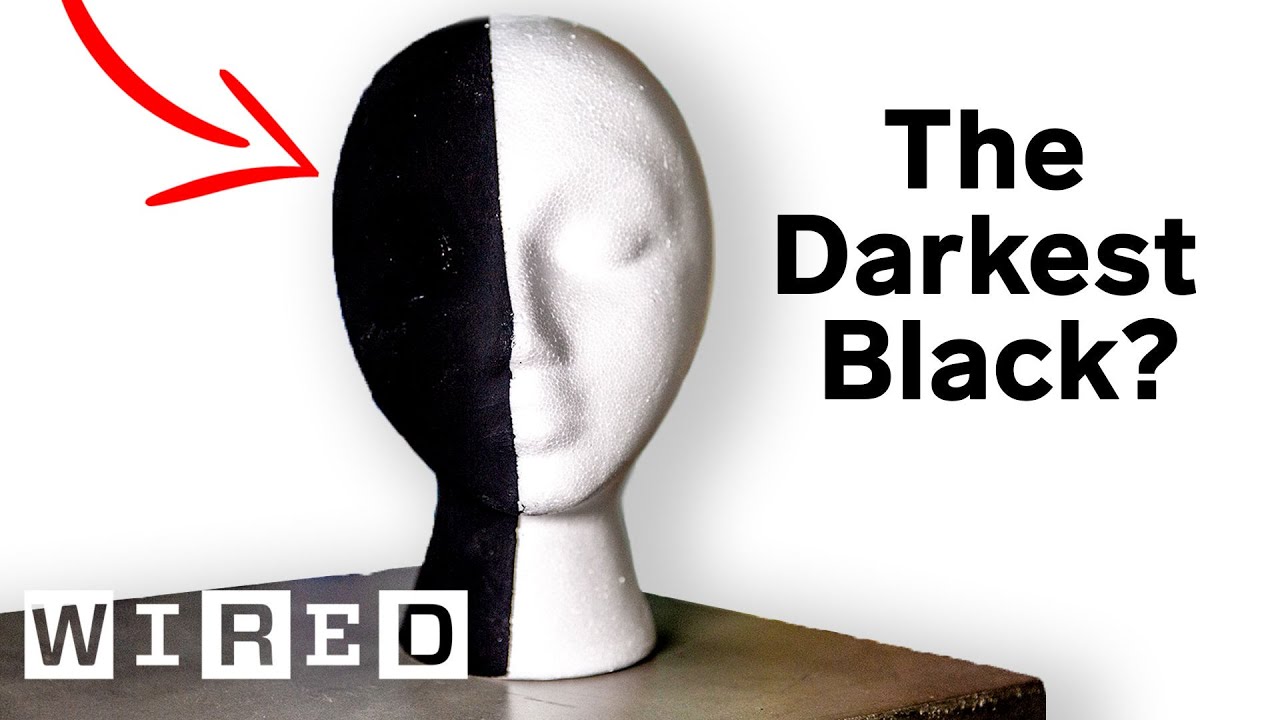
WIRED’s Aerielle Pardes sat down with artist Stuart Semple and physicist John Lehman to unpack a strange arms race that has nothing to do with paint swatches and everything to do with physics. The target is Vantablack, a coating so light-absorbent it turns sculpted 3D objects into flat, featureless voids. What started as an engineering solution for space telescopes has turned into a fight over who gets to own the darkest shade ever made.
- Surrey NanoSystems unveiled Vantablack in 2014, a coating of vertically aligned carbon nanotube arrays that absorbs up to 99.965% of incident light.
- Sculptor Anish Kapoor acquired exclusive artistic rights to Vantablack in 2016, prompting Stuart Semple to fire back with open pigments including “the pinkest pink” — which Kapoor was explicitly barred from buying — and later the ultra-matte acrylic black known as Black 3.0.
- In late 2019, MIT engineers unveiled a carbon nanotube material that captures 99.995% of light, roughly ten times blacker than the previous record, debuted on a $2 million yellow diamond at the New York Stock Exchange.
The Physics of a Bottomless Black
Vantablack’s trick isn’t pigment, it’s architecture. The coating is made of carbon nanotubes packed so densely and aligned so precisely that light entering the array bounces between the tubes instead of reflecting back out, getting trapped until almost none of it escapes. Physicist John Lehman explains why that matters far beyond gallery walls: ultra-black coatings line the inside of sensitive optical instruments, deep-space telescopes, and calibration systems, where suppressing stray light is the difference between a clean image of a faint galaxy and useless glare.
That’s the paradox at the center of WIRED’s report — a material developed to solve a niche aerospace problem became one of the most talked-about substances in contemporary art, because it does something the human eye has never quite been able to process. When Vantablack is applied to a textured object, the surface reads as a hole rather than a shape.
Vantablack absorbs up to 99.965% of incident light, flattening 3D textures into a bottomless visual void.
Kapoor’s Land Grab and the Backlash
The controversy ignited in 2016 when Anish Kapoor struck a deal for exclusive artistic rights to Vantablack, meaning no other artist could legally use the exact material in their own work. The art world pushed back hard against the idea that a single person could privatize a color. Stuart Semple answered by releasing “the pinkest pink” as an accessible pigment for any artist — with one carve-out written directly into the terms: Kapoor himself was banned from buying it.
Semple didn’t stop there. He kept iterating on open-source ultra-matte acrylic blacks until he landed on Black 3.0, a formula built to compete directly with Vantablack’s depth while remaining available to anyone who wants a tube of it. It’s the same open-versus-exclusive tension that shows up across creative industries whenever a breakthrough material or process gets locked behind a patent — a dynamic worth watching the same way documentary filmmakers have tracked other closed-door industries.
MIT Raises the Bar
Vantablack didn’t stay the record holder. In late 2019, engineers at MIT unveiled a carbon-nanotube material that absorbs 99.995% of light — about ten times darker than anything that came before it — and they made sure people noticed, unveiling the coating on a $2 million yellow diamond at the New York Stock Exchange. The stunt turned an obscure materials-science paper into a visual gag: a gem literally worth millions rendered invisible under stage lights.
For an audience used to seeing color explained in soundbites, that kind of demonstration lands harder than a spec sheet. It’s the same appeal that drives interview-driven science segments — take a technical claim and make it visible in a single, absurd image.
Semple’s Black 3.0 is still sitting on shelves, sold to anyone with the exception of one buyer, while MIT’s coating remains a lab-grade material rather than a commercial pigment. That gap — an artist-accessible black on one side, a record-setting industrial black on the other, and Kapoor’s exclusive license sitting in between — is exactly the standoff Pardes’ report leaves open, with no sign either side is backing down.








DAY 85: Sharks Really Wanted This Fish!
Horrifyingly Mysterious Lakes In The World
A Stunning Small Home Made From Hemp
Magical Hobbit-Like Eco Cave House
Mountain property with Waterfalls, Cheap land in Kentucky for sale