

 InfoSearched
An artist figured out how to turn living, breathing humans into flat paintings — and it started spreading online a decade before anyone called it a TikTok trend.
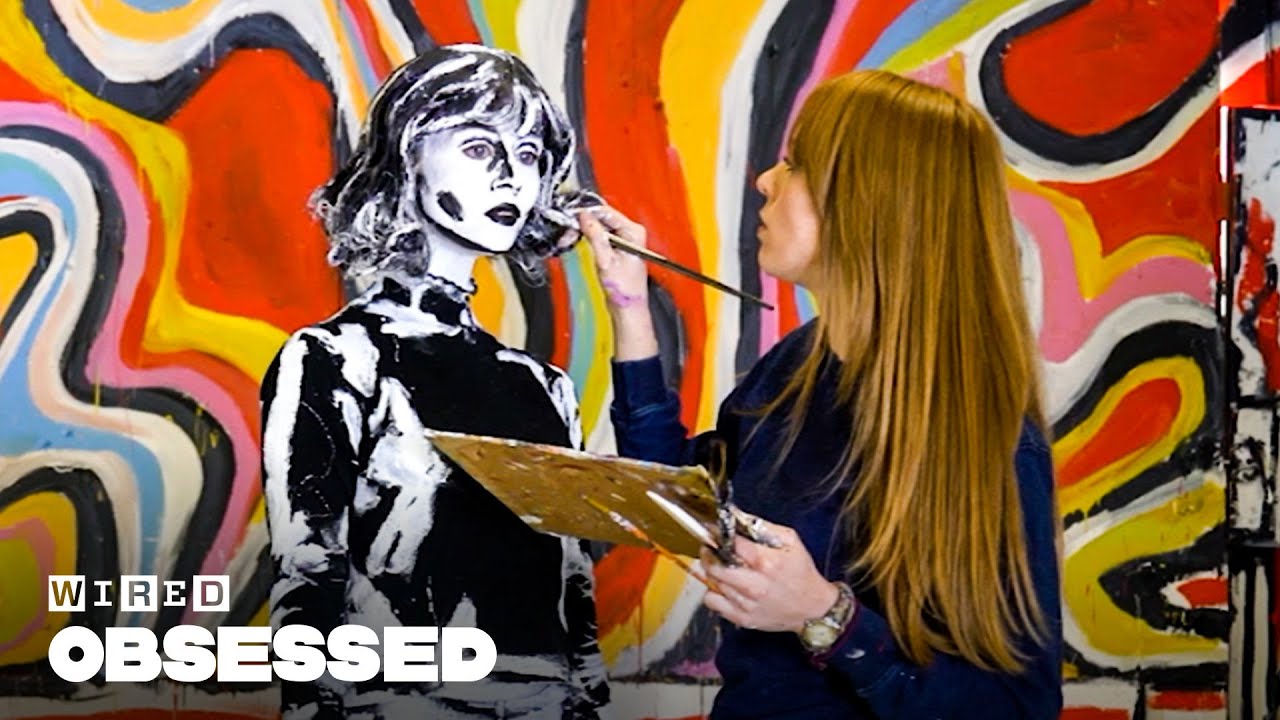
Alexa Meade doesn’t paint on canvas. She paints directly on skin, hair, clothing and the walls behind her subjects, collapsing an entire three-dimensional scene into something that reads, at a glance, like a flat portrait someone hung on a wall. WIRED’s Obsessed series caught up with her to break down exactly how she pulls off the illusion, and why she gave up a government career to build it from scratch.
- Meade left a track in government and politics to work as a full-time visual artist around 2009, despite having no formal fine-art training.
- Her technique — painting acrylic directly onto 3D subjects to make them look 2D — went viral globally after kottke.org spotlighted it in March 2010.
- She’s exhibited at the National Portrait Gallery and Art Basel, delivered a viral 2013 TED talk called “Your Body Is My Canvas,” and body-painted Ariana Grande for director Dave Meyers’ 2018 “God is a Woman” video.
Reversing the Illusion
Trompe l’œil painters have spent centuries trying to trick the eye into seeing depth on a flat surface. Meade flips that entirely: she takes something genuinely three-dimensional — a person’s face, arm, torso, the chair they’re sitting in — and paints it so convincingly that it flattens back into what looks like a picture. Shadows get painted where light hits and highlights get painted where the paint is thickest, tricking the camera and the viewer’s eye into reading depth cues as brushstrokes instead of actual form.
She’s said she never took to painting on a traditional flat canvas — the medium didn’t click for her. It was only when she started experimenting with shadow and light on real objects in real space that the style fell into place, almost by accident, while she was still working outside the art world entirely.
From Kottke.org to the TED Stage
Meade’s rise wasn’t the product of a gallery pedigree or an art-school pipeline. It was the internet. When kottke.org featured her body-paint photos in March 2010, the images spread fast, and within a short stretch she went from an unknown experimenting in her spare time to an artist fielding international attention. That momentum carried her to institutional stages — the National Portrait Gallery, Art Basel — and eventually to a 2013 TED talk, “Your Body Is My Canvas,” that pushed her technique to an even wider audience.
She struggled with painting on a flat canvas — but treating a living person as the canvas is where the style actually clicked.
That arc — outsider technique, viral discovery, mainstream validation — mirrors how other self-taught creators have broken into industries that normally demand formal credentials, the same way an untrained craftsman once reshaped an entire luxury trade without ever attending design school.
The Ariana Grande Crossover
Meade’s work reached its biggest mainstream moment in 2018, when director Dave Meyers brought her in to body-paint Ariana Grande for the “God is a Woman” music video. Grande appears submerged in a swirling pool of purple and blue paint, an image directly inspired by Meade’s earlier milk-bath collaboration with performance artist Sheila Vand. It took a technique built on street corners and gallery floors and put it in front of a pop audience that had likely never heard her name.
Technical Challenges in Camera Calibration
Part of what makes Meade’s work land on video, which is exactly why WIRED’s Obsessed crew wanted to document her process, is that the illusion holds up under a lens in a way it sometimes doesn’t in person. A photograph strips away the depth cues a human eye can pick up by moving around a subject, so the flattening effect she paints in becomes even more convincing on camera than in the room.
Meade has kept working the same core idea for over a decade now — real bodies, real paint, an illusion that only fully resolves once you stop trying to find the edges of the canvas.







Dysfunction to Dynasty – Ch. 5 Jep Robertson: DRUGS AND DECEPTION
Exploring the Arctic’s Global Seed Vault
INCREDIBLE AND INGENIOUS Hidden Rooms AND SECRET Furniture
Starting an Outdoor LifeStyle
The Secret Darker Art of Dr. Seuss