

 InfoSearched
Grow the right fungus in the wrong room and you get slime. Grow it right and you get lion’s mane the size of a softball.
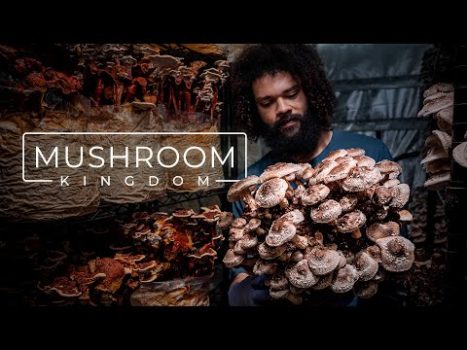
PARAGRAPHIC’s new short, “Cultivating Gourmet and Medicinal Mushrooms,” published June 11, 2021, walks through exactly what separates a contaminated grow bag from a flush of shiitake worth selling at a farmers market. The video sets aside the usual foraging-and-folklore treatment of fungi and instead tracks the actual production pipeline — sterile spawn, bulk substrate, fruiting room — that indoor cultivators use to turn sawdust and straw into food and medicine.
It’s a species-by-species breakdown as much as a how-to: lion’s mane and reishi get framed around their compounds, oyster and shiitake around their speed and reliability as crops. The throughline is that mushroom cultivation isn’t one recipe repeated four times — it’s four different biological problems with four different solutions.
- The feature profiles lion’s mane (Hericium erinaceus) for its neuroprotective and cognitive-support compounds, reishi (Ganoderma lucidum) for immune modulation, and oyster (Pleurotus species, including pink oyster) and shiitake (Lentinula edodes) as the culinary workhorses.
- Wood-decay species like shiitake and lion’s mane need enriched hardwood sawdust or actual hardwood logs, while oyster mushrooms colonize fast on pasteurized agricultural waste such as cereal straw.
- Fruitbody development depends on holding relative humidity between 80% and 95%, running fresh air exchange to keep carbon dioxide from stacking up, and using indirect lighting as a pinning trigger.
Four Species, Four Different Jobs
Lion’s mane isn’t grown for its looks — a mature specimen looks like a frozen waterfall of icicles — but for the compounds inside it tied to nerve growth and cognitive support. Reishi, by contrast, almost never gets eaten fresh; it’s cultivated to be dried, extracted, or tinctured for its immune-modulating properties, and it fruits as a hard, lacquered shelf rather than a tender cap. Oyster mushrooms, including the pink oyster variety, exist on the opposite end of the spectrum: they’re the fastest-colonizing, most forgiving species in the video, which is exactly why they’re the entry point for most home growers. Shiitake splits the difference, prized as a kitchen staple but still classified alongside lion’s mane as a wood-decay fungus with a slower, log-based cultivation cycle.
From Grain Spawn to Bulk Substrate
Every batch traced in the video starts the same way: sterile inoculation and grain spawn generation before anything touches a bulk substrate. That spawn step is where the mushroom’s genetic material gets multiplied on a small, manageable volume of grain before it’s mixed into the much larger substrate that will actually produce mushrooms. From there, the substrate choice splits by species — enriched hardwood sawdust or logs for shiitake and lion’s mane, pasteurized cereal straw for oyster mushrooms — because wood-decay fungi and straw-decay fungi are simply built to break down different organic material.
Hygiene as the Difference Between a Crop and a Loss
Contamination is the operational threat running under the entire process. The video highlights pressure sterilization and laminar flow principles as the two safeguards standing between a clean colonization and a bag full of competing bacteria or mold. Laminar flow — filtered, unidirectional air moving across a sterile work surface — is the same principle used in lab settings, repurposed here to keep spores and airborne contaminants away from freshly inoculated grain and substrate.
Relative humidity has to sit between 80% and 95% for pinning and fruitbody development to start at all — miss that band and colonized mycelium simply stalls.
The Environmental Triggers That Start Fruiting
Colonized mycelium doesn’t spontaneously fruit; it has to be pushed into it. The video lays out the three levers cultivators pull: humidity locked between 80% and 95%, fresh air exchange to strip out the carbon dioxide that builds up in a sealed grow space, and indirect light used as a pinning cue rather than a growth source. Get any one of those wrong and the mycelium either stays vegetative or produces malformed, leggy fruitbodies instead of usable mushrooms.
What the video frames as the real story, though, is how little equipment any of this actually requires. The same low-tech, recyclable agricultural waste methods that back-yard growers use to fill a straw-packed bucket with oyster mushrooms are what small commercial operations are now scaling up to supply lion’s mane and reishi extract to a market that wants both dinner and medicine out of the same closet setup — no different in spirit from readers turning a lawn into a vegetable patch or stacking berry containers on a patio, just with a mushroom instead of a raspberry cane.






Hiking 70 Miles Alone on the Sawtooth Loop Trail in Idaho
Japan’s Master Inventor Has Over 3,500 Patents
Here’s What a Lion Does After Being Banished From the Pride
Plant this once and have FOOD for 30 YEARS!
Why Is Bill Gates Building So Many Doomsday Bunkers