

 InfoSearched
Mexico’s cartels didn’t slow down for COVID-19 — they turned the pandemic into a business opportunity.
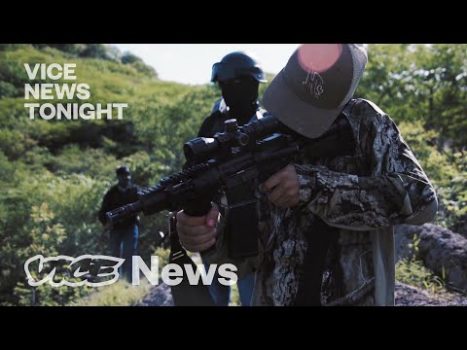
2020 was on pace to become Mexico’s deadliest year on record, and the virus that shut down much of the world barely put a dent in that trajectory. VICE News traveled to Culiacán, a city of roughly 800,000 people and the longtime headquarters of the Sinaloa Cartel, to document how organized crime not only survived the lockdowns but expanded its reach into the vacuum left by an overwhelmed government.
Border closures and disrupted supply lines were supposed to choke off the drug trade. Instead, cartels rerouted their logistics, hiked prices on synthetic drugs, and fought even harder over the territory that remained.
- Homicides in Sonora jumped 64% between January and August 2020 compared to the same stretch in 2019, according to figures from Mexico’s Secretariat of Security and Citizen Protection.
- CJNG gunmen fired more than 150 rounds during a June 2020 assassination attempt on Mexico City police chief Omar García Harfuch in an upscale district of the capital.
- Cartels handed out relief packages — food and sanitizing supplies stamped with imprisoned kingpin Joaquín “El Chapo” Guzmán’s likeness — while enforcing their own strict curfews.
Culiacán as a Case Study
Sinaloa’s capital has always been synonymous with the cartel that shares its name, and VICE News’s reporting from the ground there shows why the region became a bellwether for the entire pandemic-era crime wave. With municipal and federal authorities stretched thin by the health crisis, the Sinaloa Cartel didn’t retreat — it filled the administrative gap, projecting itself as a functioning authority in the neighborhoods it controls. That dynamic mirrors what’s documented in How Mexican Drug Cartels Make Billions, which lays out just how deep these organizations’ revenue streams run beyond street-level trafficking.
Border Closures Scramble the Supply Chain
International border restrictions and disrupted trade did land real blows on the traffickers. Precursor chemicals shipped from Asia — the raw material behind methamphetamine and fentanyl production — became harder to source, and prices for both drugs spiked sharply through 2020. But rather than folding, criminal organizations restructured their smuggling and manufacturing chains to route around the bottlenecks, treating the disruption as a logistics problem rather than an existential threat.
Turf Wars Escalate Across the North
The scramble for control of those restructured routes set off fresh fighting. Factions of the Sinaloa Cartel and the Jalisco New Generation Cartel escalated armed conflict across Sonora, Guanajuato, and Sinaloa itself, turning already volatile states into active battlegrounds even as the rest of the country locked down. The Sonora homicide numbers — a 64% year-over-year jump for the January–August window — were a direct byproduct of that contested ground.
Governance by Cartel
Where the state pulled back, the cartels stepped forward. Gangs enforced their own curfews and distributed relief packages branded with El Chapo’s image, an overt bid to win loyalty from communities the government could barely reach during the crisis. In April 2020, CJNG went further, issuing a public statement threatening 30 days of detention for civilians who ignored its own lockdown rules — a decree the state government never enforced, but one that showed how comfortable the cartel had become acting like a parallel authority.
That soft-power campaign ran alongside outright war on the state. CJNG’s June 2020 hit on Mexico City police chief Omar García Harfuch — gunmen unloading over 150 rounds in a wealthy part of the capital — was as much a message as an assassination attempt, a demonstration that the cartel would strike at the highest levels of law enforcement without hesitation.
A Policy Under Strain
President Andrés Manuel López Obrador’s approach to the cartels has been built around what he’s called “abrazos, no balazos” — hugs, not bullets — a strategy critics call naive given what was unfolding in Sonora, Guanajuato, and Sinaloa. Mexico’s federal police remain understaffed and poorly equipped, and corruption at multiple levels of government has left cartels operating with something close to impunity in the regions they control.
Abrazos, no balazos — hugs, not bullets.
The Bigger Picture on the Trade
The reporting fits into a broader pattern documented across cartel investigations, from precursor smuggling to the maritime routes covered in Watch the Coast Guard Capture Another Narco Sub With $69 Million in Cocaine — a reminder that trafficking organizations treat disruption, whether from law enforcement or a global pandemic, as a logistics puzzle to solve rather than a reason to stand down.
None of the numbers from Culiacán suggest the fighting in Sonora, Guanajuato, or Sinaloa was cooling off by mid-2021. CJNG and the Sinaloa Cartel’s factions were still contesting the same corridors that got disrupted in 2020, and García Harfuch — who survived the June 2020 attack — remained Mexico City’s police chief, a standing target for the cartel that tried to kill him.





Prostitute-Amber
I Quit The City To Build My Hobbit House
Parking Lot Fishing! I DISCOVERED an UNDERGROUND River (NEW SPECIES CAUGHT)
Building New York’s $200M Apartment
The Famous “Turtleman” Episode