

 InfoSearched
A mathematician glides across ice so thin it shouldn’t hold him, and the lake sings back.
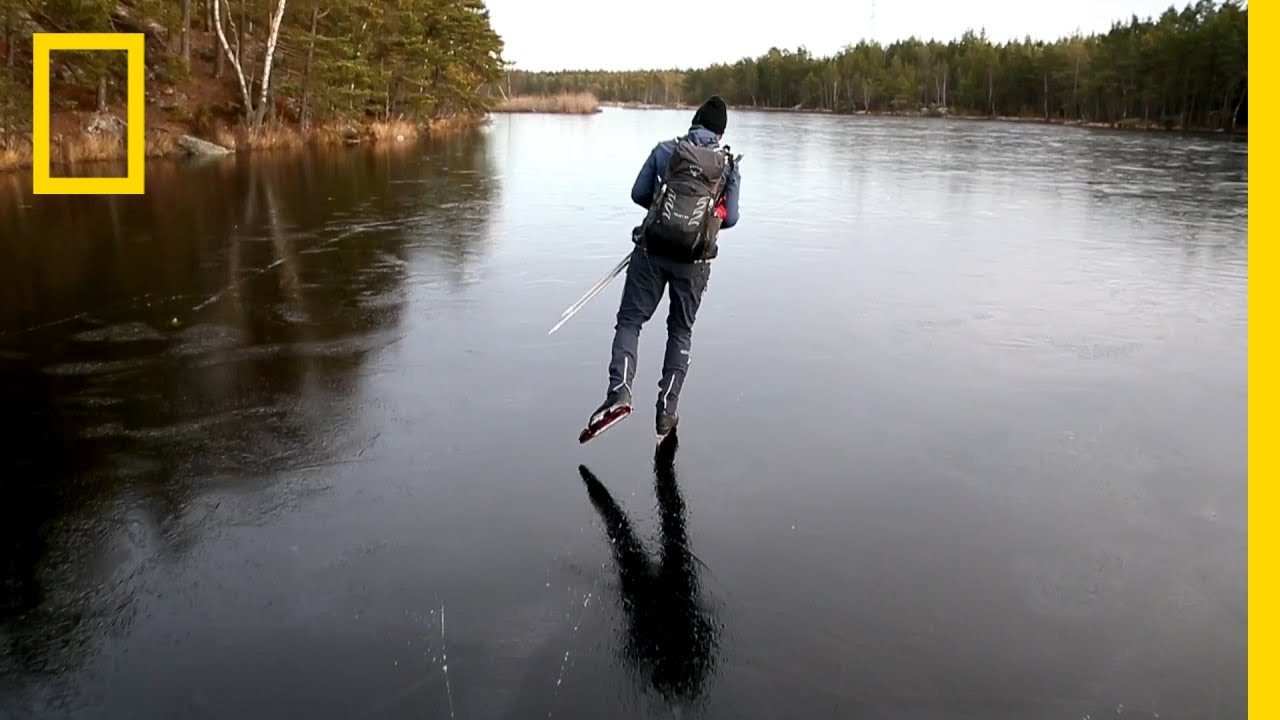
On a small lake outside Stockholm, Mårten Ajne pushes off across a sheet of black ice so new and so clear he can see straight through it to the water below. As his skates flex the surface, the ice answers with a chirping, laser-like whistle that sounds more like a science-fiction soundstage than a Scandinavian winter. National Geographic’s footage of the ride, released in January 2018, turned a niche Nordic pastime into a viral lesson in acoustic physics.
- Mårten Ajne, a Swedish mathematician and actuary with more than 35 years of experience in Nordic “wild ice skating,” deliberately seeks out ultra-thin black ice on lakes near Stockholm.
- The eerie sounds are caused by acoustic dispersion: high-frequency sound waves travel faster through the flexing ice sheet than low frequencies, arriving as high-pitched chirps followed by deeper resonant tones.
- Ajne has co-authored books on the physics and safety of the sport with photographer Henrik Trygg, and skaters use calculations of ice thickness and load distribution alongside gear like ice claws, throw ropes, and poles to manage the risk.
Distinctive Characteristics of Black Ice
Most people picture lake ice as cloudy and opaque, filled with trapped air bubbles that scatter light and muffle sound. Black ice is the opposite: it forms quickly in still, cold conditions with no air pockets, leaving a sheet that’s essentially transparent and acoustically alive. That purity is exactly what Ajne is hunting for every time he checks conditions on a new freeze.
For a Nordic skater, black ice isn’t just a novelty — it’s the smoothest, fastest surface available, gliding almost frictionlessly under a good pair of skates. But that same newness is what makes it thin, and thin ice is precisely what turns a quiet skate into an instrument.
The Physics Behind the Whistle
The sound comes down to how a solid behaves differently from air when it’s disturbed. As Ajne’s skate blade presses down and flexes the ice sheet, it sends vibrations racing through the ice itself rather than through the surrounding air. Because higher-frequency wavelengths move faster through that solid medium than lower ones, they separate as they travel outward — reaching a listener’s ear first as a high-pitched zip, then trailing off into a deep, resonant groan.
That separation, known as acoustic dispersion, is the same basic principle that gives the ice its “Star Wars” blaster quality. It’s not a special effect; it’s the natural behavior of sound waves moving through flexing, freshly frozen ice, amplified by the sheer thinness of the sheet Ajne is standing on.
The thinner and cleaner the ice, the more it sounds like a laser blast — and the more carefully a skater has to move across it.
Reading the Ice Like a Mathematician
Ajne doesn’t approach this as a daredevil stunt; he approaches it as an actuary would approach risk. Over three-plus decades of Nordic skating, he’s built out calculations for ice thickness and load distribution that tell him how far he can push a given sheet before it gives way. That math is the difference between a thrilling glide and a dangerous plunge, and it’s why he and Trygg turned their findings into published guides on the sport’s physics and safety.
Gear matters just as much as the calculations. Ice claws worn around the neck let a skater self-rescue by digging into the surface if it breaks; a throw rope and pole round out the standard kit for anyone chasing black ice seriously rather than recklessly. None of it eliminates the danger — it manages it, the same way a climber manages a route rather than avoiding the mountain.
Factors Driving Video Resonance
National Geographic’s clip landed because it delivered something genuinely strange without needing any embellishment: a real sound, produced by real physics, that most viewers had never encountered. The lake wasn’t doctored, the audio wasn’t synthesized — it was just thin ice doing what thin ice does when a skilled skater knows exactly where to put his weight.
That combination of danger, precision, and an almost otherworldly soundtrack is what separates wild ice skating from anything on a rink. It’s a pursuit built on reading conditions correctly, and Ajne’s decades of doing exactly that are what let him glide across ice most people would never dare step onto.





What I Eat In A Day (how i got my abs) | RENEE AMBERG
INCREDIBLE OFF-THE-GRID HOUSEBOAT (Coron, Philippines)
Inside the US-Iran Shadow War for Control of the Middle East
Swimming Rabbits Caught on Camera
This Single Level Tiny House Is Perfect For Disabled & Retirement Aged People