

 InfoSearched
Data has no skin, no skeleton — so Refik Anadol built machines to give it both.
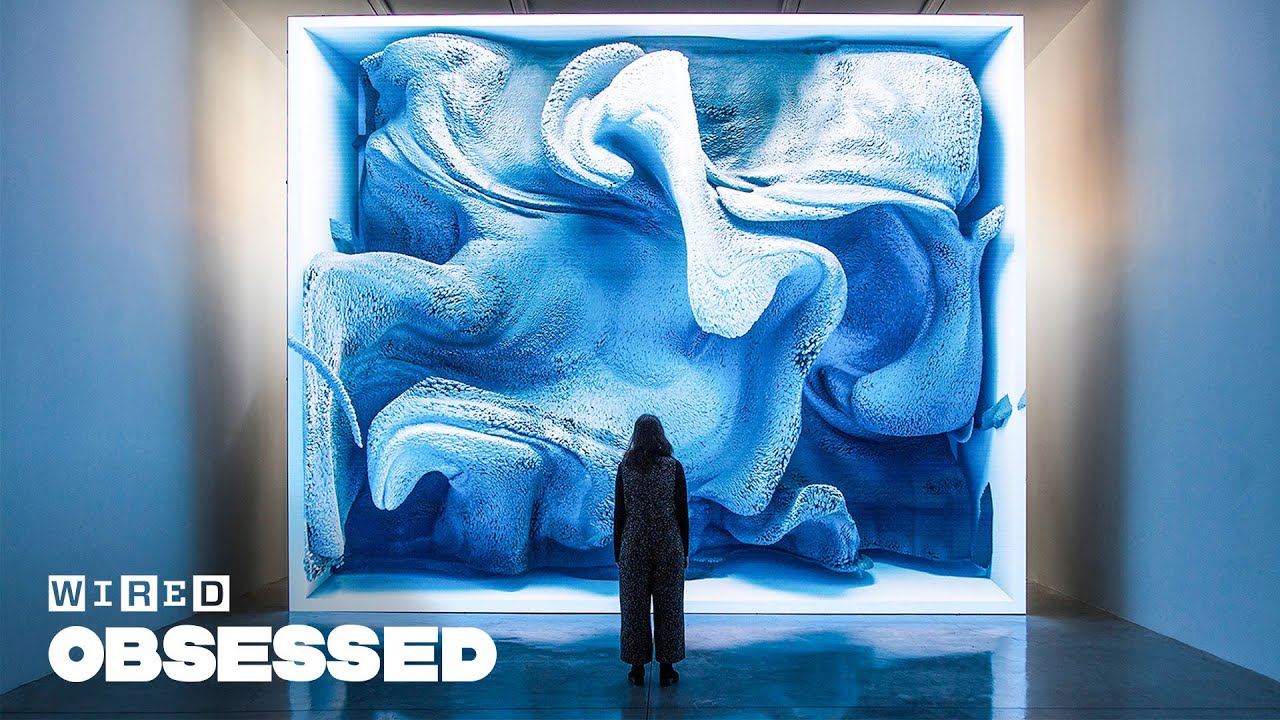
WIRED’s “Obsessed” series turns its camera on Refik Anadol, a Los Angeles-based media artist who has spent the last several years turning spreadsheets, sensor feeds, and satellite imagery into room-sized, moving works of art. He doesn’t touch a paintbrush or a slab of clay. Instead, Anadol feeds massive datasets into machine learning algorithms and artificial neural networks, letting them generate the shapes, colors, and motion that eventually get projected onto walls, ceilings, and building facades.
- Anadol’s central question, as he frames it in the profile, is simple but strange: “Can data become a pigment?”
- He describes raw data as abstract numbers with “no skin, no skeleton” — invisible until an algorithm gives it form.
- His stated goal as an artist is to build algorithms that narrate the hidden moments behind data, turning that information into kinetic, architectural-scale spectacle.
Data as a Raw Material
Most artists start with a physical substance — pigment, stone, film stock. Anadol starts with a hard drive. His installations pull from enormous archives: weather records, traffic patterns, brain scans, or the memories embedded in an institution’s own digital files. The machine learning system studies that archive the way a painter studies light, looking for patterns a human eye would never catch on its own.
That’s the leap at the center of the WIRED profile — treating data not as a spreadsheet to analyze but as a literal material to sculpt with, the same way a sculptor treats marble or bronze. Anadol’s neural networks don’t just visualize the numbers; they interpret them, generating new, synthetic imagery that never existed in the original dataset.
From Invisible Numbers to Public Spectacle
Anadol’s point in the piece is that data on its own is inert — columns of numbers nobody feels anything about. His job, as he describes it, is to build the translation layer between that abstraction and human perception, so that a wall of numbers becomes something a crowd will stand in front of for twenty minutes.
Can data become a pigment?
That question drives every project he takes on. The output isn’t a static image hung on a wall — it’s architecture that moves, shifts, and reacts, built entirely out of information that used to be invisible.
The Machine as Collaborator
What separates Anadol’s process from traditional digital art is how little of the final image he actually draws himself. The neural network is trained on a dataset, then left to generate its own interpretations, and Anadol curates and shapes what comes out the other end. He’s less a painter in this telling and more a director working with an unpredictable, algorithmic collaborator — one that can surprise him with shapes and textures no human hand would have produced.
Readers interested in how other creators are pushing unconventional materials and techniques into public-facing work might also check out the Interviews and Interesting News archive, or browse more artist and maker profiles under Documentaries.
Anadol’s larger point in the WIRED segment is that the tools of machine learning are still mostly associated with efficiency — sorting, predicting, optimizing. He’s using the same tools for the opposite purpose: slowing people down in front of a wall of moving light, asking them to feel something about numbers that, on their own, never asked to be looked at.






Building A Temple Swimming Pool Underground
This Is Why the Childhood of Rabbits Is so Terrible
Make Riptide (Expandable Pen Sword) From Percy Jackson!
Why I dress as a Regency gentleman… everyday of my life
DRIVING the Future Mercedes with NO Steering Wheel!!