

 InfoSearched
An uninsulated Idaho cabin winter drove one back-to-the-lander to dig his home into a hillside — for fifty dollars.
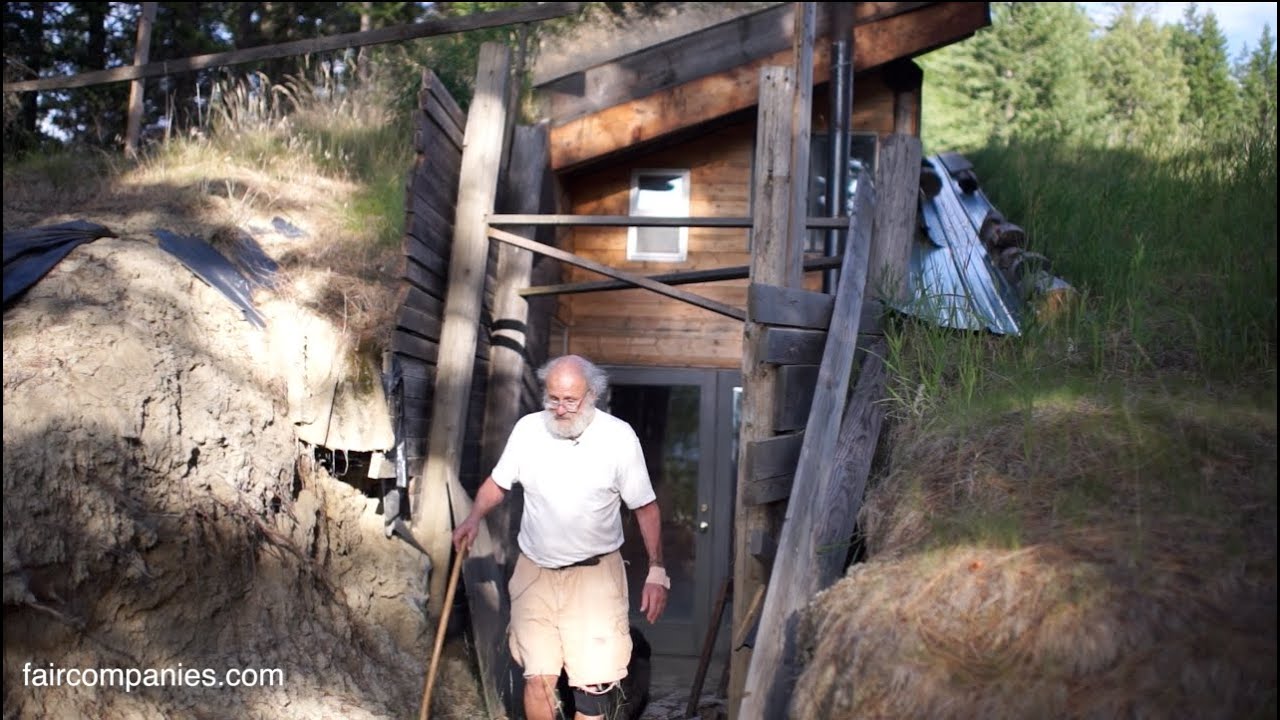
Mike Oehler left San Francisco in 1968 chasing the era’s back-to-the-land dream, bought remote acreage near the Canadian border in northern Idaho, and spent his first winter freezing in a poorly built cabin. That misery pushed him underground — literally. Videographer Kirsten Dirksen caught up with Oehler in his seventies for her documentary “Idaho modern oldtimer builds underground & solar $50 houses,” touring the earth-sheltered home he built by hand with logs cut straight off his own land.
- Oehler built his original underground house for roughly $50 in materials, then expanded it decades later for about $500.
- He rejected the standard “first thought” underground design — a hole cut into a hillside with south-facing glass — because it left rooms dark, view-less, and prone to drainage problems.
- His fixes, including the “uphill patio,” the “Hollywood Wing,” and the “Royer foyer,” became the backbone of his self-published manual, “The $50 & Up Underground House Book.”
From a Freezing Cabin to Life Underground
Oehler’s homestead sits in the kind of northern Idaho backcountry that punishes anyone unprepared for winter. After a season spent shivering in an uninsulated shack, he decided the ground itself — not lumber and fiberglass — was the better insulator. Using hand tools and timber felled on his own property, he dug and framed a house that used the earth’s mass to hold steady temperatures through both the cold months and the heat of summer, a technique now studied by builders in the wider passive-solar and earth-sheltered movement covered in tours like Step Inside Australia’s Underground Homes.
The Structural Failures of First Thought House
Oehler is blunt in the film about the mistake most people make when they first try underground construction: carve a hole into a slope, slap windows on the south wall, and call it done. He explains that this default design almost always backfires, trapping moisture, blocking cross-ventilation, and leaving occupants staring at a wall of dirt instead of a view. His own first attempt suffered from exactly that problem, which is what sent him back to the drawing board.
The “first thought house” — a hole in a hillside with south glazing — is the mistake almost everyone makes first, and the one Oehler spent decades designing his way around.
The Uphill Patio and Other Fixes
The breakthrough Oehler is most known for is the “uphill patio” — a sunken terrace dug into the slope above the house rather than in front of it, which pulls in light, drainage, and airflow while leaving room to build an attached earth-sheltered greenhouse. He paired that with the “Hollywood Wing” and the “Royer foyer” to manage entry and moisture, and used elevated clerestories and gables to bring daylight deep into rooms that would otherwise sit in shadow. These low-cost, low-tech solutions are what turned his manual into a reference point for other builders pursuing cheap, off-grid shelter, in the same spirit as projects like Solo Overnight Building a Sandbag Shelter In the Woods.
Decades on the Same Piece of Ground
By the time Dirksen filmed him, Oehler had lived on the property for over 30 years and was dealing with severe arthritis that made the hike up to his own hand-built house increasingly difficult. He still walks Dirksen through the mechanics of the design — how the greenhouse traps heat, how the clerestories track the sun, how the whole structure was assembled with materials he cut himself. It’s the same self-reliant streak that shows up in other rural Idaho stories, like Hiking 70 Miles Alone on the Sawtooth Loop Trail in Idaho.
Oehler’s arthritis had by then done what forty years of Idaho winters couldn’t — slow him down enough that the daily walk up to his own house had become the hardest part of living in it. He kept writing anyway, still pushing “The $50 & Up Underground House Book” on anyone who’d listen, because as far as he was concerned the design worked exactly as planned: cheap, warm, and built with a chainsaw instead of a mortgage.







Piers Morgan – The Luxury Life Of Dubai HD Documentary 2019
Locked Bucks Freed with Chainsaw
Centipedes: The Ultimate Nopes
13.2M Super Yacht Tour : Sunseeker 116 Yacht
This Fairytale Treehouse will make you Relive your Childhood Dreams