

 InfoSearched
Richard Hammond builds a fake living room underwater just to see if a cuttlefish falls for it.
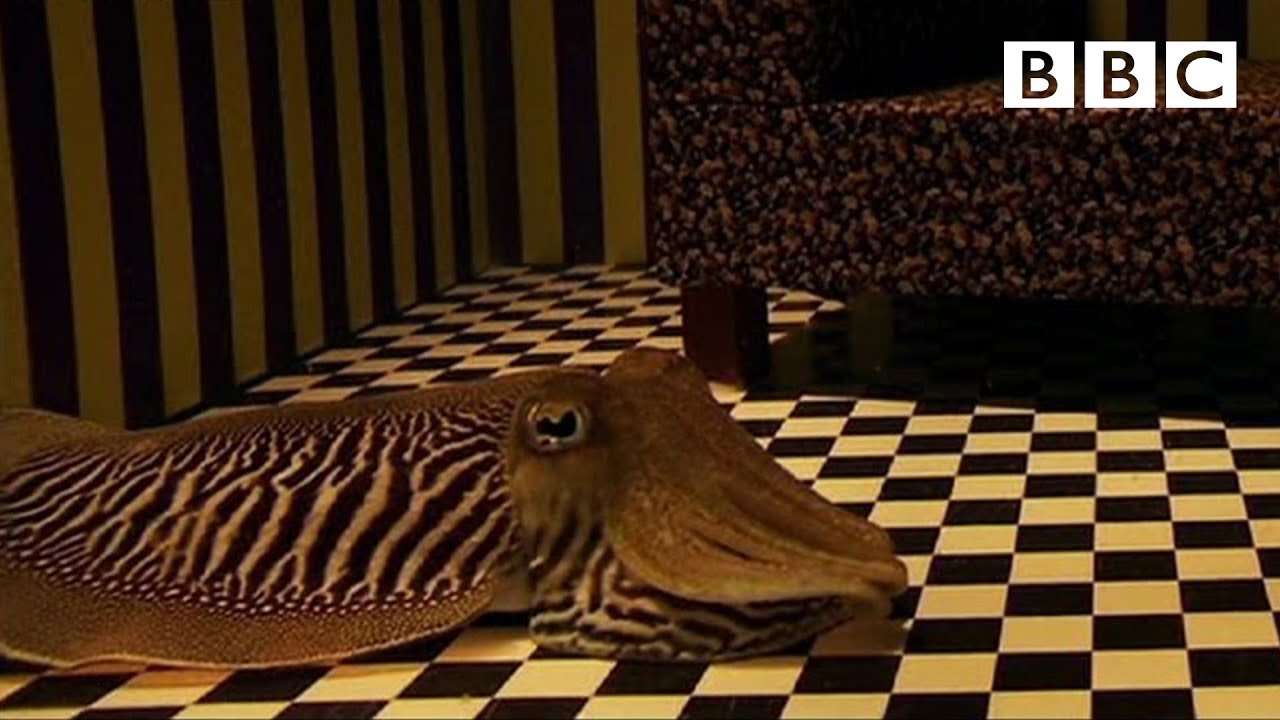
In one of the standout experiments from Richard Hammond’s Miracles of Nature, the BBC host sets out to answer a genuinely odd question: does a cuttlefish’s camouflage system, built over millions of years for sand, coral and seaweed, actually understand what it’s looking at, or is it just reacting to shapes and contrast? To test it, the production sinks a full-size domestic living room — striped wallpaper, a checkerboard floor, a chintz-patterned couch — into an aquarium tank and drops a cuttlefish into the middle of it.
- The production built a submerged living room set inside an aquarium tank, complete with striped wallpaper, a black-and-white checkerboard floor, and a miniature couch covered in floral, calico-style fabric.
- On the checkerboard tiles, the cuttlefish shifted into a high-contrast dark-and-light pattern but couldn’t reproduce the grid’s rigid geometry.
- Against the couch fabric, it matched a mottled reddish-brown hue and used dermal papillae to raise its skin into a bumpy texture, blending convincingly into the upholstery.
A Tank Dressed Like a Sitting Room
The setup is deliberately absurd. There’s no natural analogue in the ocean for striped wallpaper or a checkerboard tile floor, so whatever the cuttlefish does next isn’t something it could have learned or evolved specifically to handle. Hammond releases the animal into the tank and lets it explore on its own terms, moving from surface to surface, pausing over each one as if sizing it up before committing to a response.
That exploratory behavior matters. Cuttlefish don’t camouflage randomly — they inspect a surface visually first, then trigger a skin response tuned to what they’re seeing. Watching the animal glide across wallpaper, then floor, then furniture in the same tank gives Hammond’s cameras a rare side-by-side comparison of how differently it reacts to each texture within seconds of contact.
The Checkerboard Floor Trips It Up
When the cuttlefish settles onto the black-and-white checkerboard tiles, it does shift into a high-contrast pattern of dark and light patches, proving it’s registering the sharp visual contrast of the tiles. But it can’t lock onto the grid’s precise, repeating geometry — the blotches it produces are irregular, nothing like the clean squares beneath it. It’s a partial match: the animal reads “high contrast” correctly but has no mechanism for replicating strict, man-made regularity.
The Couch Is Where It Actually Fools You
The couch tells a completely different story. Against the busy, floral chintz print of the miniature sofa, the cuttlefish doesn’t just shift color — it goes reddish-brown and mottled, then physically changes its skin’s texture. Using dermal papillae, small muscle-controlled protrusions in the skin, it raises itself from smooth to bumpy, mimicking the raised, uneven feel of the fabric’s pattern. The combination of color and texture change is convincing enough that the animal genuinely disappears into the upholstery on camera.
Put a cuttlefish on a checkerboard and it fails the grid. Put it on a flowery couch and it vanishes completely.
The Biology Behind the Trick
None of this is possible without the cuttlefish’s chromatophores — millions of elastic, pigment-filled cells wired directly to the animal’s nervous system. Neural signals expand and contract these cells in fractions of a second, letting the cuttlefish paint new colors across its skin almost as fast as it can see them. Layered on top of that is the papillae system controlling texture, which is what turns the couch demonstration from a simple color match into a genuine 3D disguise.
What the experiment ultimately shows is that this entire system evolved for the seabed but runs on general-purpose visual rules — contrast, pattern density, edge detection — rather than a fixed catalog of “sand” or “coral” responses. That’s why it can improvise against fabric and tile it has never encountered in the wild, even if a rigid, human-made grid is a bridge too far. For more strange survival behavior from the animal kingdom, The Most Extreme Wild Animals Battles! covers other creatures pushed into unusual confrontations, and Filming The World’s Deadliest Bird digs into another BBC-style close encounter with a dangerous, camera-shy species.
The couch scene is the one that sticks — a cephalopod built for a reef somehow nailing a chintz sofa pattern on the first try, geometry be damned.






Matchstick Art – 7.5 Million sticks over 40 years
Saturation Diving- You’re in a different world
I’m A Chinese Cowboy With A Southern Accent
Deadliest Journeys – Papua New Guinea
The Haunted Island NO ONE Wants to Buy – 15 Islands you can buy