

 InfoSearched
In a valley beneath Cairo’s Mokattam Hills, a Coptic Christian community sorts the city’s trash by hand and recycles more of it than any municipal contractor ever has.
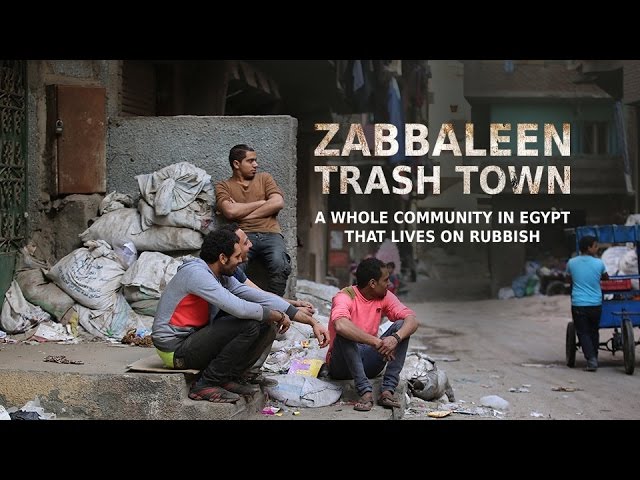
Manshiyat Nasser sits at the base of the Mokattam cliffs on Cairo’s eastern edge, known to outsiders simply as Garbage City. More than 60,000 people live there, most of them Coptic Christians whose families have worked the trade for generations. Documentarian Henk Braam’s footage follows the daily grind of that economy — the trucks rolling out before dawn, the sorting done by hand in courtyards and stairwells, and the recycling workshops that turn Cairo’s discarded plastic and aluminum into raw material sold back to manufacturers.
- Garbage City’s roughly 60,000 residents handle an estimated 60% of Cairo’s domestic waste through an informal, self-organized collection network.
- The community recycles an estimated 80–85% of what it collects, compared with under 25% achieved by the multinational waste contractors Egypt hired in the early 2000s.
- In April 2009, the Egyptian government ordered a cull of all domestic pigs, citing H1N1, which gutted the Zabbaleen’s organic-waste system and left refuse piling up in Cairo’s streets.
Operational Mechanics of the Collection System
The work is divided strictly by gender and age. Men and teenage boys — once running donkey carts, now mostly pickup trucks — drive fixed routes across assigned residential territories throughout Cairo, collecting trash bags door to door. Back in Manshiyat Nasser, women and children take over, sorting the incoming loads inside homes, courtyards, and the narrow alleys that wind up toward the Mokattam cliffs.
Plastics, glass, paper, and metals like aluminum cans get separated by hand, then baled, crushed, or granulated in small mechanical workshops built into the settlement itself before being sold to local and international manufacturers. It’s a supply chain assembled from scratch, with no municipal contract and no formal government recognition — closer in spirit to the recycling machines featured in how recycling machines turn used apparel into new clothes than to any city sanitation department, just running on human hands instead of automated lines.
A Recycling Rate the Government Couldn’t Match
The numbers are the story here. When Egypt brought in multinational waste companies in the early 2000s to modernize collection, those firms managed a recycling rate under 25%. The Zabbaleen, working without trucks fleets, sorting facilities, or subsidies, hit an estimated 80 to 85%.
An estimated 80 to 85 percent recycling rate, against under 25 percent from the multinational contractors Egypt paid to do the same job.
That gap is why Garbage City has drawn documentary crews and researchers for years — an informal settlement outperforming a formally contracted, professionally staffed alternative. It’s the same kind of counterintuitive systems story that shows up in how waste is dealt with on the world’s largest cruise ship, where scale and specialization solve a logistics problem most people never see solved at all.
The 2009 Pig Cull
Pigs used to be the hinge of the whole operation, consuming the organic food waste that made up a large share of what collectors brought back each day. In April 2009, the Egyptian government ordered every domestic pig culled, framing it as an H1N1 prevention measure even though public health experts at the time widely disputed any link between pigs and that flu strain.
The cull didn’t just cost the Zabbaleen their livestock — it broke a functioning organic-waste loop overnight. Rotting food waste that pigs had previously processed started accumulating in the settlement and in Cairo’s streets, a disruption the community has never fully replaced.
Organizing Without Formal Recognition
Groups like the Spirit of Youth Association, co-founded by community members including Ezzat Naem alongside advocates such as Laila Iskander, have spent years pushing to formalize collectors’ rights, running non-formal schools for children who work the trade, and setting up recycling cooperatives that give sorters more leverage over pricing. None of that has translated into official municipal status for Manshiyat Nasser, and eviction threats have surfaced repeatedly over the decades regardless.
Despite that, residents have built multi-story brick homes anchored around landmarks like the Saint Simon the Tanner Cave Church, carved into the Mokattam cliffs and now one of the largest churches in the Middle East. The settlement keeps functioning as an intergenerational system — sons driving the routes their fathers drove, daughters sorting in the same courtyards their mothers did — held together less by any city ordinance than by plain economic necessity.
What Braam’s footage captures, more than anything, is a system that never got the pig herds back after 2009 and still hasn’t gotten formal recognition from the Egyptian government — yet keeps clearing 60% of Cairo’s trash anyway, sorted by hand, block by block, the same way it has since the Zabbaleen first started working the city’s waste decades ago.








Easy Way To Grow Tomato Plant in Plastic Hanging Bottle
How To Regrow Everything
Breeding Maggots in a Tree (Auto Fish ‘Vending Machine’!) | Survival Fishing Challenge
Inside Liv Tyler’s Gut-Renovated NYC Brownstone
Earth-cooled, shipping container underground CA home for 30K