

 InfoSearched
Inside H&M’s flagship Stockholm store, an old sweater goes in one end of a glass box and a new one comes out the other — no water, no dye, five hours flat.
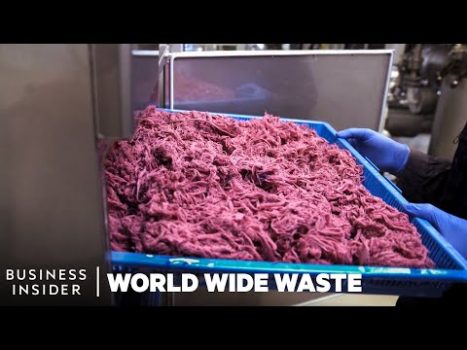
Business Insider’s “World Wide Waste” series turned its cameras on H&M’s most ambitious sustainability bet yet: a garment-to-garment recycling machine called Looop, installed inside the retailer’s flagship store on Drottninggatan in Stockholm in October 2020. The episode, “How H&M’s Recycling Machines Make New Clothes From Used Apparel,” follows the machine’s eight-stage process step by step and asks the question fast fashion can’t dodge forever — can a company that produces an estimated 3 billion garments a year actually recycle its way out of the waste it creates?
- Looop was developed by H&M in partnership with the H&M Foundation, the Hong Kong Research Institute of Textiles and Apparel (HKRITA), and Novetex Textiles, and installed at H&M’s Drottninggatan flagship in Stockholm in October 2020.
- The machine runs an eight-stage process — ozone sanitizing, shredding, carding, drawing, spinning, and knitting — turning an old garment into a new sweater, baby blanket, or scarf in about five hours, with no water or toxic chemicals.
- Customers pay 100 to 150 Swedish kronor (roughly $12–$18 USD) per remade item, but critics note Looop’s daily output is a rounding error against H&M’s estimated 3 billion garments produced annually.
Functional Mechanics of Looop Platform
Encased entirely in glass so shoppers can watch it run, Looop takes a customer’s worn-out garment and puts it through a mechanical gauntlet rather than a chemical one. The item is first sanitized with ozone, then shredded down into raw fiber before being carded and drawn — the textile-industry terms for combing and aligning loose fiber into a workable strand. From there it’s spun into new yarn and machine-knitted into a finished piece, all inside the same enclosed unit, start to finish, in around five hours.
The catch is fiber degradation. Mechanical shredding shortens the fibers pulled from old fabric, so Looop typically has to blend in virgin or sustainably sourced material — virgin wool or cotton, for instance — to give the new yarn enough strength to hold together. That means Looop isn’t a closed loop in the purest sense; it’s recycled content reinforced with fresh raw material, spun and knitted on the spot into whatever a customer’s willing to pay 100 to 150 kronor for.
The Overproduction Problem Looop Can’t Touch
The report’s sharpest point isn’t about the machine’s engineering — it’s about scale. H&M has pointed to Looop, along with broader textile-recovery investments, as proof of progress toward its stated goal of using 100% recycled or sustainably sourced materials by 2030. But Looop can only turn out a handful of finished garments a day, a volume that doesn’t register against a company producing roughly 3 billion garments annually.
Mechanical recycling cannot keep pace with the estimated 3 billion garments H&M produces every year.
That gap is exactly what environmental critics featured in the episode zero in on. High-tech, in-store recycling makes for a compelling showroom demo, but unless a fast-fashion retailer is willing to cut its total production volume, critics argue the technology functions more as a marketing showcase than an actual fix — a point that applies well beyond H&M to the wider churn of cheap, disposable clothing that keeps landfills full and drives demand explored in Business Insider’s own waste-management reporting on the world’s largest cruise ship.
Importance of Strategic Blend Integration
The requirement to mix in virgin fiber isn’t a minor footnote — it’s why every remade sweater still carries a slice of new cotton or wool instead of being pure recycled yarn. A sweater that goes in doesn’t come back out as pure recycled yarn; it comes back reinforced with new cotton or wool, meaning every remade item still carries a slice of newly sourced material. It’s a far cry from the throwaway trend cycles chronicled in pieces like 70’s Fashion Trends We’re Still Wearing in 2021, where garments were built to last rather than to be shredded and rebuilt on demand.
H&M isn’t hiding this limitation — it’s baked into how Looop is marketed, as an in-store experience and proof of concept rather than a factory-scale solution. The real test isn’t whether the glass box in Stockholm can spin a scarf in five hours; it’s whether H&M ever builds enough of these machines, at enough scale, to make a dent in 3 billion garments a year — and right now, one flagship store on Drottninggatan is the entire fleet.







Scottish Rasta Wanny’s Yard Tour! Mokko’s Neighbour in Jamaica
Inside a $65,000,000 Beverly Hills Ultra Modern MEGA MANSION
Mountain property with Waterfalls, Cheap land in Kentucky for sale
MEGAVALANCHE | Fighting for 1st place! | FULL RACE
Backyard teahouses for meditation, guest cottage, and homeoffice