

 InfoSearched
Fifteen snakes that break every rule you thought you knew about serpents.
A countdown from Top Fives runs through the planet’s most elusive, oddly built, and downright bizarre snakes — from a species so small it could pass for a strand of spaghetti to a viper with a horn on its nose. The list mixes critically endangered island endemics with the kind of household names that make even herpetologists nervous, and the common thread is how little most people know about any of them.
- The Barbados threadsnake (Tetracheilostoma carlae), formally described by biologist S. Blair Hedges in 2008, is the smallest known snake on Earth — adults max out around 10 centimeters (4 inches) and weigh just 0.6 grams.
- The short-nosed sea snake (Aipysurus apraefrontalis) is critically endangered, confined largely to Australia’s Ashmore and Hibernia reefs, and under pressure from commercial fishing bycatch.
- The Trinidad chevron is a rarely seen Caribbean island endemic found only on Trinidad, illustrating how geographic isolation alone can push a species toward rarity.
The World’s Smallest Snake
Topping the list is a snake most people will never see even if they live their whole lives on the island it calls home. The Barbados threadsnake, endemic to secondary forest fragments in Barbados, spends nearly all its time underground in a fossorial lifestyle, surfacing rarely and feeding almost exclusively on ant and termite larvae. Hedges’ 2008 description confirmed what island naturalists had long suspected — this was a species distinct enough, and small enough, to rewrite the record books for the genus Leptotyphlops, now reclassified as Tetracheilostoma.
What makes the threadsnake even stranger than its size is its reproduction. Females lay a single, disproportionately large egg, and the hatchling that emerges measures nearly half its mother’s total body length — an adaptation that gets the newborn snake large enough to survive and hunt almost immediately, since there’s no parental care waiting for it underground.
Adults reach roughly 10 centimeters and weigh 0.6 grams — about the width of a strand of spaghetti.
Endangered Sea Serpents and Island Endemics
Not every rare snake is small. The short-nosed sea snake patrols coastal reefs across the Indo-Pacific, but its stronghold is a narrow stretch of water around Australia’s Ashmore and Hibernia reefs. Habitat disruption and bycatch from commercial fishing operations have driven the species to critically endangered status, and unlike land snakes, it can’t simply retreat inland when a reef degrades — its entire life cycle is tied to that water column.
The Trinidad chevron faces a different kind of vulnerability. As one of the Caribbean’s most elusive island endemics, it exists in a habitat window so small that a single wave of deforestation or an introduced predator could wipe out a meaningful share of the population. The countdown also flags island pit vipers, blind burrowing snakes, and specialized racers that have suffered catastrophic declines for the same reasons — invasive predators, vanishing forest cover, and geographic confinement that leaves nowhere to retreat to.
The Giants and the Deadliest
On the opposite end of the spectrum sit the snakes built for raw power. The green anaconda, found through the Amazon River basin, can stretch up to 30 feet and swallow prey whole, while the reticulated python of Southeast Asia rivals it in length and relies on sheer constricting strength rather than venom. The bushmaster, the largest venomous snake in the Americas at up to 12 feet, and the Gaboon viper of sub-Saharan Africa, the largest viper species at up to six feet, both carry venom loads potent enough to be fatal without treatment. Anyone who has watched footage of a python strike, like the close call detailed in Giant Python Bit My Face, knows how fast that raw strength closes the distance.
The venom side of the list reads like a who’s-who of the world’s most dangerous species: the inland taipan of the Australian outback, considered the most venomous snake alive; the black mamba of sub-Saharan Africa, known for exceptional speed and aggression; the death adder, also native to Australia, whose triangular head and ambush strike can kill within hours; and the rhino viper of East Africa, distinguished by a horn-like projection above its nose and a bite that causes severe swelling and tissue damage. The blue coral snake of Southeast Asia and the widely distributed yellow-bellied sea snake round out the venomous entries, both marked by striking, almost warning-label coloration.
Genetic Rarities and Backyard Surprises
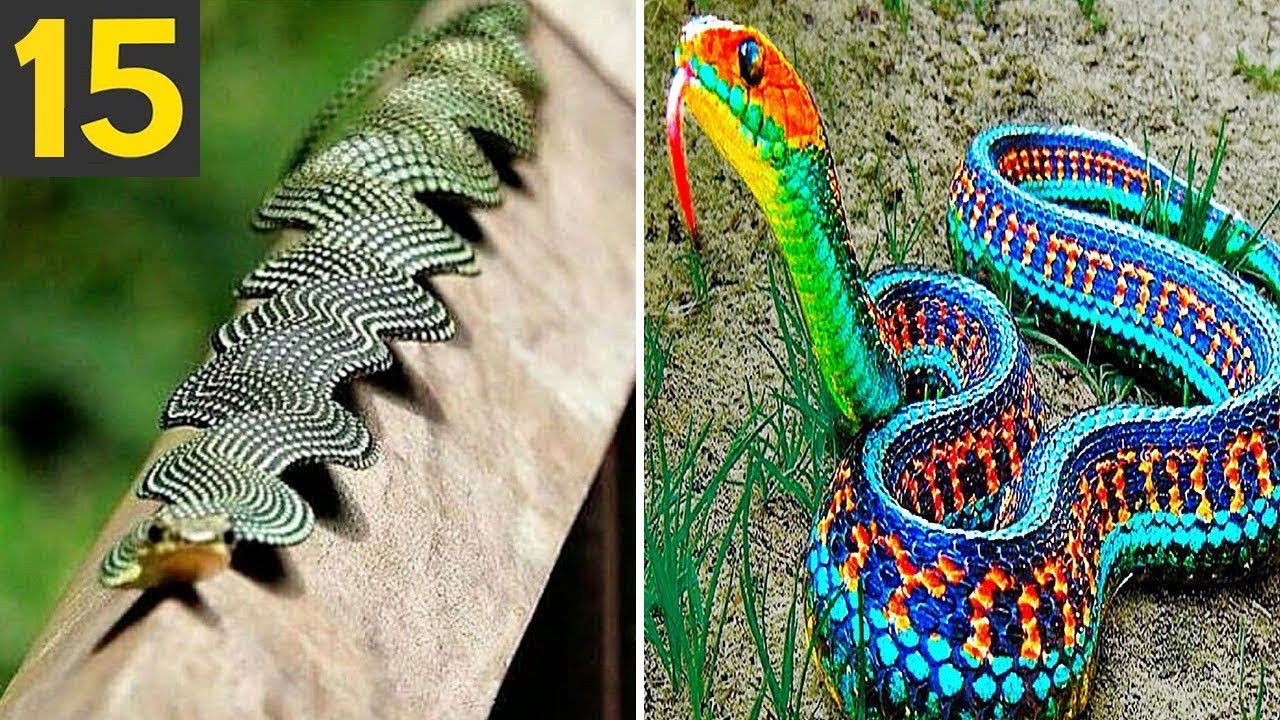
Not every snake on the list is exotic. The garter snake is common across North and Central America, but its wide range of colorful markings — stripes, spots, patches of bright color — makes it a reminder that “rare” doesn’t always mean “far away.” The true outlier here is the two-headed snake, a genuine developmental anomaly that occurs when twin embryos fail to fully separate. These specimens are exceptionally uncommon in the wild and are typically documented only when found by chance, making them as much a biological curiosity as a snake species in the traditional sense.
Of the fifteen, the Barbados threadsnake remains the one most likely to go extinct without anyone noticing — it’s confined to a handful of forest fragments on a single island, and its entire visible range could fit inside a few city blocks. That’s the throughline across this whole list: size and venom get the headlines, but it’s the ones with nowhere else to go, like the threadsnake and the short-nosed sea snake, that are actually running out of time.









“They Can’t Hide It Anymore” (unseen footage)
Robot spy gorilla infiltrates a wild gorilla troop ????️???? | Spy In The Wild
Epic Cloud Cave Wingsuit in Fusion Overcapture
Stunning Modern, Minimalist Tiny House
Pakistan’s City with No Water