

 InfoSearched
A soda bottle, some gravel, and a fistful of charcoal can turn swamp water into something you’d actually consider drinking.
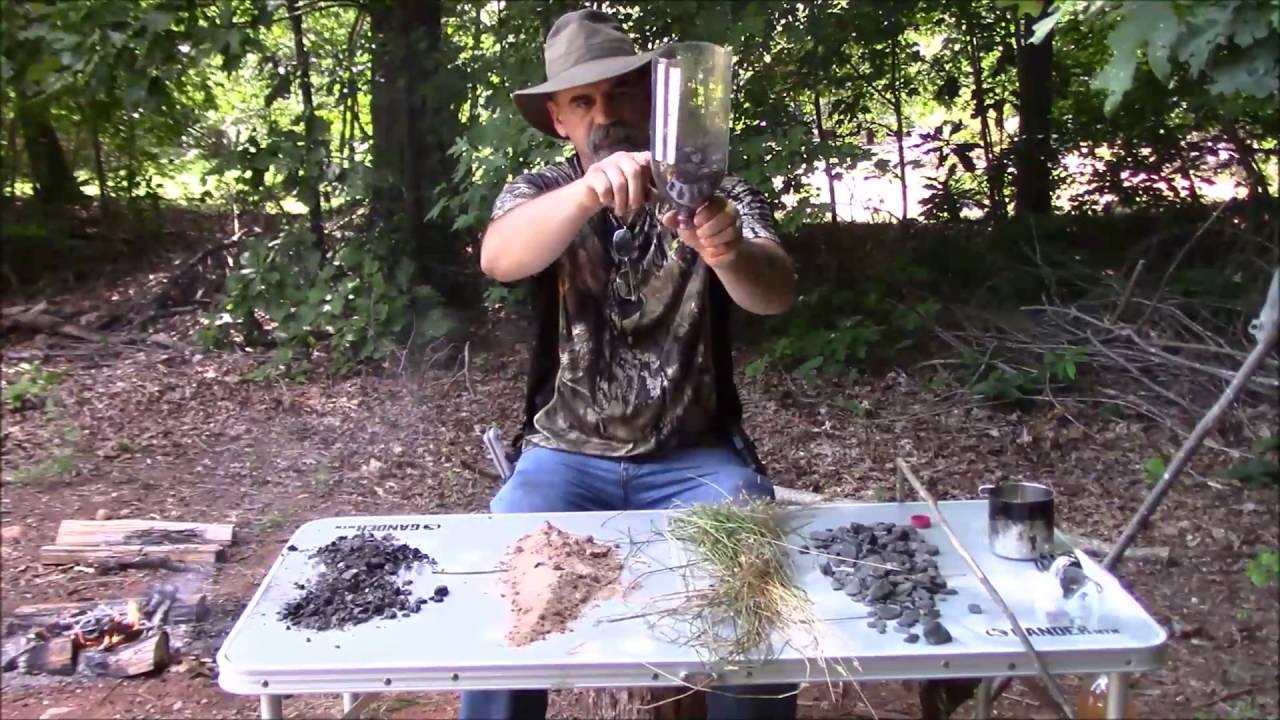
In the 2016 tutorial “2 Liter Water Filter from Natural Items,” the outdoor channel Survival on the SKinney breaks down a bushcraft staple: turning a discarded two-liter bottle into a gravity-fed water filter using nothing but stuff you’d find on the ground. The presenter demonstrates the build with genuinely filthy, mud-choked water, treating it less as a controlled lab test and more as a real-world worst-case scenario. It’s the kind of low-tech skill that shows up constantly in survival and prepping circles precisely because it requires no gear you didn’t already throw away.
- The filter is built from an empty two-liter bottle cut at the base and flipped neck-down, packed with a cloth or cotton plug, crushed charcoal, fine sand, coarse sand, and gravel or pebbles from bottom to top.
- The presenter tests the design against heavily mud-laden water and notes that multiple pours through the filter are needed before the water runs clear.
- The method works with any hollow container — a bottle, a section of hollow wood, anything that holds water — making it adaptable when specific gear isn’t available.
Building the Filter Layer by Layer
The construction starts with the bottle inverted, spout facing down, so gravity does the work. A porous plug — cotton, cloth, even a wad of dry grass — goes in first at the neck to keep the finer media from washing straight through and out the opening. From there the layers stack in what amounts to a reverse-gradient system: crushed charcoal sits closest to the neck to adsorb odors and dissolved chemicals, then fine sand, then coarse sand, with gravel and small pebbles filling the wide-open top.
That order matters. Water poured in at the top has to fight through the coarse material first, which strips out leaves, twigs, and larger floating debris before it ever reaches the finer sand and charcoal underneath. By the time it reaches the neck, most of the visible sediment load has already been caught higher up in the stack.
Testing It Against Real Mud
Rather than using tap water for the demo, the presenter runs the filter against water that’s visibly brown and clouded with silt — a stress test, not a showroom pitch. The first pass comes out noticeably murky. It’s only after running the same water through the setup two or three more times that it starts approaching something clear.
The more you cycle through the filter, the cleaner the water will be.
That single point is the crux of the whole demonstration: this isn’t a one-and-done fix. It’s a mechanical process that improves with repetition, and the presenter is upfront that starting with the least-contaminated water available — a running creek over a stagnant puddle, for instance — saves cycles and frustration down the line.
Filter Removal Capabilities and Limitations
Field guides on improvised filtration are consistent on this point, and the video doesn’t oversell the build: gravel, sand, and charcoal strip out turbidity, sediment, and a lot of the organic funk that makes questionable water smell bad. What none of those materials do is kill microscopic pathogens or neutralize chemical contamination. A bottle filter like this is a clarity fix, not a purification system.
That’s why the standard advice — boiling the filtered output, or running it through a chemical treatment — still applies afterward. The bottle setup gets you from “undrinkable sludge” to “clear water,” and the second step gets you from “clear water” to “safe water.” Skipping either half defeats the purpose.
Essential Role in Survival Kits
Part of the appeal is how little the build actually demands. There’s no need for a purpose-bought filter cartridge or a hardware-store trip — a soda bottle, streambed gravel, sand, and a few chunks of burned wood cover it. The presenter’s own framing, that the technique works with “any container… whether it be a bottle, hollow wood or whatever will hold water,” is the whole pitch: it’s a method, not a product, which is exactly why it turns up alongside other shelter-and-water content built around working with what’s already on hand, the same logic behind builds like the sandbag shelter built solo in the woods or the improvised setup in the bushcraft tent made from plastic wrap.
None of it replaces a real filtration cartridge or a rated bug-out kit, and the video doesn’t pretend otherwise — it’s a stopgap for the moment you’ve got muddy water and nothing else. Pack the layers right, run it through a few times, and boil what comes out the bottom. That’s the whole system.






The Most Dangerous Stretch of Water in the World
Woodturning – Hawthorn Root Lamp
5 Survival Shelters Everyone Should Know
How This Woman Started Diving in DIY Submarines
Survival on the smallest island in the Caribbean