

 InfoSearched
An entire hammock-tent built from nothing but plastic stretch wrap actually held.
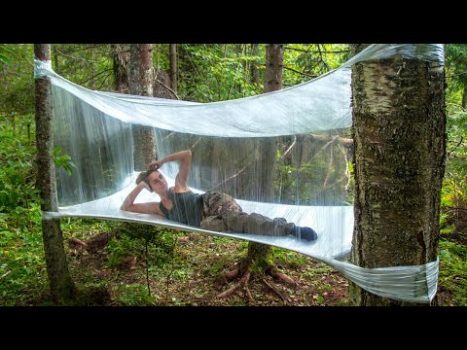
Osman Delibash, who runs the channel Os Bushcraft and Survival, set out to answer a question most campers never think to ask: can you build a full elevated shelter using only industrial plastic wrap? He hauled ten rolls into the woods, found four trees spaced at convenient intervals, and started wrapping. What came out the other end was a suspended hammock tent complete with walls and a rain roof — and he didn’t even need half the plastic he brought.
- Osman used four trees as anchor posts and wound plastic stretch film repeatedly around the perimeter to form a load-bearing base, then ran into the wall at full speed to test it — the film held and threw him backward instead of tearing.
- The hammock bed itself was built from a longitudinal layer of wrap strong enough to fall on safely, reinforced with a second, crosswise-wrapped roll for the finished platform.
- When rain started mid-build, Osman extended the wrap over the top for a waterproof roof and added a single vertical layer around the sides for walls, finishing the entire enclosed shelter with roughly five of his ten rolls.
Picking the Frame Before the First Wrap
The build starts the way most good bushcraft shelters do: with the terrain, not the materials. Osman scouted a stand of trees where four trunks sat at a workable distance from each other, cleared the dry branches and debris that would otherwise puncture the film, and used the trees themselves as the entire skeleton of the structure. No poles, no stakes, no cordage — just plastic wrap and load-bearing trunks doing the job that ridge poles usually do in a typical tarp setup.
Stress-Testing the Base
Once the perimeter between the trees was wound tight with repeated passes of stretch film, Osman didn’t just eyeball its strength — he ran directly into it. The wall didn’t puncture. It flexed, held its tension, and threw him backward onto the ground, proving the wrap could function as an actual load-bearing boundary rather than a flimsy barrier.
Ran straight into the plastic wall to test it — and got thrown right back onto the ground without tearing a single layer.
Building a Hammock That Holds Body Weight
With the frame proven, Osman laid a dense longitudinal layer of wrap across the trees to form the hammock bed — durable enough that he could fall onto it without ripping through. He then went back over it with a second roll applied crosswise, locking the platform into a genuinely secure, elevated sleeping surface. It’s the same layering logic seen in other improvised shelter builds, like the solo sandbag shelter build in the woods, where reinforcing a single material in multiple directions is what turns a flimsy layer into something that can actually support a person overnight.
Turning a Hammock Into a Sealed Tent
The weather made the decision for him. When rain started falling mid-build, Osman extended the same wrapping technique upward, stretching plastic between the trees to form a roof that matched the hammock floor below it. Then came a single vertical layer of film wound around the sides to block wind and blowing rain, with one gap left open as the entrance. What began as an open-air hammock ended as a fully enclosed, weatherproofed camp shelter — a transformation not unlike the improvised roofing solutions seen in the Iron Age bushcraft roof build done in soaking rain, where builders had to adapt on the fly once the weather turned.
Osman brought ten rolls of plastic wrap into the forest expecting to need every one of them. The finished hammock tent — base, bed, roof, and walls included — used about five.









Chinese online star Li Ziqi provides an escape from urban life
Harvesting Honey From A FLOW HIVE & Thoughts & Impressions of the Flow Hive
Why India’s Fair Skin Business Is Booming
One of the Oldest Ever People with Progeria (The Disorder That Makes You Age Rapidly)
WOMAN Builds Breathtaking SUSTAINABLE DOME HOMES