

 InfoSearched
A family of five ditched the driveway entirely and built their off-grid life around a boat dock instead.
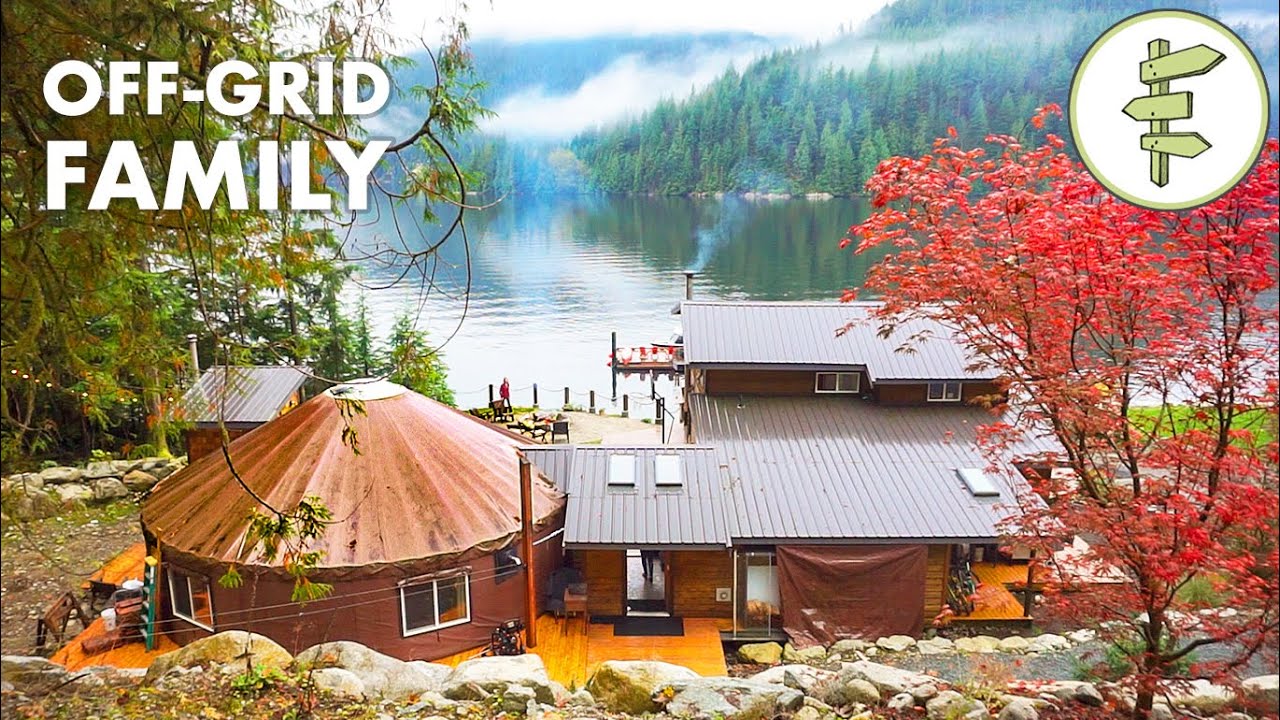
Mark and Chera rescued an old cabin on a mountain-ringed property with zero road access and turned it into a full-time home for themselves and their three kids. Every board, panel, and propane tank had to arrive by boat or barge, which shaped nearly every decision they made about how to build, heat, and power the place. Mat and Danielle of the YouTube channel Exploring Alternatives documented the whole setup in a video posted March 21, 2020.
- The property has no road access, so building materials, workers, and household goods all move in by boat and barge.
- The couple attached a yurt to the original cabin via a connecting mudroom to create bedrooms for their three kids without expanding the cabin’s footprint.
- Power comes from an 18-panel solar array plus battery bank, backed up by a run-of-the-river micro-hydro turbine and a propane generator for emergencies.
Building Where There’s No Road
Renovating a cabin is one thing. Renovating a cabin that can only be reached by water is another. Mark and Chera had to barge in every piece of lumber, every tool, and every worker who touched the project, which put a hard ceiling on how much they could realistically change about the original structure.
Rather than gut and expand the cabin, they solved their space problem by adding a yurt onto the side of it, connected through a mudroom. That gave their three kids separate bedrooms without hauling in the volume of materials a traditional addition would have required. It’s the kind of workaround that shows up a lot in remote self-builds, similar in spirit to the improvised additions seen in off-grid log cabin builds deep in the woods, where getting materials to the site is half the battle before construction even starts.
A Layered Heating System
With winter temperatures and a barge-dependent supply chain working against them, the family built in redundancy rather than relying on a single heat source. A wood stove handles the main cabin, while an automatic pellet stove keeps the yurt at a steady temperature for the kids around the clock. Wall-mounted propane heaters act purely as backup, kicking in on the coldest days or when the family is away and needs to keep the pipes from freezing.
Propane gets rationed hard. Since it only arrives by barge, it’s the most expensive resource in the whole operation, so the family treats it strictly as insurance rather than a daily fuel source.
Power From Sun and Stream
The main electrical system is an 18-panel solar array tied to a large battery bank, which comfortably covers the household through summer. The problem is winter: surrounded by mountains and stuck under overcast skies for weeks at a time, the panels can’t keep up when the family needs power the most.
Eighteen solar panels get them through summer; a run-of-the-river turbine on a hillside creek gets them through the dark, rainy months instead.
Their fix was a run-of-the-river micro-hydro turbine, driven by water pressure from a creek up the hillside. It delivers steady, 24-hour power for most of the year regardless of how much sun the panels are getting. A propane generator sits behind both systems purely as an emergency reserve, used only when it has to be. It’s a very different power strategy than something like the panel setup on a solar-equipped Tesla, where there’s no creek to fall back on if the sun disappears.
The Daily Commute
None of this works without a reliable way to get to town. The kids still attend regular school, and Mark and Chera keep flexible work schedules that let them operate from town or from home depending on the day. Getting there means a 20-minute run in one of two enclosed, heated boats, both fitted with GPS for navigating the water safely regardless of conditions.
It’s a setup that echoes the logic behind other water-based off-grid homes, like the self-built floating home that trades a foundation for a hull entirely — except here, the boats aren’t the house, they’re the driveway.
That’s the day Mark and Chera signed up for: two heated boats, one 20-minute crossing, and a family of five who trade a driveway for a dock every single morning.






Inside Lenny Kravitz’s Brazilian Farm Compound
How does luxury car lease hacking work?
Negotiation Skills: The “60 Seconds Or She Dies” Challenge With FBI Negotiator Chris Voss
Flying Foxes Vs Freshwater Crocodile | Lands of the Monsoon
FASHION TRENDS FALL-WINTER 2019-2020 & how to wear them ǀ Justine Leconte