

 InfoSearched
Landing a jet on a pitching flight deck at 150 miles an hour leaves almost no room for error.
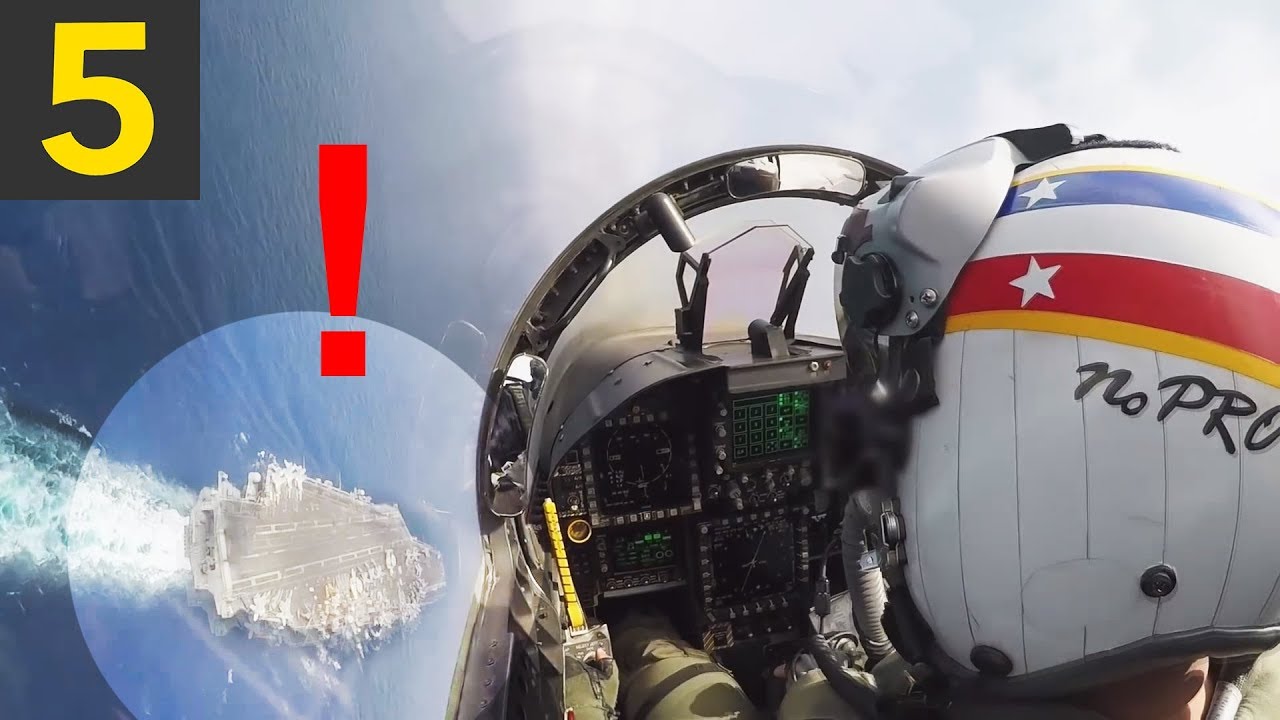
Top Fives, the countdown channel known for military and aviation compilations, built one of its most-watched videos around exactly that margin for error. “Top 5 Amazing Aircraft Carrier Landings” strings together five of the most dramatic traps in modern naval aviation, from a snapped catapult cable to a jet that touched down with no landing gear at all. The video has racked up more than 9 million views on YouTube and made the rounds through defense and aviation circles well before this compilation crossed into the mainstream.
- Top Fives’ “Top 5 Amazing Aircraft Carrier Landings” has drawn more than 9 million YouTube views and was featured by FighterSweep in December 2018.
- The countdown spans a 1985 USS Midway recovery with a snapped catapult cable and a 2017 landing where Air Force Captain Brett DeVries brought his F-16 down nose-first after all three landing gear wheels failed.
- One entry covers the USS Theodore Roosevelt riding out Super Typhoon Noul’s gale-force winds and 15-foot swells in 2015, when a jet skidded 200 feet down the deck before the arresting hook finally caught the wire.
Trap Difficulty Challenges Professional Efficiency
Every entry in the countdown circles back to the same brutal physics problem: a fighter jet has to catch a two-inch arresting wire on a runway that’s pitching, rolling, and moving forward at the same time. Carriers exist to project air power far from any friendly airstrip, but that advantage only holds if pilots can consistently bring their aircraft back down in one piece. A missed wire, a hard bounce, or a bolter at the wrong angle can wreck an airframe worth tens of millions of dollars and put the pilot’s life on the line in the same instant.
That’s the tension Top Fives leans on throughout the video — not scripted heroics, but real footage of pilots working through mechanical failures and violent sea states with the deck crew a few feet away. The same discipline shows up in cockpit footage from other high-performance flying, like the over-the-shoulder F-16 demo footage from the Myrtle Beach Airshow, where split-second corrections separate a clean pass from a disaster.
A Snapped Cable on the USS Midway
The countdown opens in 1985 aboard the USS Midway, commissioned in 1945 and kept in active service for forty-seven years. During a routine recovery, the catapult cable snapped mid-operation — a failure that, on paper, should have ended in a wave-off or worse. Instead, the pilot held the approach together and landed cleanly, sparing both the aircraft and the flight deck from serious damage.
Falklands Emergency and a Typhoon at Sea
Next up is the HMS Hermes, commissioned by the British Navy in 1959 as the first ship capable of operating the Harrier Jump Jet. By 1980 it was serving as flagship during the Falklands War, and one of its Harriers was forced into an emergency landing on the Hermes’ deck after the mainland runway became unavailable. The pilot brought the jet down without incident, a landing that still gets cited as proof of the Harrier’s flexibility in a genuine crisis.
The fourth entry jumps forward to 2015, when the USS Theodore Roosevelt was caught in gale-force winds and 15-foot swells generated by Super Typhoon Noul. A jet attempting to trap missed the arresting cable entirely and skidded 200 feet down the pitching deck before the hook finally grabbed the wire and stopped the aircraft.
Two hundred feet of flight deck, gale-force wind, and one arresting hook standing between a routine landing and a disaster.
No Landing Gear and No Room for Error
The video’s third entry shows a Chinese naval pilot executing a controlled carrier practice landing in 2019, footage that spread widely for how cleanly the hook caught without slamming into the deck first — a mistake that can end in catastrophic failure. The final and most dramatic entry belongs to U.S. Air Force Captain Brett DeVries, who in 2017 lost all three landing gear wheels on approach to a carrier deck. DeVries controlled the jet’s descent and angled the nose down himself, bringing the aircraft to a stop with heavy damage to the airframe but walking away unharmed — the kind of outcome that puts him in the same conversation as pilots covered in other Air Force skill-and-endurance testing that gets circulated in aviation communities.
Each of these five recoveries got picked apart frame by frame once the footage started circulating, and that’s the appeal Top Fives built the countdown around — not a ranking gimmick, but five separate moments where a single pilot’s hands on the stick were the only thing standing between a routine trap and a wrecked jet.








BILLIONAIRE for a week – Most EXPENSIVE of DUBAI
Brides by Force. Marriage by kidnapping pushes Kyrgyz women to suicide
Meet the Accidental Genius
Why Real Champagne Is So Expensive?
What Happened to YVONNE DE CARLO ( LILY MUNSTER )