

 InfoSearched
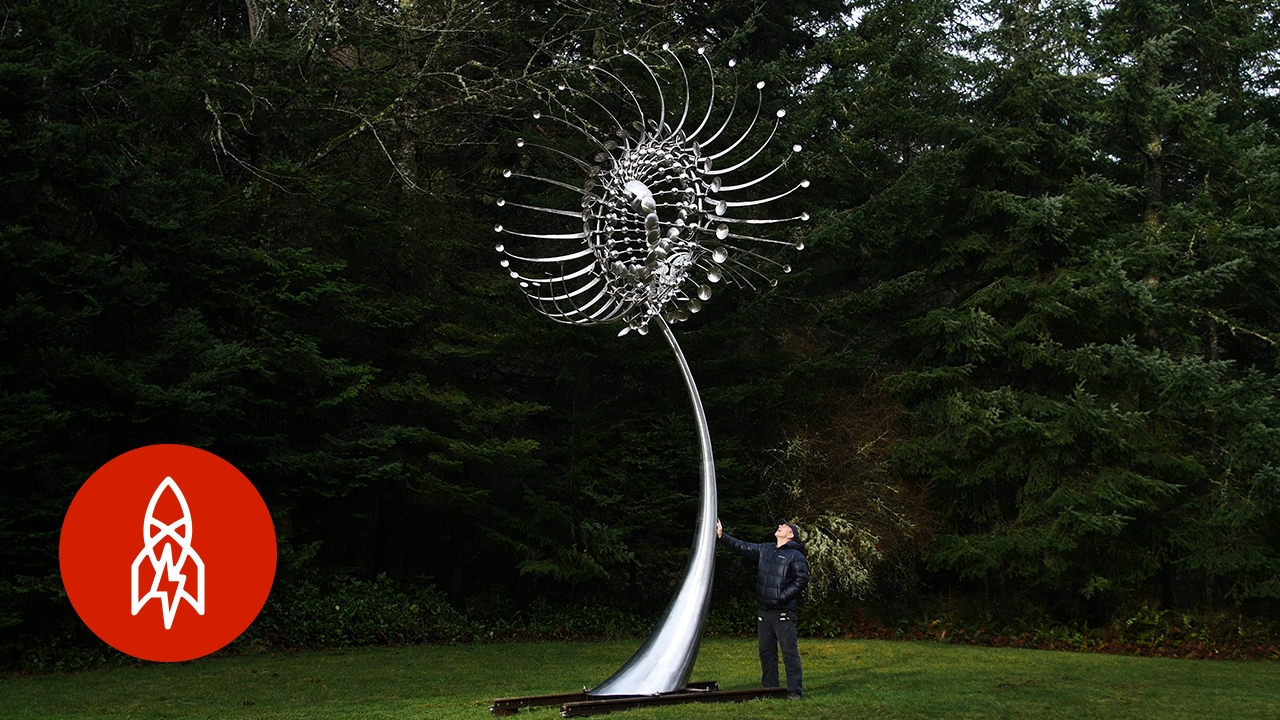
A stainless-steel sculpture the size of a house starts breathing in a 2 mph breeze.
Anthony Howe builds kinetic sculptures that look like they shouldn’t work — towering, curved-metal forms that spin, ripple and fold in on themselves like something alien, or something alive. Great Big Story caught up with him at his home and outdoor studio on Orcas Island, Washington, for the 2016 feature “These Kinetic Sculptures Hypnotize You,” and the footage explains exactly how a sculptor gets stainless steel to move like water.
- Howe’s largest sculptures stand up to 25 feet tall and weigh as much as 1,600 pounds, yet they’re balanced to start spinning in winds as gentle as 2 mph.
- He designs and tests the motion digitally with CAD software before fabricating a single part with plasma cutters, metal lathes and hand tools.
- Works like Di-Octo and In Cloud Light III are assembled from hundreds of interlocking, modular components engineered to survive gale-force winds.
The Artist Behind the Motion
Howe works out of his home and outdoor studio on Orcas Island, a wooded, water-bound spot in Washington’s San Juan Islands that doubles as both workshop and testing ground. It’s an environment not unlike the kind of self-built, off-grid woodworking workshop setups favored by makers who need space, wind and isolation to build things nobody else is building. Every piece he makes has to survive outdoors, in real weather, which shapes the entire design process from the first sketch.
Engineering the Illusion Before It’s Built
Before Howe cuts any metal, he models the sculpture’s movement digitally. Using CAD software, he simulates how each curved panel will rotate, pulse and interact with the pieces around it, essentially choreographing the sculpture’s motion on a screen before it exists in the physical world. Only after the digital model behaves the way he wants does the fabrication begin.
From Screen to Steel
That digital blueprint gets translated into steel through old-fashioned metalworking: plasma cutters slice the individual curved components, metal lathes shape connecting parts, and Howe hand-balances and assembles hundreds of rotating modular pieces so the whole structure moves as one continuous form rather than a collection of separate parts.
Howe’s largest sculptures stand up to 25 feet tall, weigh as much as 1,600 pounds, and still start spinning in a breeze as light as 2 mph.
Built to Survive Gale-Force Winds
The engineering challenge isn’t just making something that looks hypnotic — it’s making something that survives outdoors indefinitely. Howe’s sculptures are balanced with enough precision to respond to the faintest gust while remaining structurally sound in gale-force conditions, which is why his pieces can be installed as permanent public fixtures rather than gallery-only objects. The interlocking shapes catch both wind and ambient light at once, which is what produces the pulsing, breathing effect that’s drawn comparisons to alien spacecraft and undulating octopus tentacles.
Next time the wind kicks up outside, remember what it takes on Orcas Island: 2 mph is all it takes to get 1,600 pounds of stainless steel moving like it’s alive.







Why Cashew Nuts Are So Expensive
10 Cutest Exotic Animals You Can Own as Pets
Women with Different Salaries on What they Feel Guilty Buying | Glamour
Saving People From Massive Waves… They Almost Drowned
The Badger that can escape from anywhere! | Honey Badgers: Masters of Mayhem