

 InfoSearched
Thirteen episodes, one continuous build, and not a single word spoken.
Mike Pullen spent his “Bushcraft Camp Update” series quietly turning a patch of woodland into a full timber compound, and in “Bushcraft Camp: Full Super Shelter Build from Start to Finish,” the TA Outdoors creator strings all 13 episodes together into one 61-minute film. There’s no narration, no piece-to-camera explainer — just the sound of axes biting into logs, cordage tightening, and fire catching, edited in the ASMR style that has become his channel’s signature.
- The video merges all 13 “Bushcraft Camp Update” episodes into a single 61-minute, no-talking film focused entirely on ambient build sounds.
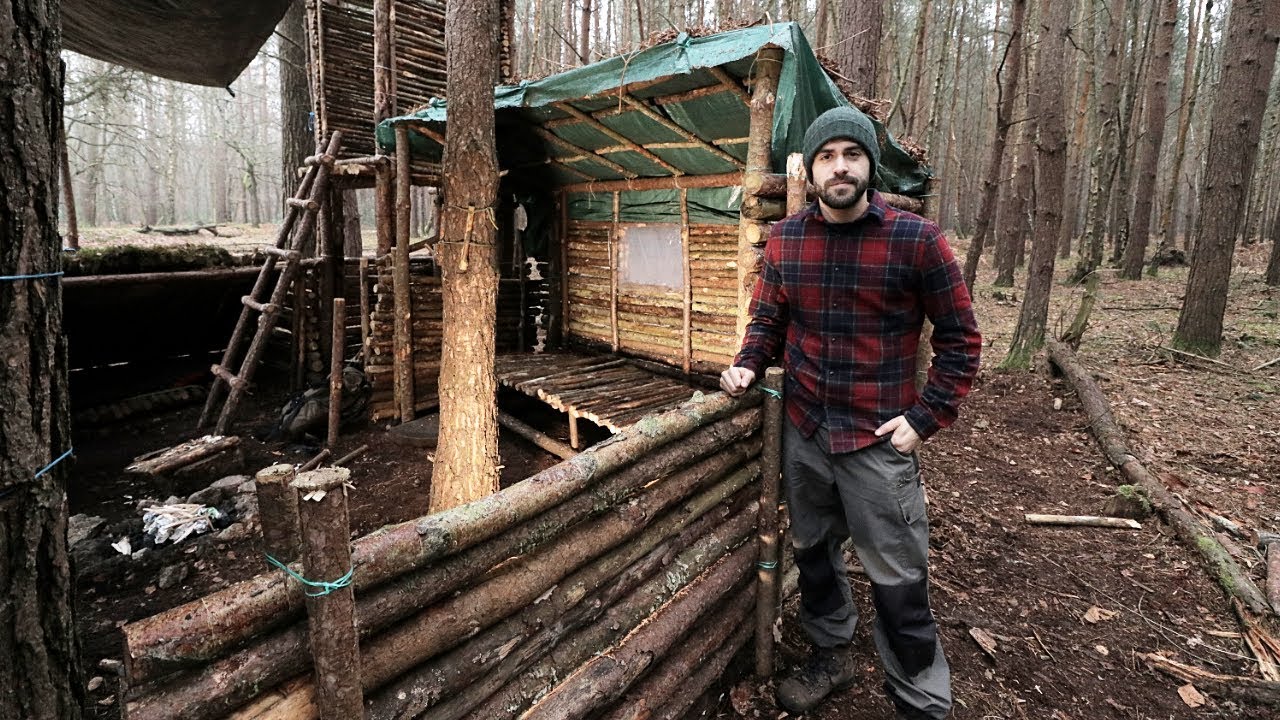
- The finished compound includes a lean-to super shelter with an elevated log bed and a tarp roof run on a rope pulley system, plus a hunting tower, dog house, second lean-to, fire pit, log store, bushcraft bench, and full perimeter walls with a gate.
- Episode 11 — building the hunting tower and ladder entirely solo — is the build Pullen singles out as his favorite part of the whole series.
From Budget Tools to a Full Compound
Pullen started the super shelter using cheap hand tools to keep costs down, then upgraded to better-quality gear once his technique caught up with his ambition. That progression is visible across the merged footage: early notching and lashing work looks slower and more improvised, while later stages — the perimeter walls, the gate, the hunting tower — move with the efficiency of someone who’s spent dozens of nights sleeping next to what he’s building. The core structure, a lean-to “super shelter,” carries an elevated log bed to keep him off the cold ground and a main tarp roof tensioned by a functional rope pulley system, the kind of detail that separates a one-night tarp setup from a camp meant to be lived in.
Building Outward from the Shelter
Once the primary shelter was standing, Pullen expanded outward. He added a dedicated fire pit, an organized log store, and a rustic bushcraft bench split straight from a log — practical camp furniture rather than showpieces. A second, smaller lean-to with its own wood roof gave him backup shelter, and a standalone dog house let his dog Jaxx stay out overnight with him. The whole site was eventually enclosed by natural timber perimeter walls with an entryway gate, turning a single shelter into something closer to a fortified woodland base.
The Hunting Tower, Built Alone
Of everything in the series, Pullen points to Bushcraft Camp Update 11 — the elevated hunting observation tower with its handmade wooden ladder — as the standout. He built it entirely on his own, without help, and it shows in the footage: notching, hauling, and bracing a tower frame solo is a different problem than building with a second set of hands.
“My favourite part of the series was definitely Bushcraft Camp Update 11 where I built the Hunting Tower with ladder completely on my own. It wasn’t an easy build, and I made many mistakes along the way, but I learnt from them, and for me that was the most important part: to learn to work with nature and not against it.”
That line captures the whole series better than any of the build footage does — this was never just about the finished tower or the finished wall. Pullen treats every mistake, every re-cut notch and re-tied lashing, as the actual curriculum, with the physical structure as the byproduct. It’s the same instinct that runs through other solo bushcraft projects on the channel, from testing shelter designs like the plastic-wrap bushcraft tent to weaving natural materials by hand in builds like the pine-needle basket project.
A Finished Camp, Not a Finished Project
With the log cabin-style compound largely complete, Pullen frames it less as an endpoint and more as a base of operations — a place to keep learning primitive technology and studying his surroundings rather than a box to check off. That mirrors the approach seen in other long-form woodland builds, like the drenched-out roof work in an Iron Age bushcraft build finished in soaking rain, where the shelter is really just the tool that makes everything else — the overnight stays, the fire craft, the survival testing — possible.
Pullen’s already used the finished camp for solo overnights, which was the point of building it in the first place — a permanent base in the woods rather than a one-off project to strike camp on. Thirteen episodes in, the ladder up to that hunting tower is still the one piece of the build he did entirely by himself, mistakes included.








The Most Cleverly Designed School Bus Conversion – A True Apartment On Wheels
30 Healthy Habit Hacks You Need To Know!
Idaho modern oldtimer builds underground & solar $50 houses
WOMAN Builds Breathtaking SUSTAINABLE DOME HOMES
Man captures all walks of life crossing log bridge