

 InfoSearched
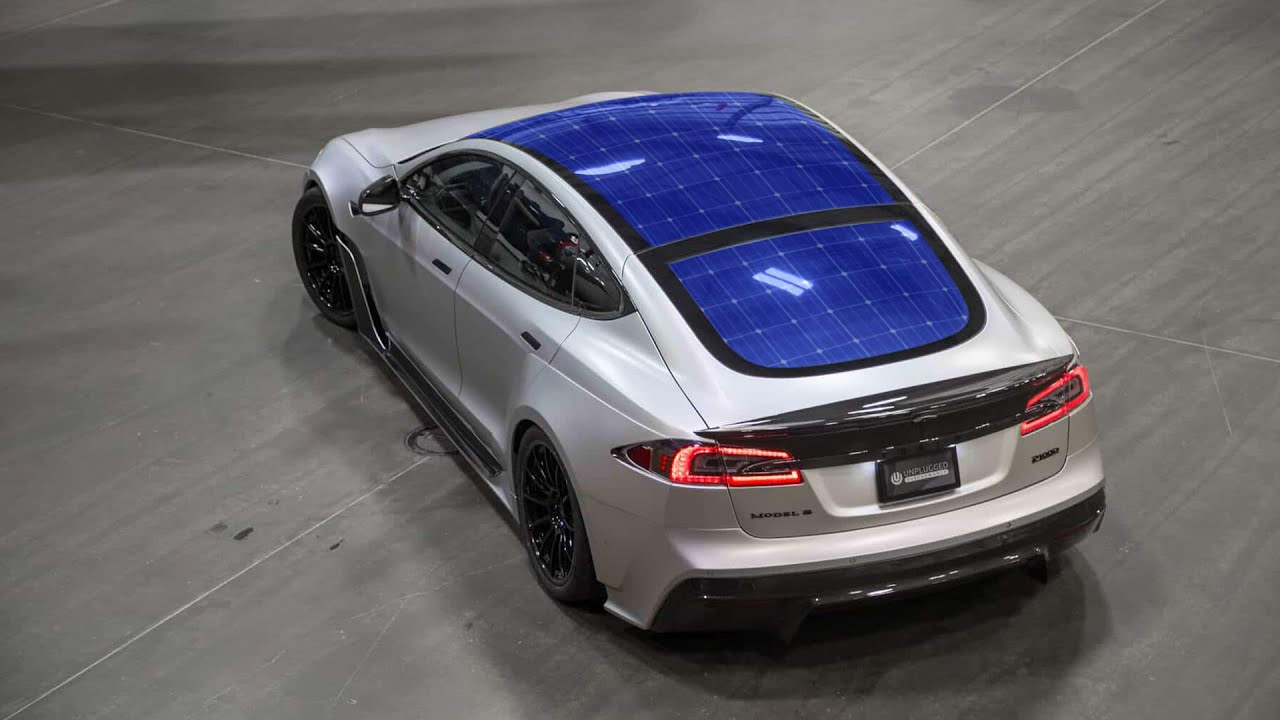
A Tesla covered in solar panels sounds like the ultimate off-grid dream — until you do the math on the roof.
The pitch is seductive: park an electric car in the sun, walk away, come back to a fuller battery. No cord, no charger, no grid. The channel Electric Future breaks down why that idea runs into hard physics the moment you try to build it, and why Tesla’s own thinking on solar-equipped cars has flipped more than once in the last few years.
- A standard car roof can only carry about 200 to 400 watts of solar capacity, which translates to a handful of miles of range per day even under ideal sun.
- Elon Musk tweeted in November 2016 that Tesla would “probably” put a solar roof option on the Model 3, then reversed course in 2017, arguing home solar paired with a Powerwall made more sense than panels bolted to a car.
- After the November 2019 Cybertruck unveiling, Musk revived the idea, confirming an optional solar bed cover good for roughly 15 miles of range a day, with fold-out solar wings potentially pushing that to 30 to 40 miles.
The Math on a Car Roof
Take a sedan the size of a Tesla Model S — roughly 5 meters long and 2 meters wide — and imagine covering the entire flat plan-view area, about 10 square meters, in solar cells. Even that hypothetical, totally impractical array runs into the same wall every real installation hits: limited surface area, a roofline that’s rarely angled toward the sun, shade from trees and buildings, and the extra weight the panels themselves add to the car.
Run the numbers on what actually fits on a normal roof — 200 to 400 watts — and the output on a sunny day is a few miles of range, not a meaningful dent in a daily commute. That gap between the dream and the wattage is the entire reason automakers have treated rooftop solar as a nice-to-have rather than a charging strategy.
A standard car roof can carry roughly 200 to 400 watts of solar capacity — enough for a handful of miles a day, not a road trip.
Musk’s Solar Reversal
Elon Musk didn’t always dismiss the idea. In November 2016 he tweeted that Tesla would “probably” offer a solar roof option on the then-upcoming Model 3, floating the idea of a retractable design. By 2017 he’d changed his mind, concluding that a car’s surfaces are too small and too poorly angled compared to a stationary rooftop solar installation on a house, especially one paired with a Powerwall battery that can recharge the car overnight using stored daytime energy plus cheaper off-peak grid power.
It’s the same logic behind why solar-equipped catamarans and off-grid boats favor big, flat, unobstructed panel arrays rather than trying to squeeze cells onto a curved hull — vehicles like the Silent 80 solar-powered catamaran work because they have the deck space a sedan roof simply doesn’t.
The Cybertruck Revival
Musk came back around to the concept after the Cybertruck’s unveiling in November 2019. He confirmed the pickup would offer an optional solar bed cover, estimating it could generate about 15 miles of driving range per day under direct sunlight. With fold-out solar wings deployed, Musk suggested that figure could climb to roughly 30 to 40 miles a day — a meaningfully bigger number than anything a sedan roof can produce, largely because a truck bed offers far more flat, unshaded surface area to work with.
Purpose-Built Solar Cars
Rather than bolting panels onto an existing platform, a handful of startups are designing electric cars from the ground up around solar generation. Lightyear, which grew out of the University of Eindhoven’s Stella program built for the World Solar Challenge race across the Australian outback from Darwin to Adelaide, built the Lightyear One using lightweight aluminum and carbon fiber and one of the best aerodynamic coefficients on the market, with four independently driven in-wheel motors to cut weight and improve efficiency.
Sono Motors is chasing the same goal from a cheaper angle with its roughly $29,000 Sion, integrating solar cells directly into polymer body panels instead of conventional painted metal. Toyota has tested a Prius fitted with high-efficiency thin-film triple-junction cells from Sharp, and Chinese manufacturer Hanergy Solar has demonstrated prototype panels capable of harvesting 8-10 kWh a day, supplying similar technology to Aston Martin’s GTE racing program.
Cell Efficiency and the Battery Bottleneck
Most solar panels on the market rely on silicon-crystal cells converting sunlight to electricity at around 15% to 19% efficiency. Newer materials in development could push that well past 50%, which would be enough to make solar-assisted daily driving genuinely practical rather than a novelty. The other half of the equation is weight: heavy batteries remain the limiting factor for any solar car, and research into graphene, solid polymers, and ceramic-based battery chemistries is aimed at higher energy density, longer service life, faster charging, and improved safety — the kind of breakthrough that would matter more to a solar car’s range than any incremental gain in panel efficiency.
For now, the split is clear: Tesla treats a roof or truck-bed panel as a trickle-charge extra, worth 15 miles on the Cybertruck and maybe 40 with the wings deployed, while outfits like Lightyear and Sono are betting an entire vehicle can be engineered light and aerodynamic enough to make solar the primary charging source rather than a backup.









Man Spends 30 Years Regenerating Farmland into Amazing Forest | Fools & Dreamers (Full Documentary)
Can Israelis and Palestinians See Eye to Eye? || Creators for Change
Entering the Murder Capital of the World.
New Earthships capture more energy, water & food at lower cost
The Man Living in Complete Isolation for 40 Years (Part 4/4) | Far Out