

 InfoSearched
Some of the strangest sand on Earth glows, digs into hot springs, or hides behind a cave wall reachable only by boat.
The YouTube countdown “15 Most Unique Beaches In The World,” posted by the channel Top Fives, has racked up millions of views by doing something simple: showing viewers coastlines that look nothing like the postcard tropical shoreline most people picture. The list runs through volcanic basalt columns, geothermal sand pits, and beaches colored by everything from microscopic organisms to broken glass bottles. Each entry gets its punch from a real geological or biological quirk, not just a pretty camera angle.
- Giant’s Causeway in Northern Ireland is built from roughly 40,000 interlocking hexagonal basalt columns, the leftovers of an ancient volcanic fissure eruption.
- Hot Water Beach on New Zealand’s Coromandel Peninsula sits above an underground geothermal spring, letting visitors dig their own private mineral bath into the sand at low tide.
- Pink Sands Beach on Harbour Island in the Bahamas gets its blush tone from microscopic red-shelled organisms called foraminifera mixing into the white coral sand.
The Volcanic Coastlines
Giant’s Causeway anchors the list for good reason. Its basalt columns, most of them hexagonal and packed together like a stone honeycomb, formed when an ancient lava flow cooled and cracked in a uniform pattern along the coast. The video also points to Iceland’s black-sand shores, including beaches like Vik and Diamond Beach, where dark volcanic rock has been ground down by the surf into sand the color of asphalt, often scattered with chunks of glacial ice that wash up from nearby icebergs.
Roughly 40,000 interlocking basalt columns line the shore at Giant’s Causeway.
That volcanic theme runs through several entries beyond the two headliners. Readers who want more on how eruptions reshape landscapes in real time might recognize the pattern from the strange lava formations that show up near active volcanoes, where cooling molten rock produces oddities that look almost too strange to be natural — the same basic physics at work on a much larger scale along these coastlines.
Hidden and Hydrothermal Beaches
Hot Water Beach works on a timer dictated by the tide. As the water recedes, a geothermal spring beneath the sand becomes shallow enough to reach, and visitors dig shallow pits that fill with hot mineral water — a free, self-made hot tub sitting a few feet from the cold Pacific surf.
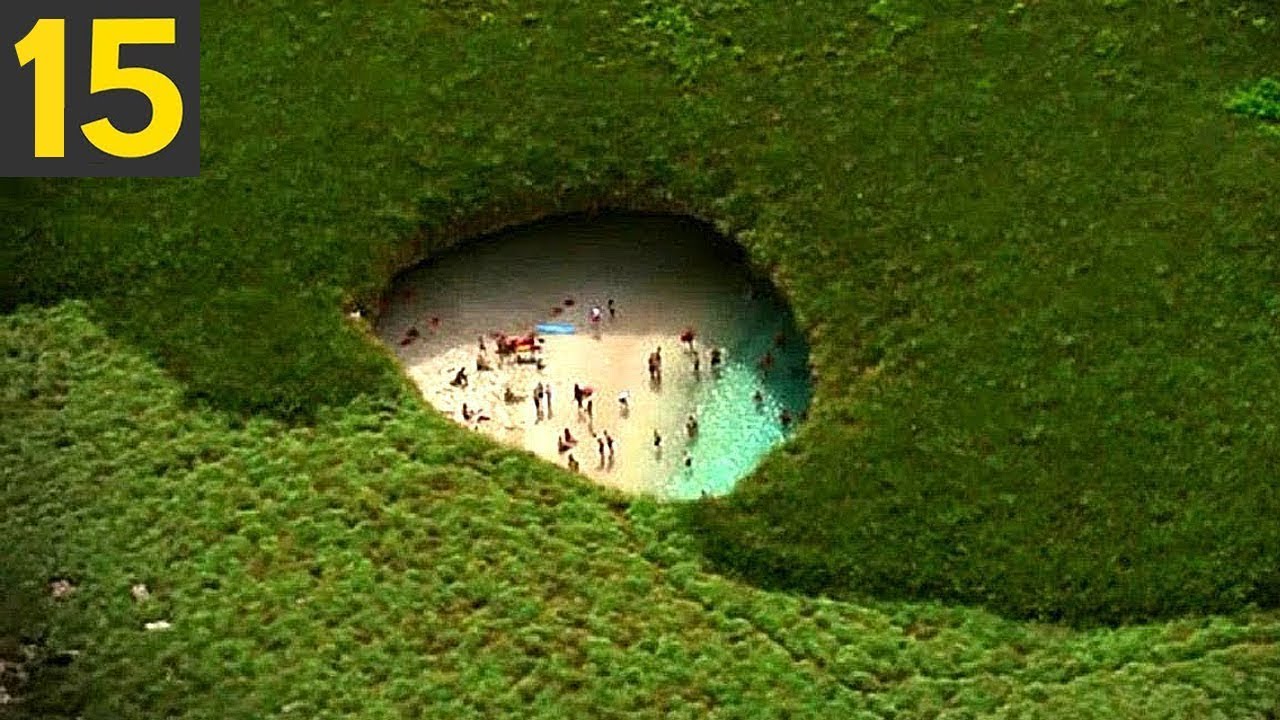
Playa del Amor, better known as Hidden Beach, sits inside the Marieta Islands off Mexico’s Pacific coast. The beach is enclosed entirely within a hollow crater, open to the sky but sealed off from the ocean on every side except for a water tunnel that swimmers and small boats use to slip in from the sea. The formation’s origin has been debated for years, but the effect is the same regardless of the explanation: a stretch of white sand and turquoise water boxed in by rock walls, invisible from the open ocean until you’re inside it.
Color That Comes From Nature, Not Filters
Pink Sands Beach gets its signature hue from foraminifera, single-celled organisms with red shells that die, break apart, and blend into the coral sand over time, producing a coastline that looks faintly rose-colored from a distance. Papakōlea Beach in Hawaii takes the opposite route, with olivine crystals weathered out of a nearby volcanic cone giving the sand a distinct green tint.
Glass Beach in Fort Bragg, California, tells a messier origin story. Decades of dumped garbage left the shoreline littered with broken bottles and other glass, and years of pounding surf smoothed those shards into rounded, colorful pebbles that now cover the beach instead of the usual sand grains — trash turned into a tourist attraction by sheer wave action.
Wildlife and Record-Setting Shorelines
Boulders Beach in South Africa rounds out the featured stops, known for its granite boulders scattered across the sand and for the African penguin colony that has made the beach its home, drawing visitors who come as much for the animals as for the rock formations. It’s the kind of stop that fits alongside other wildlife-driven coastal destinations, similar in spirit to the sinkhole formations pulling divers to farmland in South Australia — places where the landscape itself is the draw as much as anything happening on the surface.
Between the geothermal spas, the crater beaches, and the penguin colonies, the throughline of the countdown is that “unique” rarely means simply scenic — it means the sand, the water, or the rock is doing something a normal coastline just doesn’t do.







What Made the Viking Longship So Terrifyingly Effective
RJ Mitte of ‘Breaking Bad’ on Living with Cerebral Palsy
The Secret Infrastructure Beneath NYC
HOW MUCH does a RECREATION POND COST?? Swimming in a Natural Pool
It Started Out Great, But… Solo Beach Camping On An Uninhabited Island – Day 1