

 InfoSearched
Humanity is about to get a telescope powerful enough to see galaxies born within a few hundred million years of the Big Bang.
NASA, the European Space Agency and the Canadian Space Agency are in the final stretch of building the James Webb Space Telescope, a $10 billion observatory set to launch in 2021 aboard an Ariane 5 rocket from Kourou, French Guiana. It’s the scientific successor to Hubble, but built to see something Hubble never could — light so old and so red-shifted that it reveals what the universe looked like more than 13 billion years ago.
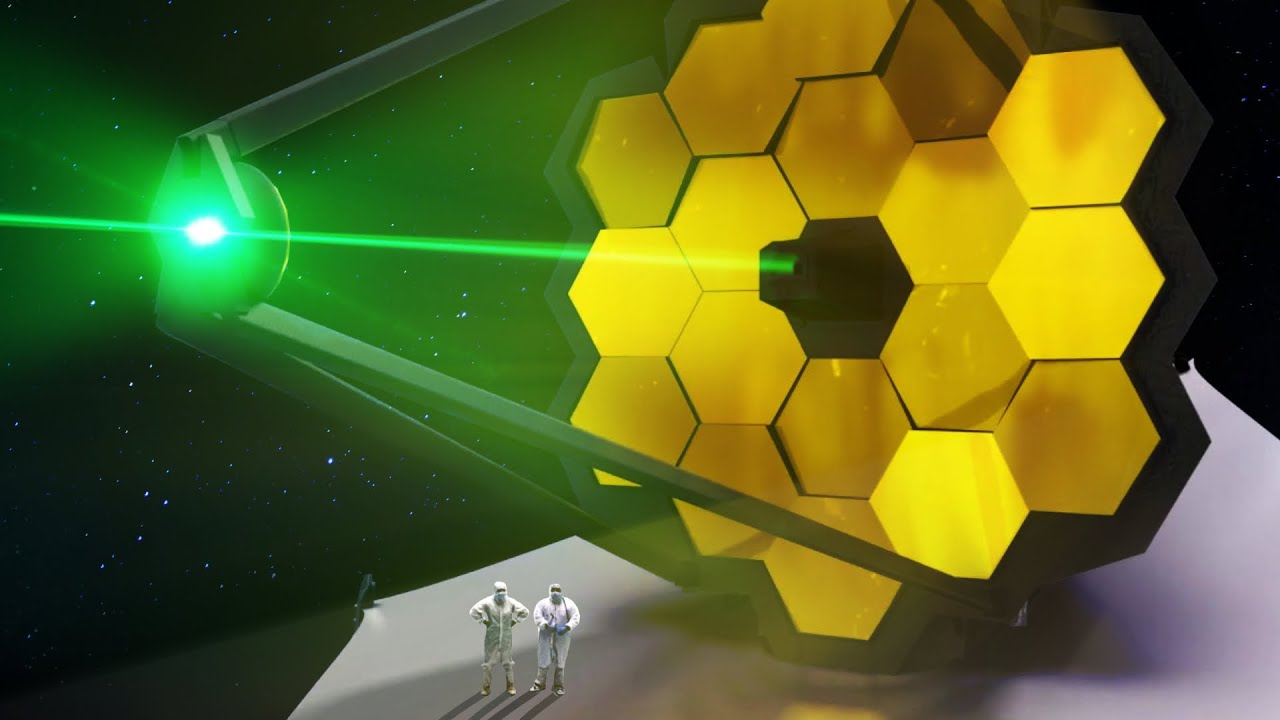
- JWST’s 6.5-meter primary mirror, made of 18 gold-coated hexagonal beryllium segments, has roughly six times the light-collecting area of Hubble’s mirror.
- The telescope will orbit the second Sun-Earth Lagrange point (L2), about 1.5 million kilometers from Earth, shielded by a five-layer, tennis-court-sized Kapton sunshield that keeps its instruments below 50 Kelvin (-370°F).
- As of early 2020, JWST was undergoing observatory-level integration at Northrop Grumman in California after years of acoustic and cryogenic vacuum testing.
Infrared Imaging Enhances Visual Data
Hubble made its name in optical and ultraviolet light. JWST is built for near- and mid-infrared wavelengths, from 0.6 to 28.8 microns, which is a different tool for a different job. Infrared light slips through dense clouds of cosmic dust that block visible light entirely, letting astronomers see stars and galaxies still wrapped in the material they formed from.
That same infrared sensitivity is what lets JWST chase the universe’s most distant, oldest light. As galaxies recede from us over billions of years, their light stretches into longer, redder wavelengths — a phenomenon astronomers call redshift. Objects from the universe’s infancy are so redshifted that their light has moved entirely out of the visible spectrum and into the infrared, which is exactly where JWST is built to look.
JWST’s mirror collects roughly six times the light Hubble ever could, at a fraction of the wavelength range humans can see.
Staying Cold Enough to See Heat
Infrared astronomy has one brutal problem: the telescope itself gives off heat that can drown out the faint thermal signals it’s trying to detect. JWST’s answer is the sunshield — five layers of Kapton film, each about the size of a tennis court when unfolded, stacked to block sunlight and radiate heat away into space.
Parked at L2, roughly 1.5 million kilometers from Earth on the side away from the Sun, the observatory can keep its instruments below 50 Kelvin without a mechanical cooling system doing all the work. That combination of distance and shielding is what makes the mirror’s infrared observations possible in the first place.
The Four Instruments Doing the Work
JWST’s science payload is built around four instruments: the Near-Infrared Camera (NIRCam), the Near-Infrared Spectrograph (NIRSpec), the Mid-Infrared Instrument (MIRI), and the Fine Guidance Sensor paired with the Near-Infrared Imager and Slitless Spectrograph (FGS/NIRISS). Together they’re designed to image the earliest galaxies, break down starlight into spectra that reveal chemical composition, and track faint targets with the precision needed for years of continuous observation.
Beyond peering into deep cosmic history, the telescope is slated to characterize exoplanet atmospheres, study the dust-shrouded nurseries where stars and planets are born, and observe bodies in the outer solar system. It’s a broader mandate than Hubble’s original brief, built on decades of lessons about what astronomers actually needed next.
From the Drawing Board to the Launch Pad
The project traces back to 1996, when it was known simply as the Next Generation Space Telescope before being renamed for James E. Webb, the NASA administrator who oversaw the agency during the Apollo era. Getting from that concept to a flight-ready observatory has taken over two decades and repeated schedule slips, with the telescope now finishing integration work at Northrop Grumman ahead of its 2021 launch target.
The next milestones are the remaining stages of observatory-level testing before JWST ships to French Guiana for the Ariane 5 launch — and once it reaches L2, the sunshield and mirror segments still have to unfold and align perfectly in space, a sequence with no second chances and no repair missions if something goes wrong.









The DAILY LIFE OF A MONK DOCUMENTARY (Routine of a BUDDHIST MONK IN THAILAND)
Watch This Caterpillar Turn Into A Puss Moth
Dan Price’s underground home, art & philosophy on $5,000/year
How This Woman Makes People Look 2D with Body Paint
15 Most Unique Beaches In The World