

 InfoSearched
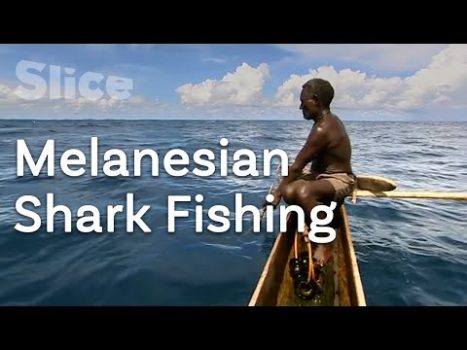
Off the west coast of New Ireland, men still paddle miles into the Bismarck Sea to summon sharks with a rattle made from a coconut shell.
The documentary Becoming a Man in Melanesia, excerpted here by SLICE, follows the shark callers of villages like Kontu, Messi, and Tembin on Papua New Guinea’s New Ireland province. This isn’t wading into surf and grabbing at fins — it’s a centuries-old rite of passage carried out from hand-carved outrigger canoes, far from shore, where a single misjudged move puts a man alone in open water with an apex predator.
- Shark callers paddle wooden dugout outrigger canoes miles into the Bismarck Sea off New Ireland’s west coast, targeting villages including Kontu, Messi, and Tembin.
- The ritual centers on the larung, a coconut-shell rattle shaken underwater to mimic schooling or wounded fish, paired with chants believed to call ancestral shark spirits.
- Once a reef or silky shark closes in, the caller slips a woven cane noose called the morung over its head, wrestles it by hand, then clubs and hauls it aboard.
A Ritual, Not a Stunt
Shark calling in New Ireland has nothing to do with the reckless bare-handed grabbing associated with shallow-water “noodling” elsewhere in the world. It’s an inherited hunting method tied to clan taboos and spiritual preparation — men undergo specific rites before they’re permitted to paddle out and call. The knowledge passes from older hunters to the next generation of boys as they come of age, making the hunt itself the proving ground for manhood in these coastal communities.
That lineage of technique and belief is what separates this practice from the tribal tests of endurance seen in other Melanesian rites of passage, like the ordeals documented in People Of This Tribe Violate All Laws Of Physics!. In New Ireland, the test isn’t pain tolerance — it’s the nerve to sit in a canoe and lure a predator close enough to touch.
The Larung and the Chant
The caller’s tool is deceptively simple: a rattle fashioned from a coconut shell, shaken just beneath the surface to throw off vibrations that read to a shark like a struggling or schooling fish. Alongside the rattle, callers chant ritual songs passed down through the clan, songs believed not just to attract sharks but to summon the spirits of ancestors who once hunted the same waters. The combination of sound and song is treated as inseparable from the physical technique — skip the chant, and the hunt is considered incomplete, spiritually if not practically.
The Noose and the Wrestle
Once a reef or silky shark takes interest and swims alongside the canoe, the caller offers bait rigged to a wooden propeller or pole to draw it in closer. The critical moment comes next: slipping the morung, a specialized noose woven from cane, over the shark’s head. From there it’s a direct physical struggle — the hunter immobilizes the animal by hand at close range before clubbing it and dragging it into the canoe.
The caller doesn’t grab the shark from a boat’s edge in shallow water — he wrestles it by hand, alone, miles out in the Bismarck Sea, with only a woven cane noose between him and the animal.
It’s a method built on precision rather than brute force, closer in spirit to the calculated confrontations seen across The Most Extreme Wild Animals Battles! than to any recreational fishing technique.
Feeding the Village
A successful catch doesn’t stay with the hunter. Sharks brought back to Kontu, Messi, or Tembin are distributed through the village, turning an individual test of nerve into a communal food source. That distribution is as much a part of the tradition as the hunt itself — the ritual only completes its purpose once the catch feeds the people who depend on the sea, a dynamic echoed in coastal communities profiled in Fishpeople | Lives Transformed by the Sea.
For the men of New Ireland, the canoe trip out to open water and the chant over the larung aren’t a performance for cameras — they’re the same steps their fathers and grandfathers took, and the same ones they’ll eventually hand to their own sons before the next shark ever surfaces.








THE UNSTOPPABLE SILENT 80 SOLAR POWERED CATAMARAN!
Why Cashew Nuts Are So Expensive
Living Off the Grid in Paradise
The Man Who Cheated Vegas Casinos For Years And Stole Millions
Trash Town. A whole community in Egypt that lives on rubbish