

 InfoSearched
A carpenter turned artist is smashing safety glass into photorealistic faces, one calculated hammer strike at a time.
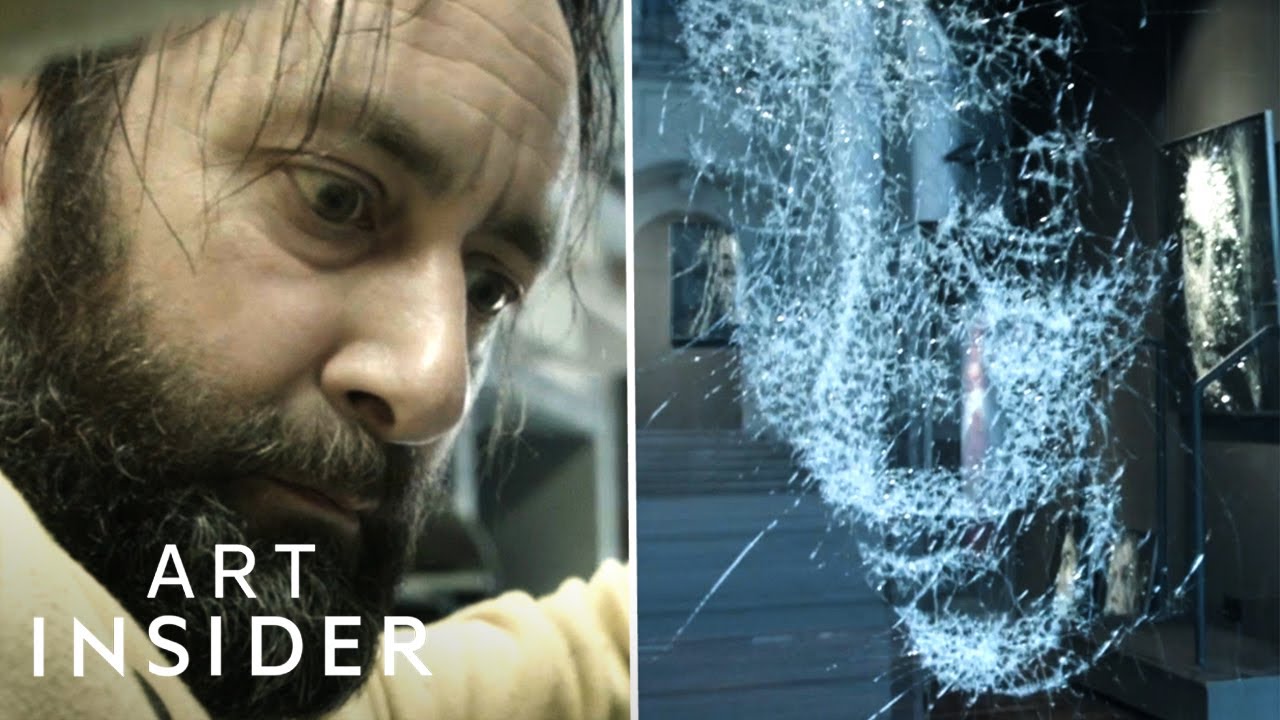
Simon Berger doesn’t sketch, paint, or carve. He swings a hammer at sheets of safety glass and somehow leaves behind a human face. The Swiss artist, based in Herzogenbuchsee, spent three years failing before he figured out how to control shattering glass well enough to turn cracks into shading, cheekbones, and eyes.
- Berger trained as a carpenter before moving into visual art, first experimenting with wood, spray paint, and scrap metal.
- His technique works on laminated safety glass, often car windshields, which he fractures with a hammer to build up a “labyrinth of lesions” that reads as a portrait.
- A single piece can take one clean attempt or up to five, with botched strikes costing hundreds of Swiss francs in ruined glass.
From Carpentry Bench to Broken Glass
Before he was known for cracked windshields hanging in galleries, Berger worked with his hands in a much more conventional trade. Carpentry taught him structure and material behavior, but it didn’t hold his attention for long. He drifted toward art through wood, then spray paint, then welded scrap metal, chasing a medium that felt like his own. None of it stuck until he picked up a hammer and aimed it at glass.
The shift wasn’t an accident he stumbled into overnight. Getting from random cracks to a recognizable face took him three years of trial and error, refining exactly how hard to strike, at what angle, and in what sequence to make fractures behave like brushstrokes. That kind of patience is the same instinct that shows up in other painstaking hands-on builds, like the step-by-step precision required when removing a load-bearing wall without bringing down the whole structure.
The Physics of a Controlled Break
Berger works almost exclusively with laminated safety glass, the same type used in car windshields, because the plastic interlayer holds shattered fragments together instead of letting the pane collapse. Every hammer strike sends a web of cracks radiating outward, and depending on force and placement, those cracks catch and refract light differently, creating the illusion of shadow, contour, and depth across a face.
There’s no undo button. Miss a mark or hit too hard and the whole pane can shatter beyond use, sending him back to a blank sheet and burning through material that runs hundreds of Swiss francs per mishap. Some portraits come together on the first attempt; others need as many as five tries before the fracture pattern lands the way he intended.
Breaking, for Berger, isn’t destruction — it’s the only tool he uses to build the image at all.
Treating Destruction as a Craft
Most people see a shattered windshield and think “damage.” Berger sees raw material. He describes the fractures he creates as a deliberate labyrinth of lesions, a phrase that captures how methodical the supposed chaos actually is. Instead of adding pigment or texture to a surface, he’s subtracting structural integrity in exact, mapped-out doses until a recognizable human face emerges from the cracks.
That inversion — treating breakage as a formative act rather than a flaw — is what separates his work from novelty stunt art. It’s less about the shock of a shattered pane and more about the control required to make destruction look intentional, which is the same tension that makes other high-stakes, hands-on crafts compelling to watch, whether it’s careful material-driven building projects or precision trades where one wrong move means starting over.
Berger doesn’t get a second chance mid-strike, and that’s the whole point. Every finished portrait hanging in a gallery represents whichever attempt didn’t shatter into a pile of expensive scrap, and the wrecked panes that came before it never make it to the wall.








17 Year Old Builds Tiny House For Only £6,000!
Discover Jamaica’s Most Dangerous Areas: Tivoli & Trench Town, Kingston
5 DAYS eating ONLY WILD FOODS! | Survival Challenge | The Wilderness Living Challenge 2017 SEASON 2
Professional MODEL leaves BEVERLY HILLS to LIVE in a VAN
How To Make A Wooden Rocket Stove