

 InfoSearched
Long before gunpowder or steel hulls, one wooden boat design terrorized coastlines from Northumbria to North Africa.
Smithsonian Channel’s Combat Ships: Viking Longships breaks down exactly why the Norse raiding vessel became the most feared ship of the early medieval world. It wasn’t size or firepower — it was a set of engineering choices, made with axes and iron rivets, that let small crews strike fast, vanish just as fast, and go places no other ship of the era could follow.
- The longship’s shallow draft — as little as one meter even fully loaded — let raiders beach directly on open shore or push deep into rivers, skipping harbors entirely and denying defenders warning time.
- Clinker (lapstrake) construction, with overlapping oak planks fastened by iron rivets and sealed with tarred wool, hemp, or animal hair, produced a hull flexible enough to bend with ocean swells instead of cracking under them.
- Under sail, longships could hit 10 to 17 knots in good wind, while a symmetrical, double-ended hull let crews reverse direction instantly without turning the boat around.
The Shallow-Draft Advantage
Everything about the longship’s tactical edge starts with how little water it needed under it. Drawing roughly a meter even when packed with warriors, gear, and provisions, the vessel could run straight onto an unguarded beach or slip miles up a river estuary that would ground a conventional trading ship. That meant Norse raiders didn’t need a port, a dock, or even calm water — just enough tide to float a hull the width of a modern rowboat and the length of a small ferry.
This is the detail Smithsonian Channel’s breakdown keeps circling back to: fortified harbors, the standard defense against seaborne attack in the 8th and 9th centuries, simply didn’t apply. A longship crew could land where no one expected a ship to land at all, strike, and be back in open water before local defenders had organized a response.
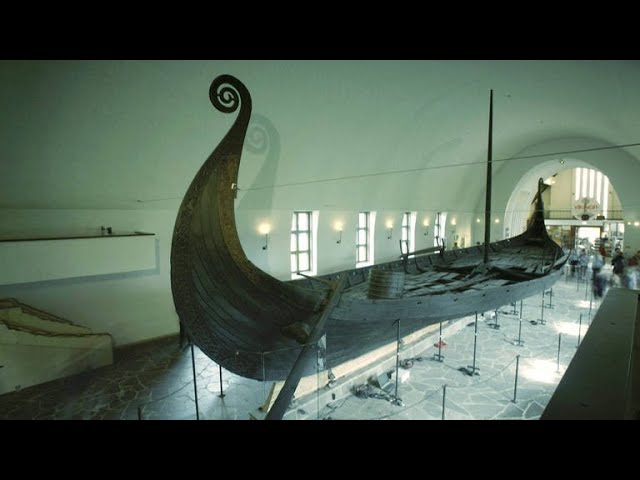
A fully manned longship could still float in water barely a meter deep — shallow enough to run straight onto an open beach with no harbor required.
Clinker Construction and the Flexing Hull
Norse shipbuilders used the clinker, or lapstrake, technique — overlapping oak planks riveted together with iron and caulked with tarred wool, hemp, or animal hair. Paired with a central keel running the length of the vessel, this gave the hull something rigid-frame ships of the same era lacked: give. Instead of resisting a swell and risking a crack, the longship’s planking flexed with the wave, which mattered enormously on open Atlantic crossings and in choppy coastal water alike.
That resilience is a big part of why longships could handle both jobs the Norse needed — pounding through North Sea swells on a raid toward the British Isles, then turning around and threading a shallow inland river without a different hull design. Anyone who’s toured a modern lapstrake or catamaran build, like the Sunreef Power Catamaran walkthrough, can see the same overlapping-plank logic still shaping hull design more than a thousand years later.
Sail and Oar Working Together
The longship ran a dual propulsion system rather than betting everything on one method. In open water, a large square-rigged wool sail could push the ship to 10 to 17 knots in favorable wind — fast enough to outrun most pursuers of the day. When the wind died, or when a crew needed to fight a current going upriver, oars took over, with rowers seated on sea chests rather than fixed benches so the boat stayed maneuverable in tight quarters and dead calm alike.
That combination is what let a single vessel serve as both a long-distance raider capable of open-ocean crossings and a river craft that could push inland toward targets far from any coastline — the same operational flexibility that eventually carried Norse crews toward the Mediterranean and inland waterways leading toward the Middle East.
The Double-Ended Hull’s Escape Trick
Perhaps the sneakiest advantage covered in the Smithsonian Channel breakdown is the longship’s symmetrical, double-ended design — identical bow and stern. A crew didn’t need to turn the ship around to retreat; they simply reversed rowing direction and the longship moved the other way just as efficiently as it had come in. For an amphibious raiding party working on a tight clock before local forces could muster a counterattack, that instant reversal was the difference between a clean escape and getting trapped against a shoreline.
Combined with the shallow draft and the flexible clinker hull, it’s easy to see why the design held up for centuries with only incremental changes — the same reason maritime history keeps returning to Norse hull engineering the way naval documentaries return to modern hull tours to explain why a given shape works.
What the episode makes clear is that none of these features worked in isolation — the shallow draft only mattered because the clinker hull could survive the pounding, and the double-ended reversal only mattered because oarsmen on sea chests could actually execute it fast. Take away any one piece and the longship is just a fast boat, not the raiding weapon that put Norse crews on beaches from Northumbria to the Mediterranean coast.






Why Dubai’s Man-Made Islands Are Still Empty
Survival on the smallest island in the Caribbean
INCREDIBLE OFF-THE-GRID HOUSEBOAT (Coron, Philippines)
Woman Addicted To Drugs Lets Cameras Follow Her Daily Life
13 Beach Life Hacks / Coolest Summer Ideas!