

 InfoSearched
A 3,700-year-old pyramid just gave up secrets that had been sealed since the days of the pharaohs.
In Dahshur, the royal necropolis south of Cairo and just north of King Sneferu’s Bent Pyramid, Egyptian archaeologists cracked open the substructure of a pyramid nobody knew existed. The mission first found the internal chambers back in April 2017, but it’s the detailed excavation that followed — and the artifacts pulled out of the rubble — that turned this into one of the more significant Middle Kingdom finds in years.
- Egypt’s Ministry of Antiquities, represented by ancient antiquities sector head Mahmoud Afifi and Dahshur necropolis director Adel Okasha, confirmed the pyramid dates to the 13th Dynasty of the Middle Kingdom — roughly 3,700 years old, built somewhere around 1700–1800 BC.
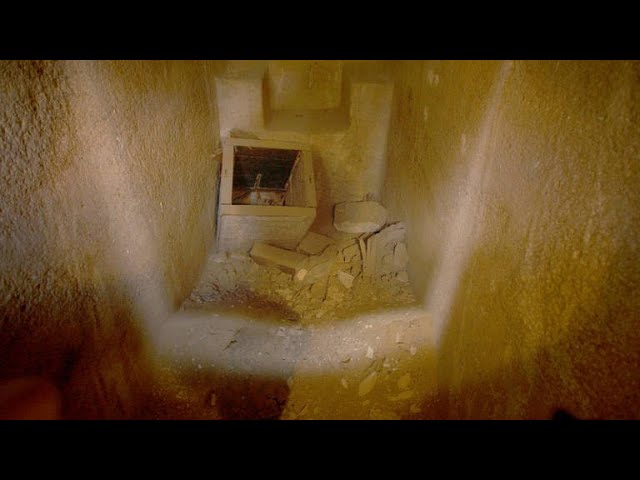
- Inside, excavators mapped a descending corridor leading to the pyramid’s core, an interior hall connecting to a southern ramp, and an adjoining chamber.
- An alabaster block measuring about 17 by 15 centimeters, carved with ten vertical lines of hieroglyphics bearing the royal cartouche of Pharaoh Ameny Qemau, helped researchers identify who the structure belonged to.
A Pyramid Hiding in Plain Sight
Dahshur has been picked over by archaeologists for more than a century, thanks to Sneferu’s Bent and Red Pyramids standing nearby. That makes it all the more striking that an entirely new pyramid substructure was sitting undetected just north of the Bent Pyramid. The mission’s 2017 breakthrough came when diggers broke through to the internal descending corridor, the passage that runs into the heart of the monument and that visitors see opened in the video above.
From there, the layout unfolded the way Egyptologists expect from a Middle Kingdom royal tomb: the corridor fed into an interior hall, which connected to a southern ramp, leading toward an adjoining chamber. The pyramid’s exterior had eroded badly over thirty-seven centuries, but the interior stonework and architectural plan survived in remarkably good shape — giving researchers a rare, largely intact look at how 13th Dynasty builders actually laid out a royal burial monument.
The Cartouche That Named the King
The find that let the Ministry of Antiquities put a name on the pyramid was a small one: an alabaster block roughly the size of a hardcover book, 17 by 15 centimeters, inscribed with ten vertical lines of hieroglyphics. Within those lines was the royal cartouche of Ameny Qemau, a little-documented pharaoh of the 13th Dynasty — a period so thinly recorded that most of its kings are known from king-lists rather than monuments.
Ten lines of hieroglyphics on a block of alabaster no bigger than a laptop were enough to put a name to a pyramid that had sat unidentified for 3,700 years.
That’s what makes the 13th Dynasty such a magnet for Egyptologists — kings like Ameny Qemau barely register in the historical record, and any inscribed object that confirms a name and a reign is treated as a major find. Documentary crews and researchers alike have leaned on finds like this to reconstruct a dynasty that left behind far fewer written records than the Old or New Kingdoms.
Princess Hatshepsut’s Canopic Box
Later work in the burial chamber turned up a wooden box inscribed with the name of Ameny Qemau’s daughter, Princess Hatshepsut — not to be confused with the New Kingdom’s famous female pharaoh who shared her name centuries later. The box originally held canopic jars, the containers ancient Egyptians used to preserve organs removed during mummification, a detail that ties this newly opened pyramid directly to royal burial practice rather than a secondary or looted deposit.
Together, the alabaster cartouche and the princess’s canopic box give archaeologists two independent inscriptions naming the same royal family, which is about as strong a confirmation as you get from a period with this little surviving documentation.
Middle Kingdom Mysteries Persist Among Egyptologists
The 13th Dynasty ran roughly from the collapse of the Middle Kingdom’s stronger centralized rule into the fragmented period that preceded the Hyksos invasions, and its king list is notoriously choppy — some pharaohs reigned only a year or two. Every inscribed object recovered at Dahshur adds a data point to a dynasty that’s largely reconstructed from fragments like this one rather than from lengthy temple records.
For anyone who follows how these digs get pieced together on camera, it’s worth pairing this kind of on-site excavation footage with the broader run of archaeological documentaries and interesting-news coverage that track finds like this as they’re announced.
The pyramid’s exterior is gone, worn down by thirty-seven centuries of desert weather and quarrying, but the corridor, hall, ramp and chamber the mission mapped in 2017 are still there for future study — and Dahshur, sitting right next to the Bent Pyramid, has already proven it can hide a full pyramid substructure nobody had catalogued before. Whatever else surfaces at that necropolis next is unlikely to stay buried for long.






5 Reasons NOT To Buy a Tiny Manufactured Home
DMT Always Shows Shane Mauss the Same Purple Woman on His Trips – Tales from the Trip
Backyard teahouses for meditation, guest cottage, and homeoffice
5 Bushcraft Shelters – Full Camp Builds Start to Finish
How to Make Stone Tools in a Survival Situation