

 InfoSearched
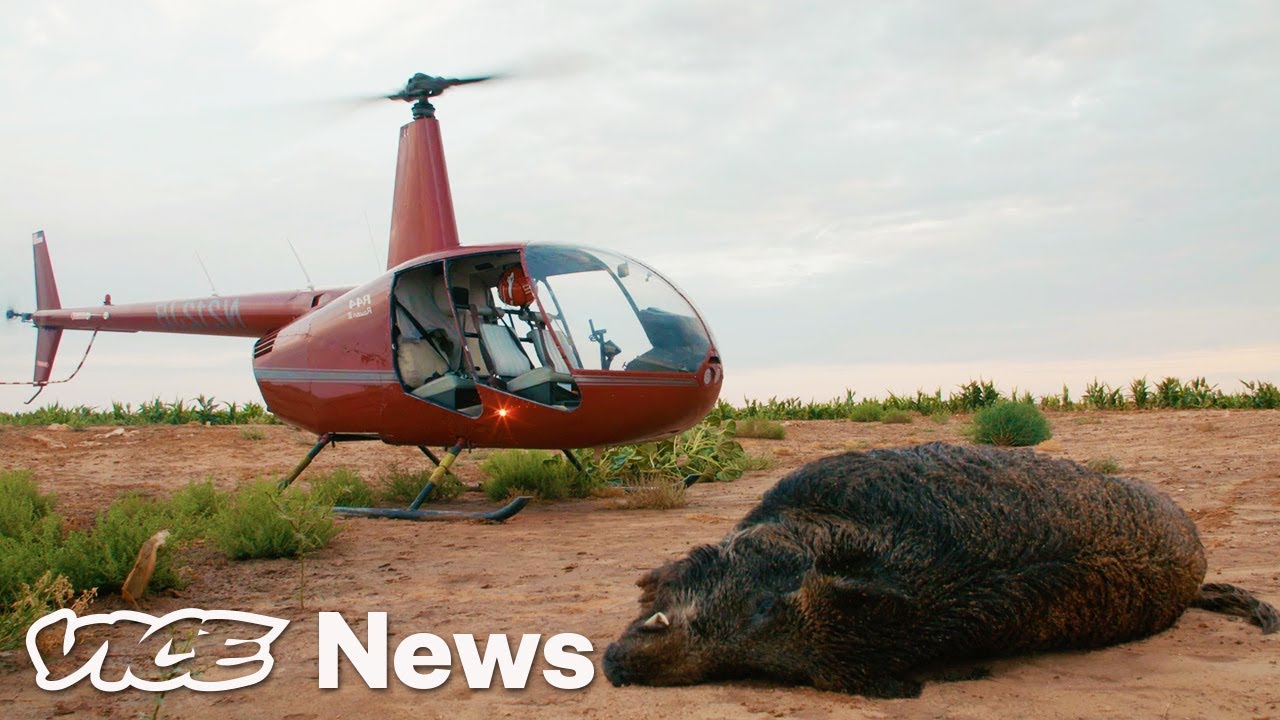
Texas has 2.6 million feral hogs tearing up its farmland, and one industry’s answer is to hunt them from the open door of a helicopter.
VICE News went inside the booming aerial gunning business built around Texas’s feral hog crisis, riding along with outfitters who sell tourists a seat in a low-flying chopper and a fully automatic rifle. The pitch is simple: pest control has become a paid thrill ride, and landowners desperate to save their crops are the ones signing off on it.
- Texas is home to roughly 2.6 million feral hogs, more than a third of the entire U.S. population, causing hundreds of millions of dollars in crop and land damage every year.
- Outfitters like HeliBacon, based near Bryan, Texas, operate under House Bill 716 — the so-called “pork chopper” bill — which lets private companies legally sell the gunner’s seat to paying clients on private land.
- State biologists estimate two-thirds or more of the hog population has to be killed every single year just to keep the numbers from growing.
Farmland Losses Driven by Hogs
Feral hogs breed young, breed often, and have almost nothing left in Texas to hunt them. Sounders root up pastureland and cropland overnight, wrecking irrigation lines and turning fields into what looks like plowed earth by morning. With few natural predators left in the state, the population has outpaced almost every conventional control method ranchers have tried — fencing, trapping, ground hunting.
That math is what pushed state lawmakers toward House Bill 716 in the first place. Ground crews simply can’t cover the acreage fast enough, and a hog sounder that scatters into brush is nearly impossible to track down on foot. A helicopter, by contrast, can sweep hundreds of acres in the time it takes a ground team to clear one field.
The Mechanics of Pork Chopping
HeliBacon and outfitters like it turn depredation flights into a commercial product, charging clients several thousand dollars for a multi-hour ride in the gunner’s seat. Customers range from lifelong Texans to out-of-state tourists and international visitors who’ve never fired a gun before boarding. Every client goes through a mandatory firearm and flight safety briefing before the aircraft leaves the ground.
Once airborne, gunners work with semi-automatic and fully automatic weapons, tracking running sounders across open pasture as the pilot banks low over the property. The arrangement only works because it’s built on landowner agreements — ranchers who’ve had enough of the rooting and crop loss give outfitters permission to fly their acreage, then split the arrangement as pest control dressed up as eco-tourism.
State biologists say hunters need to kill two-thirds or more of Texas’s feral hogs every year just to hold the population steady.
The Pushback From Critics
Not everyone buys the pest-control framing. Animal welfare advocates and conservationists have criticized the helicopter hunts as a thrill sold to tourists under the cover of conservation, arguing there’s a real ethical problem with gunning down running animals from the air. Critics also question whether a pay-to-play tourism model can ever put a meaningful, lasting dent in a hog population that reproduces faster than any hunting operation — ground-based or aerial — can keep up with.
Outfitters and the landowners who hire them see it differently: with millions of hogs and hundreds of millions of dollars in annual damage on the line, they argue the choice isn’t between “humane” and “inhumane” control, it’s between aerial gunning and watching a state agricultural crisis get worse. That divide — pest management versus blood sport — is unlikely to resolve any time soon, and it sits alongside other invasive-species fights playing out across the country, from Australia’s mouse plagues to the aftermath of Pablo Escobar’s hippos still overrunning Colombian waterways.
Aerial Views From the Cockpit
The flights themselves are short but intense — low passes over pasture, a pilot calling out sounders in the grass, and gunners firing on animals that are running full speed beneath the skids. It’s the kind of aerial precision work that shares more DNA with military flight training than with a traditional deer stand, and outfitters lean into that adrenaline angle when they market the experience to first-time clients who’ve never held a rifle, let alone fired one from a moving helicopter.
For now, the pork chopper business keeps flying because the math never really changes: millions of hogs, a handful of helicopters, and a state that keeps handing out landowner agreements to anyone willing to pay for the seat.




Most PAINFUL experience of my life ???? Samoan Traditional TATTOO
The Most Dangerous Newborn Baby Animals On Earth
World-class sinkholes attract divers to South Australian farms
Colonial Army Rations: Beer Every Day! – Spruce Beer In Early America
Population of One: Living Alone in an Abandoned Ghost Town